TATE ETC. No. 69 (Spring 2026) shares a conversation between Trinidadian artist Christopher Cozier and Dominique Heyse-Moore, curator of “Hurvin Anderson,” on view at Tate Britain until August 23, 2026. [Also see previous posts Hurvin Anderson’s Luscious Paintings and Exhibition: Hurvin Anderson-Tate Britain.] Here are excerpts of this captivating conversation. For photos, paintings, and full interview, visit TATE ETC.
In 2002, the British painter Hurvin Anderson went on an eight-week residency to Trinidad that would shape his practice for years to come. Artist Christopher Cozier was his guide, and the pair visited numerous places that have reverberated in Anderson’s memory – and found form in his paintings – ever since. Here, Cozier speaks to curator Dominique Heyse-Moore about his memories of that time, and Anderson shares photos he took during the trip.
DOMINIQUE HEYSE-MOORE It’s January 2026, a few weeks before the opening of Hurvin Anderson’s survey show at Tate Britain, and I wanted to talk to you, Christopher, about the time you spent with Hurvin in Trinidad in 2002. Hurvin grew up in Birmingham and was living in London at the time, and he visited Trinidad for an eight-week Caribbean Contemporary Arts (CCA) residency in 2002, which was a key moment for him in terms of the development of his painting. I’m at my computer in Tate Britain’s offices in London. I wanted to ask: where are you right now?
CHRISTOPHER COZIER I’m in my studio in St Ann’s, which is a tributary valley that comes down from the north into Port of Spain, the capital city of Trinidad and Tobago. It’s not rural, but it’s some respite from Port of Spain. St Ann’s is famous for two things. When the early Trinidadian anthropologists, people like J.D. Elder and Andrew Carr, were studying traditional folklore in the mid-20th century, they came up to St Ann’s to see people do things like bongo dancing. But there’s also a mountain called Mount Hololo, which was famously associated with a slave rebellion. One of the slave rebels escaped into the St Ann’s hills.
There’s a calypso called Let Them Fight For Ten Thousand Years (1942) by Growling Tiger, which he sang just after the Second World War broke out. In it, he says he’s going to move into the St Ann’s hills and plant fruits and vegetables and let the white people fight for 10,000 years. It feels like a pertinent moment to be talking about this, with the US military intervention in Venezuela taking place around us. You can see Venezuela from most parts of Trinidad on a clear day. When I go up into the mountains, which are three or four minutes away in the car, I often think about Burning Spear’s song Man in the Hills (1976), in which he says ‘we should live up in the hills’. It is a homage to the notion of marronage, being off-plantation, off the Western project. [. . .]
DHM Of course, all of Hurvin’s work is a transatlantic conversation. Having visited you in St Ann’s, I remember it as being really lush. There is that feeling of escape into the verdant landscape, which Hurvin loves to paint so much. While Hurvin was on his residency, you took him around and introduced him to a lot of Trinidad. (You did the same for me too when I visited.) Could you tell me about meeting Hurvin? How did that happen?
CC Hurvin first visited in 2002, but I had been taking people around Trinidad throughout most of the 1990s. I grew up in the Northwest Peninsula, which is close to the capital but feels different to the rest of the country. The Northwest Peninsula has a higher proportion of Afro-Creole people, and fewer people of Indian descent. Once you leave the peninsula, that situation is reversed. My parents are immigrants from Barbados, so growing up I wasn’t travelling around Trinidad visiting family. The only way for me to get out and see the country was to tour with my mother, who worked as a travelling officer for the cocoa and coffee industry board.
In the 1990s, as my art was getting more popular locally, students would come and interview me for their school exams. I started saying that, in exchange for doing the interview, they had to invite me to their home or neighbourhood. And that was really fascinating, because I would end up in parts of the country you wouldn’t even think of going. So, that’s the background to how I started exploring the island. Around the time Hurvin arrived, I was already doing tours of Port of Spain but trying to understand a different way of navigating the space – because there were ways that people talked in that era. They wouldn’t say ‘meet me at the corner of this street and that street’; they would say, ‘by the nuts man who sells on the corner’, or ‘by the tamarind tree’. [. . .]
DHM Hurvin’s got all these plan chests in his studio, and I think a lot of his archive is in there. He returns to these pictures and paints in the studio, returning again and again to certain scenes. But a lot of these photos have been blown up and merged with other images, in the way that memories merge when you repeatedly return to them. What was it like to travel around with Hurvin?
CC When you are talking to someone, moving around with somebody, sharing your experience of a place, something happens. Particularly when you’re dealing with artists. I was showing Hurvin something about Trinidad, which was opening up thoughts for him. But at the same time, his reactions to what I was showing him, and to what he was observing independently, were opening up thoughts for me. It was very fertile. It was exchange. It wasn’t just a one-way conversation. I’m not really sure if he grasped what was at stake there, in terms of how his observations impacted me. [. . .]
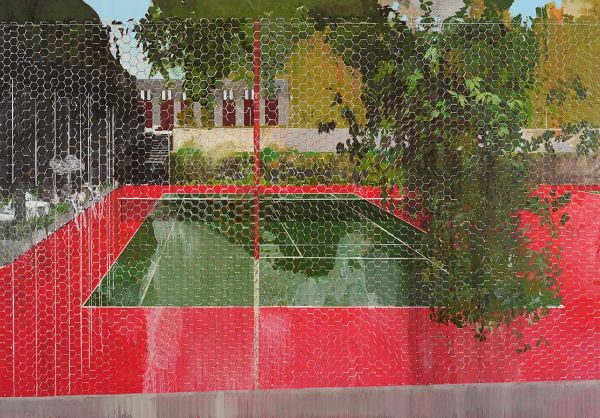
DHM Could we talk about Country Club? We’ll be showing three from this important series of works that Hurvin started in 2003. These works depict the Trinidad Country Club in the Maraval district of Port of Spain. You see the clubhouse and tennis courts, but they are surrounded by high hedges and fences.
CC The property that was rented by the organisers of the residency, and where Hurvin stayed while he was in Trinidad, was next door to the Country Club. They were staying on the second floor, which looked across into the tennis courts. So, when Hurvin was here he took a lot of pictures looking into that space, and these eventually became his Country Club series.
The St Lucian poet and playwright Derek Walcott had a poem set in a country club, ‘A Country Club Romance’ (1951), originally titled ‘Margaret Verlieu Dies’. And there was a country club incident, where I think a white expat woman, married to a Black man, came to Trinidad and wanted to play tennis at a club, but she was asked to leave, which was a scandal. That was one of the scandals in the newspapers that led to greater racial and social awareness. [. . .] When Hurvin started painting the Country Club through that chain-link fence, one of the things that he spoke about – separate from this notion of free spaces, non-surveilled spaces of becoming – was looking through these barriers.
He mentioned that when he went back to Jamaica with his mother as a child, his encounter with Jamaica was through the security barriers in the shops, behind these kinds of grilles in the kiosks. That was where our interests joined. When I think of Hurvin, I think a lot about wrought-iron patterns. One of the first pieces I showed when I came back to the Caribbean in 1988 after studying in the US was a small card with wrought-iron burglar bars on it, and it said ‘inside’ and ‘outside’. I left it around in bars, like a calling card. So, I think that created a dialogue between Hurvin and me, because we both spoke about seeing the world through barriers. [. . .]
Hurvin Anderson, Tate Britain, 26 March – 23 August
Christopher Cozier is an artist who lives in Trinidad.
Dominique Heyse-Moore is Senior Curator, Contemporary British Art, Tate Britain.
For full article, see https://www.tate.org.uk/tate-etc/issue-69-spring-2026/wish-you-were-here
[Shown above, photo by Richard Ivey: Hurvin Anderson’s Country Club: Chicken Wire 2008. © 2026 Hurvin Anderson. Courtesy the artist and Thomas Dane Gallery. Source: https://www.tate.org.uk/tate-etc/issue-69-spring-2026/wish-you-were-here.]
TATE ETC. No. 69 (Spring 2026) shares a conversation between Trinidadian artist Christopher Cozier and Dominique Heyse-Moore, curator of “Hurvin Anderson,” on view at Tate Britain until August 23, 2026. [Also see previous posts Hurvin Anderson’s Luscious Paintings and Exhibition: Hurvin Anderson-Tate Britain.] Here are excerpts of this captivating conversation. For photos, paintings, and full interview,