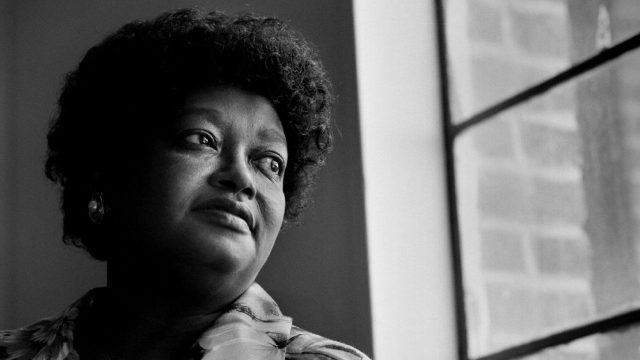
On 2 March 1955, Claudette Colvin, a 15-year-old African- American high-school student, boarded a segregated bus in Montgomery, Alabama, taking a window seat. “When the driver ordered her to give up her seat so a white woman could be more comfortable, Ms. Colvin – who had been studying black history in class, learning about abolitionists like Harriet Tubman and Sojourner Truth – did not budge,” said The Washington Post.
History would record that it was Rosa Parks who helped kickstart the Civil Rights Movement by refusing to give up her seat on a Montgomery bus. Yet Colvin, who has died aged 86, did so nine months before Parks, refusing to move until police dragged her off. The episode galvanised the city’s black community.
‘Slight and bookish’
Claudette Austin was born in 1939 and raised in rural Alabama. Her mother, Mary Jane Gadson, abandoned by her husband, was unable to support Claudette and her sister; they were adopted by an aunt and uncle, whose name they took. Claudette attended the all-black Booker T. Washington High School, said The Daily Telegraph. She and many others were politicised by the case of a schoolmate, Jeremiah Reeves, “who in 1952, aged 16, was sentenced to death for raping a white woman, by an all-white jury who deliberated for less than half an hour”.
In 1955, as a “slight and bookish” teenager, she took her stand against the Jim Crow bus laws, telling the driver: “It is my constitutional right to sit here.” She was found guilty of assaulting a police officer, disturbing the peace and violating a city race ordinance.
‘Troublemaker’
The latter charge was ripe for challenge. But the National Association for the Advancement of Coloured People (NAACP) felt Claudette was too immature to become a constitutional test case. “Others believed her dark skin and poverty also played against her.” Matters were further complicated when she became pregnant after her trial. Instead, Rosa Parks, a seamstress and secretary of the local NAACP, was chosen as the “unthreatening, middle-class standard-bearer” for the Montgomery bus boycott that began that year. Even so, in 1956, Colvin was chosen as one of four plaintiffs in a federal lawsuit brought by the civil rights lawyer Fred Gray; it established that the city’s bus laws were indeed unconstitutional.
“All the attention made life difficult for Ms. Colvin,” said The New York Times. “Whites shunned her, but so did many black residents, who she said considered her a troublemaker.” In 1958, with her young son she moved north, to join her sister in New York’s Bronx. She worked as a maid and as a nurse, and spoke little about her past until her story was rediscovered in the 1990s. In 2021, Colvin successfully petitioned to have her juvenile arrest record expunged. “I guess you can say that now I am no longer a juvenile delinquent,” she said.
Inspired by the example of 19th century abolitionists, 15-year-old Colvin refused to give up her seat on an Alabama bus