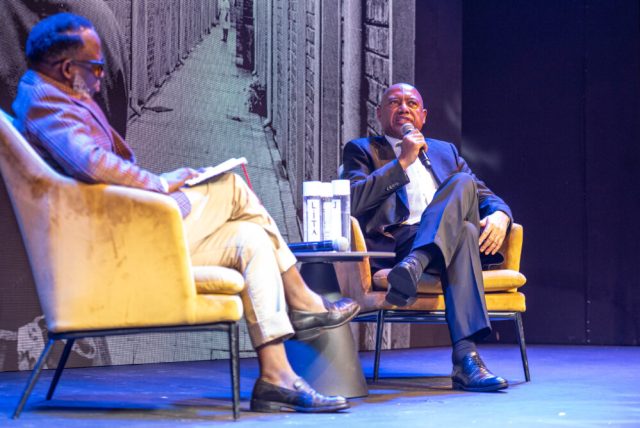
When I ask Joburg Film Festival (JFF) curator Nhlanhla Ndaba how you even begin to narrow down more than 700 films into a festival programme, he doesn’t start with numbers or spreadsheets.
He starts with a feeling.
“The first thing that we do,” he tells me, “is come up with a theme. That theme guides everything.”
The 2026 JFF, running from 3 to 8 March, arrives under the ambiguous yet intriguing banner Feel the Frame.
This year, Ndaba and the festival’s leadership team want audiences to look beyond directors’ names and lead performances and instead pay closer attention to the invisible labour that makes cinema possible: sound, cinematography, editing, costume, make-up and lighting.
“The people behind the scenes are often left out,” Ndaba says.
“Yet they’re the ones who make things happen.”
It’s an idea that feels especially resonant in a moment when the South African film and television industry is under severe strain.
But before the conversation turns to crisis and survival, Ndaba is eager to talk about craft, about cinema as something to be experienced, not just consumed. The philosophy shapes the festival’s programme in more ways than one.
For much of its history, the Joburg Film Festival operated through direct curation: the team sought out films rather than inviting submissions. But Ndaba realised something was missing.
“We weren’t getting enough prominent African and South African films,” he says. “And when I dug deeper, I found that a lot of filmmakers didn’t even know how to submit to the festival or that they could.”
The solution was simple but transformative: an open call, with a particular emphasis on African cinema.
The response has grown dramatically. This year’s edition received 770 submissions from 98 countries, including 691 films via open call and 87 from distributors the festival has long-standing relationships with.
“It sounds exciting,” Ndaba says, laughing, “but it’s terrifying.”
Watching that many films fairly, thoughtfully and with care requires infrastructure. For the first time, the festival brought in a team of four film readers from different levels of the industry to assist with the initial viewing process.
“We didn’t want anyone’s work to disappear into a void,” Ndaba explains. “Every film deserves to be seen properly.”
Each film is scored across multiple criteria: story, direction, performance, editing, sound and music. To move forward, a film needs to score at least eight out of 10.
“We set the bar high,” he admits.
“Sometimes it feels like we’re shooting ourselves in the foot. But standards matter.”
The rigour is intentional. Ndaba is candid about wanting to challenge a local industry that, in his view, has grown too comfortable repeating familiar visual and narrative tropes.
“There’s nothing wrong with kasi stories,” he says. “They’re a good entry point. But you can’t remain there forever. You have to evolve.”
From those hundreds of submissions, the reading team narrows the field to roughly 120 films. From there, Ndaba and his festival programmer, Jack Chiang, take over, eventually selecting 123 films: 60 feature-length titles and 63 shorts, grouped into themed 90-minute blocks.
African films are prioritised but never by default.
“We’re not going to take your film just because it’s African,” Ndaba says. “The story still has to work.”
When I ask Ndaba about the themes that emerged most strongly this year, he talks about family, migration, colonialism, patriarchy, ageing, self-determination and war.
They’re heavy words but the films he highlights approach them with nuance and emotional depth.
One of the most striking titles is 1001 Frames by Iranian film-maker Mehrnoush Alia, a film that interrogates power, exploitation and toxic masculinity within patriarchal systems, including the film industry itself.
“It’s about how women perform under pressure,” Ndaba says. “And how they resist.”
The festival has partnered with non-profit organisation Sisters Working in Film to host a post-screening panel addressing real-life experiences of abuse and exploitation on South African film sets, an example of how Feel the Frame extends beyond the screen and into difficult, necessary conversations.

Another Iranian film, It Was Just an Accident by Jafar Panahi, arrives with a heavy political charge. Panahi made the film while under house arrest and since then, his cinematographer has also been arrested.
“The film is about censorship and the psychological toll of authoritarianism,” Ndaba says.
“The fact that people were arrested for making it already tells you everything.”
Closer to home, Kabelo, directed by Carl Houston McMillan and starring Warren Masemola, explores identity, aspiration and exploitation; the quiet pressures that shape who we choose to admire and why.
“It asks: Who do you look up to?” Ndaba says. “And what does that say about you?”
If Feel the Frame is about looking at things differently, then films like Kokuho embody that ethos. The Japanese, Oscar-nominated title explores mastery, sacrifice and the tension between inherited status and earned excellence.
“It questions what it really means to be exceptional,” Ndaba explains. “And who gets to decide.”
That tension also runs through Late Fame, starring Willem Dafoe as a retired poet unexpectedly pulled back into the spotlight by a younger generation. The film meditates
on nostalgia, legacy and the uncomfortable space between reverence and projection.
“They see him as a living legend,” Ndaba says. “He doesn’t.”
Technology and authorship come into focus in Memory of Princess Mumbi, a Kenyan mockumentary by Damien Hauser that uses AI as both a tool and a subject.
“It’s about authenticity in a world shaped by algorithms and what human connection means now,” ,” Ndaba says.
But perhaps the most quietly radical film Ndaba mentions is Retreat, a thriller directed by Ted Evans, who is deaf, with an entirely deaf cast.
“It shows you how sound and lighting can tell a story,” Ndaba says. “Even without sound.”
Set in a commune under threat, the film relies on visual tension, movement and atmosphere.
Ndaba insists that even if the subtitles were removed, the story would remain legible, a profound reminder of cinema’s expressive range.
in 2024.
However, African cinema remains the festival’s heartbeat. Ghanaian filmmaker Zoey Martinson’s The Fisherman, the first Ghanaian film selected for the Cannes Film Festival, reimagines folklore to explore generational tension, tradition and modernity.
There’s a talking fish, yes, but also a meditation on ambition and compromise in a rapidly changing society.
From South Africa comes The Trek by Meekaaeel Adam, set entirely in the Karoo and framed through supernatural forces that haunt a 19th-century Dutch family crossing contested land.
“The land isn’t just a backdrop,” Ndaba says.
“It’s alive. It’s judging them.”
The film interrogates colonialism not as history but as an ongoing moral and spiritual reckoning, a theme that feels particularly urgent at this moment.
Given the current turmoil in the local industry including shrinking budgets, stalled rebates and widespread job losses, I ask Ndaba what role a festival can realistically play.
“A festival isn’t just about films,” he says. “It’s about bringing people into the same room.”
Through JBX Talks, the Joburg Film Festival hosts industry discussions involving producers, funders, government bodies and filmmakers; conversations that are often impossible elsewhere.
“At a protest, you hand over a memorandum,” Ndaba says. “Here, you actually talk.”
He speaks candidly about the importance of the DTIC rebate, recalling how it enabled films he worked on for Netflix to be completed.
“Without it, we would’ve had a 50% shortfall,” he says. “That’s the reality.”
For Ndaba, the festival is both mirror and meeting point, reflecting the state of cinema while offering space to imagine alternatives.
“We need to talk about the future,” he says. “Streamers, funding models, international collaboration. These conversations can’t wait.”
As our conversation winds down, I think about the festival’s theme again. Feel the Frame is both an instruction to notice craft and an invitation to sit with discomfort, complexity and care, to experience cinema as something layered
and alive.
From deaf-led thrillers to AI-inflected mockumentaries, from Iranian political resistance to Ghanaian folk tales and Karoo-set reckonings, the 2026 Joburg Film Festival promises a programme that asks us to pay attention.
As the Joburg Film Festival returns in 2026, curator Nhlanhla Ndaba explains why craft, care and unseen labour are taking centre stage