
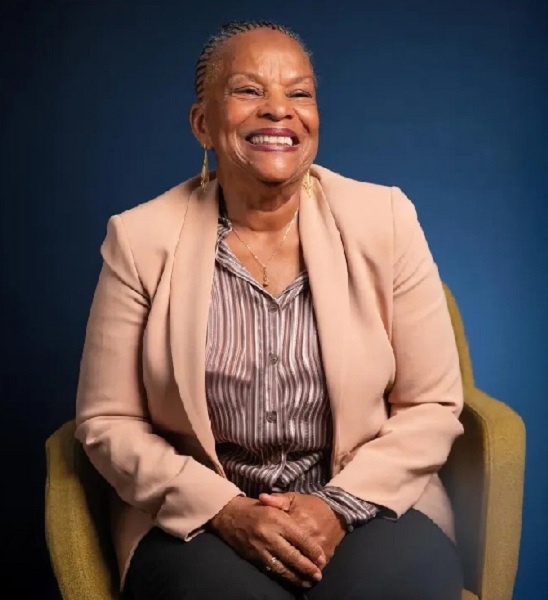
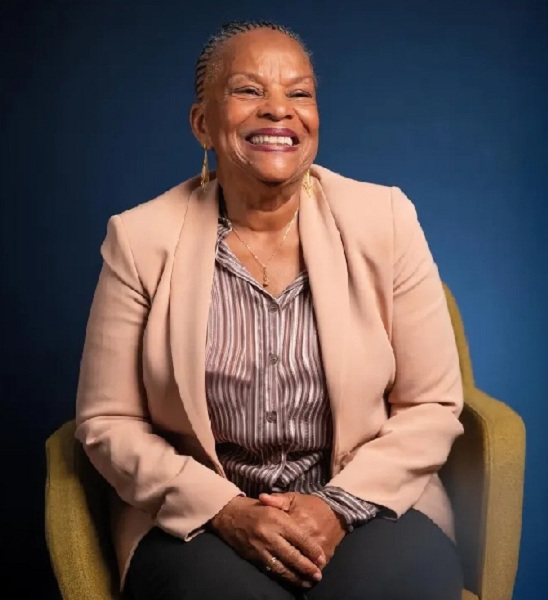
Florent Buisson (Paris Match) shares excerpts from an interview with France’s former Minister of Justice and presidential candidate Christiane Taubira (born in Cayenne, French Guiana). Here are excerpts from Buisson’s “’On va dans un coin pleurer, pour être capable de faire son travail…’, Christiane Taubira, l’ultime confession [‘We go off to cry in a corner, so we can be able to do our job…,’ Christiane Taubira, the final confession.]
A 3-hour and 39-minute interview in the form of a political testament. A short-lived candidate in the 2022 presidential election, before withdrawing due to a lack of the required 500 endorsements, the left-wing icon Christiane Taubira has since retired from political life. She [made] a lengthy return this Tuesday, February 10, on the INA [French National Audiovisual Institute] website, as a guest on the third season of the series “Passé composé, figures du siècle,” where prominent figures from all walks of life, whose impact has marked French society, reflect on their lives.
The former minister, who championed the law legalizing same-sex marriage, granted a nearly four-hour interview to journalists Michèle Cotta and Patrice Duhamel on May 26, addressing a wide range of topics. Her childhood, her ten siblings, the death of her mother when she was 16, her clandestine abortion at 18, her fight for Guyanese independence, her first election as a member of parliament in 1993. Or her 2002 presidential candidacy, experienced as a trauma by the Socialists who saw it as one of the reasons for Lionel Jospin’s elimination in the first round that year…
Explosive duo with Tapie
“I didn’t approach him; it was the president of the Radical Left Party who came to see me in 1993, without mentioning Tapie,” she explains. “The leadership of Walwari (a Guyanese political party close to socialism) wanted a meeting with the PRG, sensing that it could be a breath of fresh air, taking us out of local politics.” I met Bernard Tapie for the first time and said to him, “It’s strange, all these stories about you, what are they, conspiracies?” He replied, “There are things, but well, I’ll tell you I’m a bit of a rogue…” There were a lot of clashes, arguments… […] But during one of the last meetings, he was approached by planters in Martinique who asked him, as a Member of the European Parliament, to commit to obtaining subsidies for their sugarcane, rum, etc. Bernard Tapie stood up and said, “I think the future of Martinique doesn’t lie in sugarcane and bananas, so I’m not committing to providing you with more subsidies.” [. . .] I appreciated the frankness and integrity, even if some might find it an inappropriate word… That’s how I do politics.”
[. . .] In 1998, Christiane Taubira spearheaded the landmark law recognizing the slave trade and slavery, which was finally adopted in 2001. “An important piece of legislation and an extremely painful journey, a battle,” she explained in an interview with the French National Audiovisual Institute (INA).
Physical consequences of her activism on her health
The former presidential candidate also speaks candidly about the impact of politics on her health. “Like many women, I’ve paid for my struggles physically,” she says. “Because of my frequent trips to French Guiana when I was a member of parliament, I have dry eyes, and it’s incurable. When I speak, it’s like I have needles in my eyes. I’ve also paid for this life with a hormonal imbalance. I was 43 when they induced menopause because I was losing weight and had iron deficiencies. I also have a weak right ankle because I sprained it during the debate on the slavery law in 2001, and during the session, I was constantly getting up, sitting down, and so on.” I experienced paroxysmal vertigo during the 2002 presidential election. Hypertension during the debates on the Marriage for All law… »
2013, Marriage for All, love and hate
She therefore championed the Marriage for All act, which went into debate in early 2013, after a period of consultations and delays. The opposition was fierce and organized. “I like the beautiful values that change people’s lives. But it was very violent, the death threats, etc. I already took a hit; there was hysteria in society. […] Today, I’m thanked everywhere. In general, I receive more thanks than criticism. The most significant stance is that of the right-wing leaders for the tenth anniversary in 2023. No one has asked for it to be revisited.”
Then came 2015, the deadly attacks of January and November. She speaks at length about the work carried out by her ministry on the intelligence law, about the joint efforts with the Ministry of Health and medical personnel to identify the victims’ bodies (a representative from the prosecutor’s office was required to issue the death certificate once the body was identified), so that the families could begin their grieving process. “We had to act quickly because the families were waiting. (Silence) At times, you go off to cry in a corner, to be able to do your job (she is emotional, editor’s note) … We stayed there, at the Ministry of Justice, for three days and three nights working. It’s so monstrous what we’re facing; we have people searching for loved ones without knowing if they’re alive or not. And at the same time, we must work… We hid away to cry.” [. . .]
Excerpts translated by Ivette Romero. For the original article (in French), see https://www.parismatch.com/actu/politique/on-va-dans-un-coin-pleurer-pour-etre-capable-de-faire-son-travail-christiane-taubira-lultime-confession-264036
Also see https://uwm.edu/clacs/christiane-taubira-bio/
Florent Buisson (Paris Match) shares excerpts from an interview with France’s former Minister of Justice and presidential candidate Christiane Taubira (born in Cayenne, French Guiana). Here are excerpts from Buisson’s “’On va dans un coin pleurer, pour être capable de faire son travail…’, Christiane Taubira, l’ultime confession [‘We go off to cry in a corner, so