
The National Science and Technology Forum (NSTF) is a unique and proudly South African organisation that exists to represent all stakeholders in science, engineering, technology (SET) and innovation in South Africa (SA). The NSTF marked its 30th anniversary last year as the largest, longest-standing and most representative independent stakeholder body of its kind. The NSTF represents organisations (councils / associations / institutions / societies / companies, etc) across both the public and private sectors. The membership serves as a map of role-players in the national system of innovation (NSI) currently consisting of over 150 organisations across six sectors, in addition to government.
History: SA celebrated Freedom Day Monday, 27 April, marking the start of the democratic dispensation and the 32nd anniversary of the country’s first democratic, non-racial elections held in 1994. This milestone in the nation’s journey holds significant relevance for the founding of the NSTF. Its precursor, the National Science and Technology Initiative (NSTI), was established in 1991 and actively participated in the historic Convention for a Democratic SA (Codesa) discussions. As a result of the findings and recommendations of the NSTI, government together with key stakeholders founded the NSTF in 1995 to oversee the establishment of a new democratic science system. The majority of founding members are still involved in the NSTF (constituting about 17% of NSTF’s current membership). The then Minister of Arts, Culture, Science and Technology, Dr Ben Ngubane made his intention clear by recognising the body as a forum for consultation and addressing issues in the broader science community, a mandate that NSTF still proudly fulfils.
And now: Since those early days, the NSTF has maintained its role as consultative forum for the government sector in matters related to SET and innovation. However, it has also grown and developed, playing a role in thought leadership and convening stakeholders on an independent platform, around burning issues like artificial intelligence (AI), climate change, and the quality of STEM education.
NSTF executive director Jansie Niehaus says, “The NSTF has always operated at the science-society interface. We’ve kept evolving – just like science.”
The NSTF’s vision is: A transformed country:
• where SET and innovation contribute to an optimal quality of life for all
• where STEM and innovation education and training are effective, and
• SET professionals are representative of the population.
(STEM = science, technology, engineering and mathematics.)
An independent space that is part of the collaboration process:
The NSTF’s independence allows it to be uniquely positioned within the NSI. The need for multi-stakeholder partnerships and collaborations remains high on the agenda to overcome the socio-economic challenges that not only the country, but the world faces, and during these trying times. Collaborations are enabled through the NSTF’s ‘quadruple helix’ framework (research-business-government-civil society) reflected in its membership, the representation on all its committees, (Executive, proSET, Science Councils/Statutory Bodies, Awards and Adjudication Panel), as well as through broadly representative participation in the NSTF-South32 Awards, NSTF Discussion Forums, communications and Youth outreach. Together, we can offer the kind of thinking and direction that can achieve socio-economic development and growth.

NSTF Discussion Forums tackling SA’s key challenges
The NSTF’s ongoing activities include hosting conferences, discussion forums and panels, which are platforms for constructive interaction and discussion with SET and innovation stakeholders, including government, on key priority areas of concern to the community. The purpose of these events is to exchange expert knowledge from various perspectives on burning issues. At least 82 such discussion events on a wide variety of subjects were hosted over the years, usually over two or more days, with a line-up of more than 10 experts per event.
Last year, for example, the forums unpacked topics such as Fourth Industrial Revolution (4IR) technologies in SA (as used especially in research), Climate, environment, water and food (unpacking research at the interface of these areas), and Quantum Science and Technology in SA (in collaboration with the SA Quantum Initiative (SA QuTI)). The NSTF also co-hosted the Public Relationship with Science Conference with the Department of Science, Technology and Innovation (DSTI) and the Human Sciences Research Council (HSRC), to engage with and unpack the findings of the HSRC’s Survey on the South African Public Relationship with Science (SAPRS). The NSTF followed this up with a panel discussion at the annual Science Forum SA (SFSA) in Pretoria in December 2025.
This year the NSTF is hosting discussions and networking the community on the following issues:
• Al for STEM Education (26-27 August 2026) in partnership with the NSTF proSET Sector (Professionals in SET, proSET is a sector of the NSTF representing over 50 professional bodies and learned societies)
• Research Software as enabler and research output (7-8 October 2026) in partnership with the NSTF Science Councils and Statutory Bodies Sector
• Healthy Ageing – NSTF’s theme for 2026 (11-12 November 2026)
• Also taking place from 2-4 June in Gauteng, the Indigenous Knowledge (IK)-Based Technology Innovation Investment Summit, hosted by the DSTI in partnership with the NSTF, The Innovation Hub (TIH) and the Universities of Limpopo (UL), North-West (NWU), and Venda (Univen), will bring together entrepreneurs, investors, postgraduate students, researchers, policymakers and industry leaders to advance entrepreneurship rooted in IK.
The NSTF’s flagship programme, the NSTF-South32 Awards
The NSTF holds annual awards since 1998, currently called the NSTF-South32 Awards, in honour of the main sponsor. Also known as the ‘Science Oscars’ of SA, they recognise various achievements in the SET sectors, including innovation. It’s been 28 years of rewarding the efforts and contributions of top scientists and related professionals in SA.
Having grown from just two categories and two awards, the outstanding work of South African science is currently recognised in 20 awards, made across 16 different categories ranging from top scientific research to technological innovation, which produce outputs that positively impact society and contribute to socio-economic growth. It includes research and development in all SET-related fields (water, environment, agriculture, climate, food security, energy, health, social science, etc), and activities (including management and leadership, capacity development, science diplomacy, research data curation, research software creation, communication and outreach, technology transfer, and education and training activities).
“In SET fields, work is often long-term, resource-intensive, and underappreciated,” Niehaus explains. “Recognition reminds scientists that what they’re doing matters, not just to their peers but also to the South African government and public.”
These awards have grown steadily over the years in the number of winners awarded, the range of categories, and in participation by the community from 54 to 302 nominations adjudicated. The gala dinners to honour the finalists and announce the winners, evolved from one joint event in Gauteng until 2019, to a hybrid event since 2021, broadcast live from two cities simultaneously (Cape Town and Johannesburg) to an online audience and attended in-person by more than 700 guests.
“We’ve built a system that’s naturally inclusive,” says Niehaus. “We don’t need to manufacture transformation; when you open the doors properly, excellence comes from everywhere.”
Over the years, 328 winners have been crowned. Of the individual winners (excluding teams and organisational winners), 36% were women, including 28 black women, while about a third of all winners were black. There were 18 recipients who later received National Orders, SA’s highest honour.
The theme for the 2026 NSTF-South32 Awards is Healthy Ageing, aligning with the United Nations (UN) proclamation of the Decade of Healthy Ageing (2021–2030). The NSTF is making a special theme award this year for an outstanding contribution to SET and innovation in this subject area. Special annual theme awards have been made annually since 2015, a unique feature of the Awards.
The 28th annual Awards Gala Event is taking place on 16 July 2026 in Cape Town and Johannesburg simultaneously and will highlight the above theme. The NSTF winners are promoted throughout the year by raising awareness among the media and the general public, profiling the work of SET professionals, teams and organisations that SA should know and be proud of.
Youth programmes: Inspiring the next generation

Youth outreach: The NSTF promotes STEM, and STEM subjects, qualifications, careers and role models among the youth.
This year, NSTF celebrates 25 years of the unique NSTF Brilliants Programme. First year students are annually selected and recognised for their outstanding performance in the National Senior Certificate (NSC) examinations of the previous year, in physical science and mathematics, as well as their choices of studies in STEM related courses. At least one boy and one girl is selected from public schools in each province. This initiative gives prestigious recognition on a national stage to students for their outstanding performance while encouraging them to continue and become the scientists, engineers and SET leaders of the future.
So far, more than 442 top-performing students have been recognised, inspired and motivated, with a large number of these assisted with bursaries, over the past 25 years.
A further prize for the students is participation in a STEM-related educational tour every year. This year, the tour will consist of visits to a variety of research facilities and NSTF Award winners in the Western Cape province that will introduce them to, e.g.: research in brain health and rare diseases, astronomy, biodiversity, IT and innovation, nuclear science, and space science. Lastly, they will be inspired and motivated by being honoured at this year’s NSTF-South32 Awards gala event.
Furthermore, a few students are selected annually to participate at the London International Youth Science Forum (LIYSF) in the United Kingdom (UK), this year held from 19 July to 1 August. The NSTF partnership with LIYSF continues for a fourth year and so far, eleven students have benefitted from this life-changing experience. The programme welcomes about 500 of the best young science students from over 90 countries, and explores future developments in the sciences with lecture demonstrations, specialist seminars and debates led by a team of scientists and experts. Attendance will be dependent on sponsorship received.
Other NSTF Youth programmes:
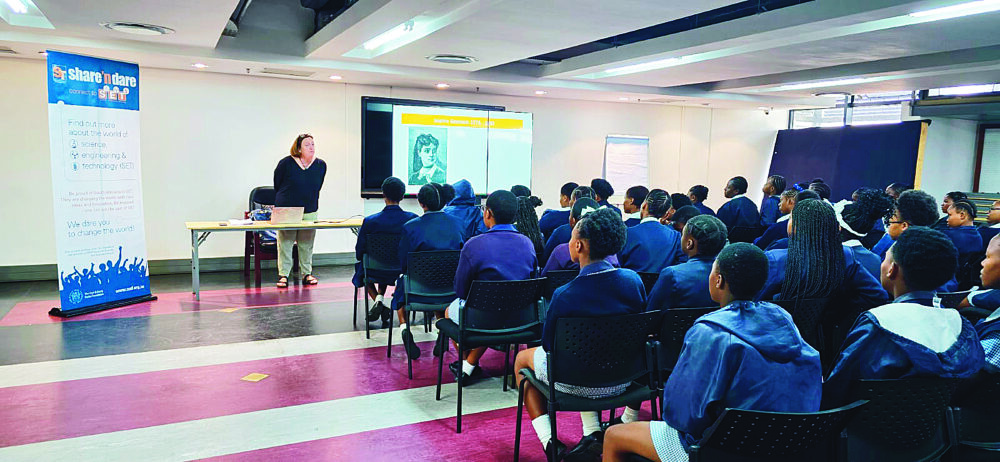
• Share ‘n Dare (S&D) Programme, running since 2008, provides platforms for award winners to share their knowledge with young people and the public across the country, including rural areas. Award winners participate on a voluntary basis and welcome the opportunity to ‘pay it forward’ to inspire and inform the youth of our country and others.
• Career talk videos: Since 2021, high quality career talk videos with award winners are produced and circulated widely on social media platforms (LinkedIn, Facebook, YouTube, TikTok, Instagram, and X), as well as to high schools all over SA, including rural and township areas.
• The popular NSTF Bursary Directory on the NSTF website keeps learners and students updated with currently available SET-related bursaries for undergraduate and postgraduate studies, from a wide variety of sources. The web pages include a list of bursary providers.
• The NSTF Bursary Fund is dedicated to studies in STEM. It aims to assist talented students who would otherwise be neglected, and who do not have full bursary support from other sources.
• The STEMulator.org is an interactive online learning platform initiated by the NSTF proSET sector to excite young people into the STEM world and associated studies and careers. It is a proudly South African non-profit initiative, freely available online and as a mobile phone app. It is also distributed to schools and is a useful teaching resource. Here the youth and those young at heart can ‘Explore>Discover>Learn’ and find ‘The Hidden World Revealed.’
• The NSTF Science Based Careers booklet presents STEMulator’s career descriptions in one place. It contains more than 130 STEM careers, classified as engineering, medical, mathematical and social science career fields, as well as careers ‘for the 4IR’, ‘green’ careers, as well as careers that include creativity.

The NSTF distributes SET-related news:
Through the monthly e-newsletter of SET-related policies, events and SET news specific to SA. In addition to NSTF news, information is taken from a wide variety of sources to give readers a monthly overview of the SET and innovation landscape in SA. The NSTF eNews includes opinion pieces that are thought provoking.
Raising awareness through the media including social media:
The main mission of the NSTF is to promote SET and innovation in SA. Campaigns are launched for every discussion forum, the various stages of the NSTF-South32 Awards, special campaigns profiling award winners, as well as for the youth activities. The purpose is to engage the media to raise public awareness through the dissemination of knowledge, newsworthy information, and the outstanding contributions of South African SET professionals and organisations, including new innovations.
Mapping the NSI landscape:
The NSTF describes (maps) the SET professional landscape, role players and stakeholders in the NSI. On an ongoing basis, the NSTF identifies organisations with mandates related to SET and innovation in SA and approaches them to join the forum. This ensures that the NSTF continues to be as broadly representative as possible, with a variety of disciplines, professions, sectors and organisation types. It also fosters inclusivity and active participation and ensures financial sustainability of the organisation. Furthermore, the NSTF proSET sector produces a booklet, ‘SET Professionals’ Who’s Who’, which aims to enhance the understanding of the SET landscape and the role of the various professions active in these fields. The public at large, government, employers in general, as well as industry and commerce can increase their understanding of and appreciation for SET, the relevant professions and the professional societies.
The National Science and Technology Forum (NSTF) is a unique and proudly South African organisation that exists to represent all stakeholders in science, engineering, technology (SET) and innovation in South Africa (SA). The NSTF marked its 30th anniversary last year as the largest, longest-standing and most representative independent stakeholder body of its kind. The NSTF