[Many thanks to Peter Jordens for bringing this item to our attention.] Kyann-Sian Williams (New Musical Express, NME) writes, “Evidenced by the massive spectacle that is Kingston’s carnival season, music has been a lifeline, a memory and the muscle of the island – especially in hard times.”
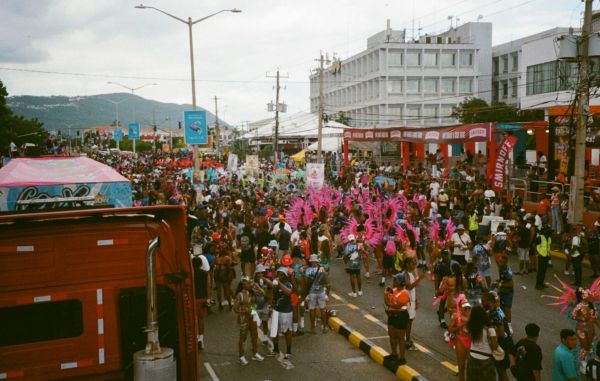
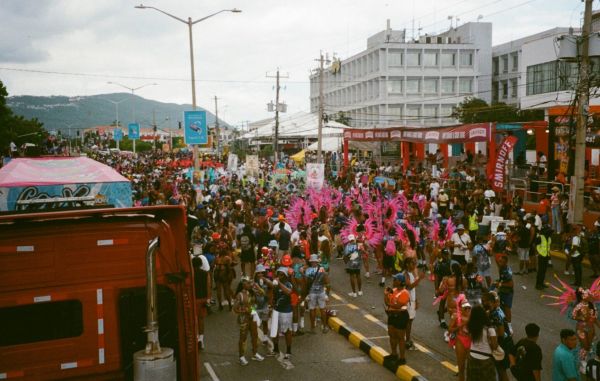
A magical, colourful spectacle is unfolding on the streets of Kingston. People are covered in jewels from head to toe, and women are carrying flowery wings like carnival fairies. Trucks roll slowly through shut-down streets, bass travelling through concrete before it reaches bone, while feathers and sequins catch the afternoon sun that’s beating down as the Road March parade – the biggest day of Carnival In Jamaica’s week-long celebrations – takes over the city.
Across the route, floats cut through the crowd with a steady rhythm. Soca legend Machel Montano commands one – carnival time is his heyday, as he soundtracks some of the biggest songs of the season – while international Jamaican music superstars like Shenseea, Ayetian and Klassik Escobar keep the energy high from above, playing to the crowd. Below, the response is immediate: waistlines wukking, arms flinging, cups pushed skyward.
Just months earlier, parts of this same island looked unrecognisable. In October 2025, Hurricane Melissa tore through Jamaica’s south coast, flattening homes and farmland – stripping people of their livelihoods. It caused an estimated USD$8.8billion worth of damage, killed 45 people, injured nearly 100, and left thousands of families without homes.
For a diaspora scattered across continents, Jamaican music has always functioned as more than entertainment – an anchor back to roots. In the wake of the storm, it became a way to rebuild and reconnect, and from London to Kingston, club nights turned into fundraisers and sound systems into lifelines, its familiar rhythm something to return to when everything else felt uncertain.
In St. Elizabeth – one of the hardest-hit regions – leading modern reggae star Protoje watched it unfold in real time. “It looked atomic,” he says. “Like a bomb went off.” His stark description matches the reality of the situation – the strongest hurricane ever to hit the island country caused an aftermath that was both economic and emotional. “My mom used to grow a lot of produce there, and it all got ruined in the storm,” he explains.
That loss threads through ‘At We Feet’ – a Damian Marley-featuring track from Protoje’s latest album, ‘The Art Of Acceptance’, that moves between documentation and defiance. In the song’s accompanying visuals, he shows onions, melons, and pak choi – crops native to the region – and uses them to show the fruitfulness of the area before. [. . .]
Carnival season 2026 arrives in the middle of that promise being kept. The studio, recently renovated under CEO Cedella Marley, now functions as a full creative hub – recording, rehearsal, visuals, vinyl pressing, all under one roof – and its rates are deliberately affordable, starting at 5,000 Jamaican dollars (£23.35) an hour. “This is for everybody,” says Stephen Marley at the relaunch. The intention behind those words runs centuries deep.
“Reggae is the music of the people, and the drum is the heartbeat of a society,” Young says. “Jamaicans especially have been able to use music as a platform to speak about our injustices and our resistance – but it has also been a way for us to advocate for ourselves.” [. . .]
For full article, visit www.nme.com/features/music-features/carnival-in-jamaica-2026-3941501
[Photo above by Kyann-Sian Williams (New Musical Express.]
[Many thanks to Peter Jordens for bringing this item to our attention.] Kyann-Sian Williams (New Musical Express, NME) writes, “Evidenced by the massive spectacle that is Kingston’s carnival season, music has been a lifeline, a memory and the muscle of the island – especially in hard times.” A magical, colourful spectacle is unfolding on the