
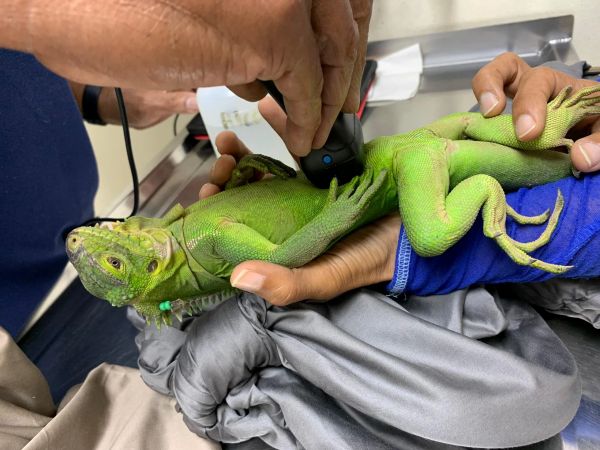

Danica Coto (Associated Press) writes about the survival of the once critically-endangered Lesser Antillean iguana (Iguana delicatissima) on Prickly Pear East Cay. The Prickly Pear Cays represent one of six marine protected areas of Anguilla. [Many thanks to Peter Jordens for sending us all related links.]
Silence used to prevail in the forest of a private Caribbean islet until environmentalists transformed it into a love nest for the critically endangered Lesser Antillean iguana.
Now, the sounds of iguanas plopping on the ground and scurrying about as they multiply are making scientists smile. “It’s something that’s ours,” said Devon Carter, a research officer with the nonprofit Anguilla National Trust. “We don’t have lions, we don’t have elephants, but what we do have, we need to appreciate.”
The population of the Lesser Antillean iguana, also known as Iguana delicatissima, was zero on Prickly Pear East Cay nearly a decade ago. But scientists in nearby Anguilla who were determined to save the species from extinction tucked 10 iguanas into small, breathable cotton bags and ferried them by boat to the cay with no predators in hopes they would breed. And breed they did. The population has surged to 300 and counting, converting the cay into one of five sites worldwide where the iguana is trying to make a comeback. It is estimated that there are fewer than 20,000 species remaining, according to conservation groups.
“Prickly Pear East has become a beacon of hope for these gorgeous lizards and proves that when we give native wildlife the chance, they know what to do,” said Jenny Daltry, Caribbean alliance director for the conservation groups Fauna & Flora and Re:wild.
A lover and foe
Indigenous people are estimated to have arrived in the eastern Caribbean roughly 7,000 years ago. The Lesser Antillean iguanas were already there, likely having reached the islands by floating atop debris spewed by rivers that had burst their banks in South America, according to the International Union for Conservation of Nature.
At the time, the iguanas inhabited some 10 islands, but they are now extinct on Antigua, Barbuda, St. Kitts, Nevis and St. Martin, and have largely vanished from Guadeloupe, St. Barts and Martinique, according to the Re:wild conservation group. [. . .]
Life on a new island
After one year, scientists captured 23 Lesser Antillean iguanas in Anguilla, a number believed to be almost the island’s entire population of that species. The iguanas were genetically tested to ensure they were full breeds and then the first 10 were tagged and released on nearby Prickly Pear East, Mukhida said.
Once that population seemed to adapt well to its new home, scientists released the remaining 13 iguanas. “We were seeing babies, we were seeing their burrows where they were nesting,” Mukhida recalled. “It was really encouraging that they were breeding.”
Lesser Antillean iguanas are bright green when young but morph into a slate gray or dusty black as adults, with a lifespan of more than 20 years in the wild.
But concerns remained despite the successful breeding. [. . .]
For full article and video, see https://apnews.com/article/anguilla-caribbean-saving-lesser-antillean-iguanas-65094851cdabf667404d892603673424
Also see “Match made in Caribbean brings welcome news for lizard lovers,” in
Fauna & Flora at https://www.fauna-flora.org/news/match-made-in-caribbean-brings-welcome-news-for-lizard-lovers
For background information on Prickly Pear East Cay, see https://en.wikipedia.org/wiki/Prickly_Pear_Cays
Danica Coto (Associated Press) writes about the survival of the once critically-endangered Lesser Antillean iguana (Iguana delicatissima) on Prickly Pear East Cay. The Prickly Pear Cays represent one of six marine protected areas of Anguilla. [Many thanks to Peter Jordens for sending us all related links.] Silence used to prevail in the forest of a