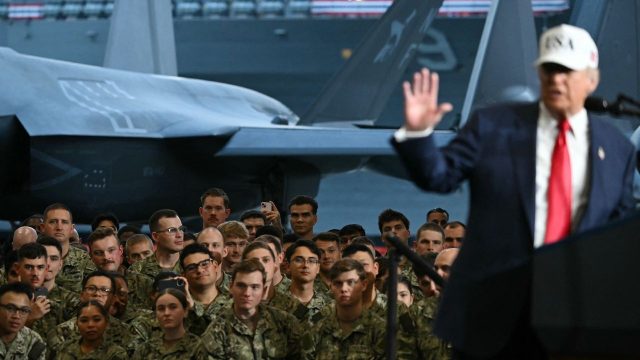
It is an age-old question in politics: guns or butter? Government resources are not unlimited, so leaders have to prioritize military spending or social welfare programs, or try to strike an uneasy balance between the two. President Donald Trump is choosing guns.
The federal government is “fighting wars. We can’t take care of day care,” Trump said to a private luncheon last week, per NBC News. The job of the federal government is to “guard the country.” But it is “not possible” for it to “take care of day care, Medicaid, Medicare” and similar social programs. Those priorities were reflected in Trump’s 2027 budget proposal released last week, said The Associated Press. The document advocates “boosting defense spending to $1.5 trillion” — an increase Trump “telegraphed” even before the war with Iran — while cutting non-defense programs 10% “by shifting some responsibilities to state and local governments.”
Trump’s speech “clarifies” that military spending is a higher priority for him than the social spending “that many of his working-class supporters increasingly rely upon,” said The New York Times. Democrats seized on the comments, saying the president’s priorities are misplaced. Trump is “CHOOSING to cut Medicaid and Medicare for more money for war,” Rep. Shri Thanedar (D-Mich.) said on X.
What did the commentators say?
Republicans have the “worst budgeting idea possibly ever,” Charles P. Pierce said at Esquire. Voters are unlikely to reward a party “seeking to cut health care” while backing an “unpopular war launched by an extremely unpopular president.” It is a politically “suicidal maneuver” that must have “every alarm bell ringing” in the heads of GOP incumbents fighting an uphill battle to keep control of Congress in this year’s midterm elections.
It is true that health expenses “are a major budgetary problem” for the federal government, Aaron Blake said at CNN. At $2 trillion a year, they are the “largest portion of federal spending” and growing. But a new CNN poll shows that the president’s “biggest political problem” with the Iran war is “how much it’s costing.” There is “precious little appetite” among voters to make sacrifices for the conflict. Trump chose perhaps the “most politically unhelpful terms imaginable” by pitting defense spending against child care.
Washington’s preference “spending on butter over guns” has resulted in a “shrunken military industrial base” that has weakened U.S. defense capabilities, The Wall Street Journal said in an editorial. The proposed $1.5 trillion defense budget is thus a “credit” to Trump, doubling military spending from its 2021 levels. There are “savings to be had by cutting fraud in Medicaid and other welfare programs,” a necessary step in the face of the “multiplying threats America faces.”
What next?
Trump’s proposed budget faces tough sledding in Congress. “Supersizing” the military budget while “slashing” domestic spending “could cost Republicans in the coming midterms,” said Politico, especially if voters hold the GOP responsible for “economic consequences of the Iran war.” Trump may struggle to “build enough political will” among Republicans to “fulfill his defense goals.”
Trump: Feds cannot pay for ‘day care, Medicaid, Medicare’