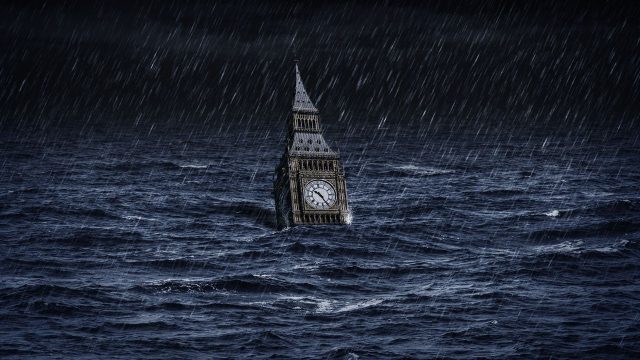
“You would be forgiven for thinking the rain this year has been relentless – because in some parts of the UK, it actually has been,” said BBC weather presenter Ben Rich.
There have been more than 280 flood warnings and alerts in place across southwest and central England, Scotland and Wales. So far, 26 weather stations have reported monthly rainfall records, and the heavy rainfall has brought strain to homes, businesses and the environment across the UK.
The constant rain feels like “some sort of biblical punishment”, said The Independent. Few corners of the country have been spared entirely, with the southwest of England and Scotland “bearing the brunt”. And there is still “more to come”.
What did the commentators say?
“We have, then, reached the apotheosis of British climate: unchangeably changeable weather,” said The Times. The weather is “stuck”, and the “setting it has been stuck on is ‘miserable’”.
The “main architect” of our current weather pattern has been the fixed jet stream heading in from the Atlantic, said the Met Office. Caused by significant “cold plunges” across North America, this “powerful ribbon of air” is positioned further south than expected at this time of year. Acting as a “conveyor belt”, it funnels low-pressure systems towards northern Europe, which in turn increases the “frequency and intensity of rain-bearing weather fronts”.
At the same time, high-pressure zones in mainland Europe stop the jet stream in its tracks, “blocking” the system from passing through. As a result, we are left with “increasingly saturated ground, travel disruption, and a general sense that winter has been stuck on repeat”.
“Spare a thought” for the “saturated souls” of North Wyke in Devon, Cardinham in Cornwall and Astwood Bank in Worcestershire, said The Independent. They have experienced downpours every day from 31 December to 8 February, with more expected. But perhaps the “bleakest” fate has been Aberdeen’s: as of 10 February the city hadn’t “seen a single minute of sunshine for two weeks and counting”. That’s the “longest period for the area” since records began in 1957.
Britons have been “dodging deluges or showers” for 40 consecutive days in the worst-affected areas, said The Guardian. The “persistent” wet weather is impacting “farmers, builders, sports, wildlife – and damaging roads and homes”. Hundreds of people have faced “misery” after the flooding of businesses and homes. Wild swimmers have been hit by “sewage problems on beaches and inland”, caused by the heavy rainfall.
There is the “occasional bright spot” amid the grey-skied gloom. A “month of mud” festival has been organised in Somerset’s Quantock Hills, and on Studland beach in Dorset the extreme weather has caused a “historic shipwreck” to emerge, “thought to be the remains of a Dutch merchant ship that sank in 1631”.
What next?
This week “looks as grey and damp as the week before and the week before that”, but there is “evidence of a change”, based on Met Office data, said The Times. There could be a “brief window” where a lingering system breaks down, bringing fleeting sunlight to Scotland in particular.
However, “although this Valentine’s Day we expect to glimpse the sun, it would be wrong to call it light at the end of the tunnel”. In fact, it is “more a skylight, in the middle of a long, bleak and damp tunnel, to which we are all about to return.”
But “change is on the horizon”, said BBC weather presenter Chris Fawkes. In the last week of February the Atlantic jet stream is returning to the far northwest of Scotland, and there is a possibility that high pressure may bring “more settled weather conditions” by the end of the month. “It’s a long way off, but it’s the least we deserve given just how wet and dull it’s been over recent weeks.”
An Atlantic jet stream is ‘stuck’ over British skies, leading to ‘biblical’ downpours and more than 40 consecutive days of rain in some areas