
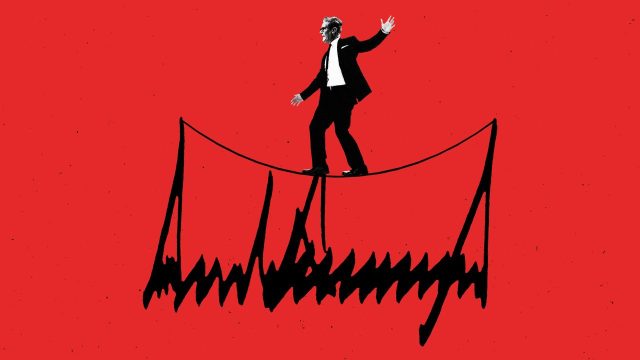
Keir Starmer has called the threat of further US tariffs on Europe “completely wrong” and “not the right way to resolve differences within an alliance”. But, as he played down talk of retaliatory tariffs and stopped short of criticising Donald Trump personally, he continues to walk a difficult tightrope between the Europe and the US.
The prime minister held an emergency press conference this morning, following a weekend of diplomatic turmoil as Trump ramped up the pressure on the UK, Denmark, Finland, France, Germany, the Netherlands, Norway and Sweden by threatening to impose 25% tariffs if they continue to oppose his proposed takeover of Greenland.
“There is a principle here that cannot be set aside because it goes to the heart of how stable and trusted international cooperation works,” Starmer said. Any decision about the future status of Greenland “belongs to the people of Greenland and the Kingdom of Denmark alone”.
The PM’s tactic has always been to pursue “calm discussion” in the face of “the crash and noise of Trump’s second term”, said James Heale in The Spectator. Once again, he “just has to hope that speaking softly in private will mean more than sounding off in public”.
What did the commentators say?
In spite of their “obvious differences”, Starmer has “invested huge political capital and personal energy in building a personal connection” with Trump, said Amanda Akass on Sky News. This has, his supporters argue, protected the UK from the worst excesses of the Trump administration and been crucial in keeping the president onside with Ukraine.
It was a “shrewd” move to position himself as Trump’s “most dependable and closest ally”, said Tom Harris in The Telegraph. But now that the US president’s expansionist global ambitions have stretched to include “the enforced purchase” of Greenland, this “carefully cultivated relationship” has become “an embarrassment”.
Having “assured voters” that the special relationship was “as strong as ever”, Starmer has “had to accept that, when push comes to shove, America lumps Britain with the EU – and that is “painful”, said The Economist. Worse, said Harris in The Telegraph, the man who was “once seen as the conduit between Trump and Europe” is now “regarded with suspicion by both the White House and Brussels”.
Starmer’s “secret hope”, said ITV’s Robert Peston, is that moderate Republicans “will be so shocked by Trump’s attempted demolition of the so-called special relationship with the UK that they will urge the President to think again”. But “that may be naive”. If there is one thing we know about Trump, it’s that he “doesn’t respond well to being told he is wrong, even by his friends”.
What next?
These are “unprecedented developments and the options open to European powers are limited”, said the BBC’s Chris Mason.
For those European leaders who want to “send a warning to America, the simplest response is trade retaliation”, said The Economist. But while Germany has thrown its weight behind Emmanuel Macron’s call to consider a “trade bazooka”, Starmer has so far maintained a less confrontational stance, saying today that a trade war was in “nobody’s interest”.
That said, in the face of widespread international and domestic anger at Trump’s threat to take over Greenland and punish Nato allies who get in his way, there’s no doubt that Britain’s PM is now taking a stronger line with the US. It is “hardly a ‘Love Actually’ moment of brave UK defiance in the face of a domineering US president”, said Sky’s Akass, “but Keir Starmer has clearly decided it’s time to start pushing back”.
PM condemns US tariff threat but is less confrontational than some European allies


