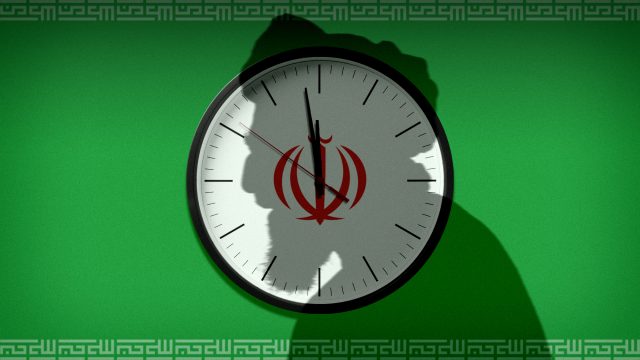
Israel launched its war in Iran to keep the Islamic regime from acquiring a nuclear weapon. The question now is whether the regime will survive the onslaught at all, especially with President Donald Trump considering joining the fray.
A collapse of the Iranian government “is unlikely,” said NBC News. The regime is “unpopular, but it still has a tight grip on power” and there are no likely alternatives ready to seize power. Still, Israeli Prime Minister Benjamin Netanyahu said to reporters this week that the government in Tehran could fall. Israel’s war is “changing the face of the Middle East.”
The Israeli mission is “now moving inexorably toward regime change,” said David Ignatius at The Washington Post. But Israel “can’t bomb its way” to a new Iran that reverses the 1979 Islamic revolution. Indeed, the bombing campaign Iran is experiencing usually “makes people hunker down, turn inward and often fight harder.” There is a hope, however, that this moment will offer Iranians a “chance to build something new.”
Regime change gamble
The war has “reopened the door” to political change in Iran, said Joseph Bosco at The Hill. While the conflict has “significantly” set back Iran’s nuclear ambitions, it has also “weakened the domestic credibility and ruling power” of the Islamic government. The West “must not allow the opportunity to pass.” Iran’s regime has been “living on the edge” by supporting terrorism across the region and against the United States for more than 40 years. “Let’s push it over.”
Israel’s “endgame” might be a regime change in Iran, “but it’s a gamble,” said Amir Azimi at BBC News. Israel’s attack is a “real threat to Iran’s leadership,” compounded by Iranian unhappiness with the country’s “economy, the lack of freedom of speech, women’s rights, and minority rights.” If the government should fall it is “unclear where such a process might lead.” One possibility is a “descent into chaos” that would have a “massive impact across the Middle East.”
‘The moment is auspicious’
The “only lasting foundation” for long-term Middle East peace is “overthrowing the ayatollahs,” said John Bolton, the former national security adviser, at The Wall Street Journal. In the current crisis, “further divisions within the regime’s leadership should be fostered and exploited,” perhaps by offering “amnesty” to some current officials to induce them to “switch sides” and help create a “more consolidated opposition.” America should offer support to aid that opposition and bring down the clerics. “The moment is auspicious.”
The weakness of Iran’s Islamic government has “encouraged attacks before,” said The Economist. Iraq’s Saddam Hussein tried to take advantage of Tehran’s “post-revolutionary disarray” and launched a war against Iran that ended up lasting for eight years. Instead of “weakening” Iran’s regime, the war actually “strengthened its leadership” and allowed it to hold power for decades to come. A similar moment seems to have arrived now. But with “no clear alternative,” Iranians may wonder if “they are better off sticking with what they have.” And an “entrenched regime” could end up even more of a threat to its “foes, neighbors and citizens.”
‘Regime change’ may be on the agenda