New government plans to try to tackle Britain’s dental care crisis have been criticised as “rearranging the deck chairs” by the British Dental Association (BDA).
A £20,000 bonus will be offered to up to 240 dentists to encourage them to work in the “so-called dental deserts where there is the poorest access to NHS care”, said the BBC. “The government has also announced higher payments for dentists who take on new patients and teeth-cleaning in schools as part of a plan to expand levels of dental care.”
But the measures have faced stinging criticism from both the BDA and Labour. The opposition party called the plans “temporary measures” that did not go far enough, while the BDA said the government was doing nothing to make the service “fit for the future”.
How bad is Britain’s dental crisis?
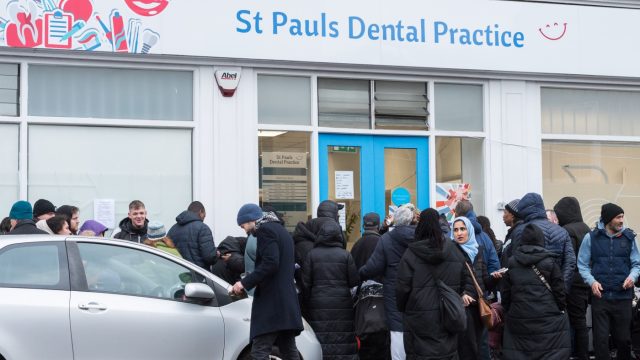
The scale of the crisis was brought into focus this week as hundreds of people in Bristol queued for hours to register with a new NHS dentist. The queues were “so large that the police were called to ensure crowd control”, said The Telegraph, and the scenes are symptomatic of how “access is hard and for new patients impossible in many areas”.
Successive governments have been criticised for slashing financial support to dentistry, with the BDA claiming it had “dropped by £1bn since 2010 once inflation was taken into account”, said the BBC. The broadcaster said it had found in its own investigation in 2022 that nine in 10 NHS dental practices were “not accepting new adult patients for treatment on the NHS” and that, although 32.5 million treatments were carried out in 2023, that was “still fewer than before the pandemic”.
NHS dentistry is not free at the point of delivery for patients in the UK, but it is intended to be cheaper than visiting a private dentist. It is meant to be “a service for everyone on demand”, said The Telegraph. However, the “reality is different”. NHS England figures in 2023 showed 54% of children and 40% of adults had not seen a dentist in the past 12 months.
These difficulties disproportionately affect those in deprived areas, said Healthwatch. The independent health and social care consumer group said that “fundamental reform” is needed to address the issues with dental care in the UK.
What exactly is the government doing?
The government says its newest proposal will add £200 million on top of the £3 billion it already spends on dental care each year and help deliver “faster, simpler and fairer access” to NHS dentists.
Its proposals include increasing payments to dentists who treat patients who have not seen a dentist for more than two years, as well as those who treat patients needing complex work. It will also expand water fluoridation across the country and deliver mobile services to rural and coastal areas along with in-school visits to treat children. Dental training posts are being increased, although that could take years to make a significant impact.
The most eye-catching measure is the government’s proposal to pay up to 240 dentists a bonus of £20,000 to work for three years in an under-served area where recruiting and retaining staff is difficult.
Will it work?
There is seemingly widespread consensus from those in the industry that the plans do not go far enough.
Thea Stein, chief executive of the health think tank the Nuffield Trust, said that after “decades of neglect” the plans may “pull it back from the brink” but won’t address the “systemic problems” that have left NHS dentistry in a “near-terminal decline”. She added the plans would not be “anywhere like enough to restore universal access to NHS dentistry” and it would take billions of pounds of funding to begin that process properly.
The BDA and Labour have also accused the Tory government of making NHS dentistry an election issue.
Shawn Charlwood, chair of the British Dental Association’s general dental practice committee, said that ministers had “wanted to stop dentistry becoming an election issue” but with this plan have “achieved the exact opposite”, said The Guardian.
Shadow Health Secretary Wes Streeting said the government was acting “now there’s an election coming”, and accused ministers of adopting Labour ideas like supervised brushing in schools because they were “out of ideas of their own”.
But both Conservative and Labour proposals are “not enough” to tackle the crisis, said The Telegraph in its editorial. It believes “something more radical is needed”.
New proposals including more money for dentists working in under-served areas criticised for not being enough