
Editor of PerspectivasAfro Silvia Valero (Universidad de Cartagena) announced an extension for the call for abstracts for the dossier “Literature and Slavery in Latin America and the Caribbean: Approaches, Biases and Perspectives (20th and 21st Centuries)” for Vol. 5, No. 2 (January-June 2026). This issue is coordinated by: Rocío Munguía Aguilar (University of Guyana), Sara Carini (Università Cattolica di Milano) and Silvia Valero (University of Cartagena). Papers are accepted in Spanish, English, French and Portuguese. The new deadline for receiving abstracts is March 30, 2025.
Description: The referential and symbolic vocation of literature, which seeks, among other things, to represent the world and its possibilities, produced literary figurations of slavery at the beginning of the twentieth century, although with greater force in the last four decades, capable of “revealing” the transversality and diversity of this experience (Glissant, 1980). “These memorial (re)writings, which someone, in another geo-historical context, referred to as “neo slave narratives” (Rushdy, 1999), are inscribed in precise historical moments and in authorial positions (Meizoz, 2007) that cannot be erased. While certain periods witnessed a shift in the literary field, away from the themes and axes of negritude associated with the era of slavery, or a diminution in their treatment, the conjunction of social and intellectual conditions associated with movements advocating for the rights of Afro-descendants in Latin America and the Caribbean in recent years has created a space for reflection, leading to a shift in the writing about slavery and its critique.
This convergence of an overwhelming opening of studies focused on Afro-ethnicities with the active participation of academic activists in the debates thus opened the literary field to the adoption of approaches and perspectives — with their inevitable biases — that we believe it is important to investigate from a global perspective, reflecting on how the issue of slavery was situated in the literary and sociocultural discourse of the region. With this dossier, we aim to delineate a critical cartography of how writers from Latin America and the Greater Caribbean, throughout the 20th century and into the 21st, have addressed themes related to the slave trade, daily life, and cognitive, emotional, psychological, and spiritual subjectivity. In the same direction, aiming to review the rewriting of historical events led by Afro-descendants. Building upon the notion that literature functions as a conduit for social discourse, as articulated by Angenot (1998), it is anticipated that this study will foster a dialogue or articulate with the historical moment in which the works were produced and/or to which they respond.
In an effort to expand the lens through which we read and interpret fictional works that address the subject, we encourage the study of works from any sociocultural space, not exclusively written by authors of African descent, and whose analysis allows us to answer, among other possible questions, the following: From what perspectives (political, aesthetic, historiographical, conceptual) was the subject of slavery introduced in literature? What point of enunciation is selected by the authors, and how is it articulated with their aesthetic, political, and/or literary perspectives? What factors influenced the literary depiction of slavery (or its absence) during specific periods of the 20th century? Furthermore, the role of literature as a form of knowledge, and its interaction with other historical and social discourses, is a crucial aspect to consider. The inquiry further opens a potential for a “poetics of slavery,” defined in structural, aesthetic, and political terms, within these literary productions. To what extent do these narratives converge or diverge from those of preceding centuries? What literary or ideological biases do they reveal? Furthermore, it is crucial to discern and analyze the literary or ideological biases that these texts might reveal, as they serve as significant sources of historical and social knowledge.
We invite researchers to submit abstracts of original and unpublished work that addresses, with critical distance and methodological rigor, in Spanish, Portuguese, French or English, any of the following topics (non-exhaustive list): The treatment of the subject of slavery (theoretical or literary) in certain periods and its conditions of production; Studies of works (individual or comparative) that engage in a dialogue with the historical context of production; Authorial approaches and positions; Dialogues, porosities and tensions between literature on slavery and the historical discipline; Aesthetics of slavery as a theme; Reception of literature on slavery, by authors of African descent or not, in Latin America and the Caribbean; Orientations and perspectives of 21st century fictions on slavery.
Abstracts should contain: 1. Provisional title 2. Text(s) to be worked on 3. Problem to be developed (questions, objectives) 4. Brief presentation of the theoretical or methodological framework of the research (primary reference bibliography); 5. Minimum provisional bibliography of the research
Deadline for submission (abstracts of 250 words maximum): March 30, 2025
Date of acceptance or rejection: April 15, 2025
Date for submission of articles (between 8,000 and 10,000 words, including abstracts, bibliography and footnotes): Before September 15, 2025
Date of publication: January-June 2026.
Send abstracts to rocio.munguiaaguilar@univ-guyane.fr, sara.carini@unicatt.it, revistaperspectivas@unicartagena.edu.co.
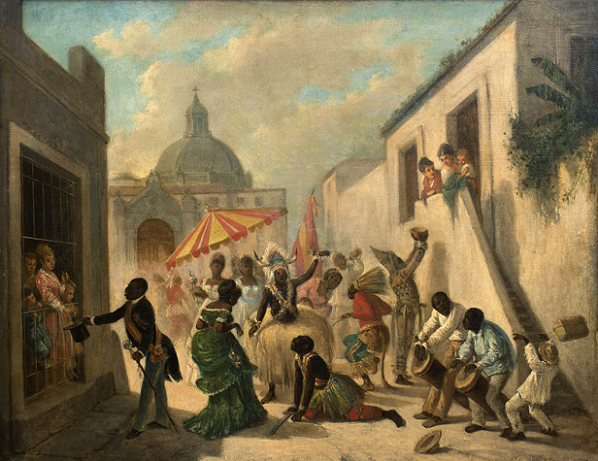
[Image above: Víctor Patricio Landaluze, Three Kings Day in Havana, 19th century, oil on canvas, 51 x 61 cm (Museo Nacional de Bellas Artes de Cuba, Havana)]
Editor of PerspectivasAfro Silvia Valero (Universidad de Cartagena) announced an extension for the call for abstracts for the dossier “Literature and Slavery in Latin America and the Caribbean: Approaches, Biases and Perspectives (20th and 21st Centuries)” for Vol. 5, No. 2 (January-June 2026). This issue is coordinated by: Rocío Munguía Aguilar (University of Guyana), Sara