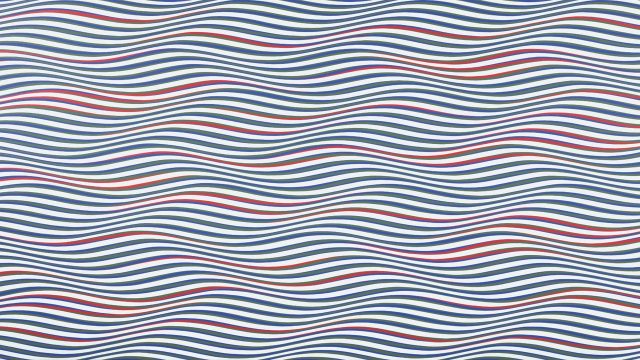
Now aged 94, Bridget Riley has been remarkably “consistent” over her long career, but is often misunderstood, said Lily Le Brun in The Observer. Back in the 1960s, her “bold, geometric, abstract” monochrome paintings caused a sensation. To her fans and critics alike, they seemed to hint at “fashionable, cutting-edge concerns: new technologies, space, psychedelics”. Riley’s real inspiration, however, was “very different”. In 1939, when the artist was eight, her mother moved her to “a damp cottage on the Cornish coast to see out the War”, and her experiences of observing the sea have formed what she calls “the basis of my visual life”.
This show in Margate brings together 26 paintings that represent nearly every stage of Riley’s career, and it seeks to investigate how the artist has repeatedly returned to the subject in her work over the past 60 years – evoking the patterns of the waves not directly, but through basic shapes and geometry. Hung within view of the gallery’s “tripleheight windows”, perched on the harbour wall looking out onto the North Sea, can her work really “stand up” to its inspiration?
At her most successful, Riley’s paintings remind you “that sight is a physical sensation … it’s something you actually feel”, said Eddy Frankel in The Times. They “make you look at the world again, rewired, reconfigured”; and the best do evoke the watery world just beyond the gallery walls. There are canvases filled with triangles that somehow recall “gentle waves lapping at the shore”; a number of “curving, wobbly paintings … loom over you like big washes of marine turbulence”; one red, blue and green example from 1980 “looks like it’s about to bulge off the canvas”. “At her worst”, though, Riley merely offers “dull minimalism”. Some recent works, painted directly onto the walls, are “lifeless” arrangements of dots with “no visual hum, no eye-melting shock of colour and shape”. Some canvases are just arrangements of stripes in pastel colours; they’re “closer to home decor than anything else”.
“However analytical you might try to be”, Riley’s works keep doing things to you on a physical level, said Adrian Searle in The Guardian. She is asking us to consider the way we see things, inviting us to look closer and really scrutinise the dazzling patterns in her art. “The longer you look, the more they reveal and the more they seem to change.” One recent wall drawing, for instance, seems to change colour as you approach, first appearing dun-hued, then developing a “silvery penumbra” when you draw closer. Elsewhere, two separate paintings entitled “Late Morning” – one from 1967, the other from 1978 – both make you register “bulges and falterings where none exist”. Although Riley’s art is very familiar by now, this is “an invigorating and magical ensemble”. She “turns concentration into reverie and leaves me agape, wide open and surprised. I can’t stop looking.”
Turner Contemporary, Margate. Until 4 May
The English artist’s striking paintings turn ‘concentration into reverie’