
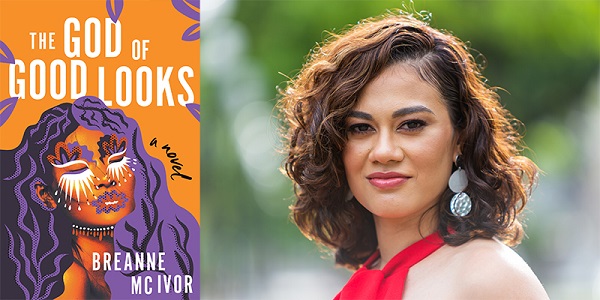

Aya de Leon (CrimeReads) interviews the “Trinidadian writer and makeup artist about her lush debut set in the Caribbean fashion scene…”
Aya de Leon interviews Breanne McIvor about her debut novel, The God of Good Looks, which has recently been nominated for an NAACP Image Award. The God of Good Looks features a rivals-to-lovers romance between two beauty influencers against the backdrop of shenanigans and high-jinks in the Trinidadian fashion industry. McIvor’s lush descriptions are informed by her background as a professionally trained makeup artist.
Aya de Leon: Although The God of Good Looks is positioned as a literary novel, and the writing has all the lovely craft a reader desires in literary fiction, I also see it as part of the conversation in crime fiction. Do you see the book in connection with the crime fiction genre?
Breanne McIvor: I love crime fiction and I love the idea of The God of Good Looks being in conversation with that genre. Of course, I would never class this book as classic crime fiction. But crime is the backdrop to my characters’ lives; murder, robberies, gang and gun warfare, white collar crime, and government corruption have all wormed their way into the national consciousness. In some ways, this is a book about how to build a life in such a country. There are times when Bianca literally can’t leave her house because she hears gunshots in the street and Obadiah’s home life has been shaped by the threat of thievery and stray bullets.
Initially, Obadiah sees his job in the beauty industry as being totally unrelated to Trinidad’s ever-increasing crime rate. And it may seem like he has a point. Makeup and murder are two entirely separate issues. But in a society where crime stalks everyone, Obadiah ultimately has to ask whether he can or should ignore the menace.
AL: Yes. It’s character-driven, and also an integral part of the setting. In previous interviews, you’ve talked about how you were pressured to take the elements of crime out of the story to appease a white tourist gaze on the Caribbean. Can you say more about the reality of crime in Trinidad and why you insisted on authenticity?
BM: Trinidad and Tobago has the sixth highest crime rate in the world and living under a near constant threat of crime, especially violent crime, leaves an indelible impact on you. Something as simple as a strange car idling outside your house would be a reason to lock all the doors, take a picture of the license plate, and peer out the curtains to make sure you’re not about to be robbed. I lived in Trinidad until I was eighteen and it wasn’t until I went to university in England that I realized how much of my life was centered around trying to make myself a hard target for criminals. It took me a while to get used to houses without burglar proofed windows or to feel safe walking on the streets after dark.
Although I’m writing fiction, I want to represent my country as I live it. I’ve spent enough time making police reports and recovering from various crimes myself to know that it would be impossible for Bianca and Obadiah to remain untouched by crime. I wanted Trinbagonians reading to see the truth of our country reflected in this book and I wanted international audiences to know Trinidad as a real place and not as a perfectly packaged tourist brochure with all the undesirable bits edited out. I hope that this novel can be part of a conversation about the scourge of crime while leaving space for readers to think about why some people feel as if crime is their only path to a better life.
AL: Well said. Crime is the path of upward mobility for those who don’t have access via the traditional pathway, education. My third novel, The Accidental Mistress is also about a Trinidadian makeup artist who is a product of class mobility through education. It’s also a crime and a romance novel about respectability politics and the failed promise of the American dream. My character goes to a US college prep school and then to Harvard. For people of color in general and people in former British colonies in particular, education and upward mobility have been offered for generations as our path to salvation. Yet for Bianca, her UK education was a bridge to nowhere. In the book, it positions her isolation after her mother’s death as the biggest obstacle to her building a successful life after college. But I felt the novel hinting at a broader critique of the system? Can you comment on that?
BM: I think you phrased it perfectly: education is often touted as a path towards upward mobility and respectability; in Trinidad, a foreign degree is often seen as better or more prestigious than a local one. However, Bianca’s affair with Eric erases any respectability her educational background may have given her. She’s fired from her magazine job, not because she’s not good at it, but because being associated with her is social poison. Meanwhile, Eric keeps his much more prestigious job as the Minister of Planning and Sustainable Development. Ultimately, power or proximity to power is more important than qualifications or abilities and it seems as if Eric is too high and mighty to experience any negative repercussions.
I think my implicit critique is the people who really understand this dynamic are often people from the upper classes. People like Eric are raised in a robust network of powerful families and often have a gilded path to success. I wanted to ask how people on the fringes of society can succeed in a system where connections are often your most valuable asset. Both Obadiah and Bianca realize that they don’t live in a meritocracy. Obadiah is a phenomenal makeup artist and Bianca is a talented editor with all the right qualifications, but those things aren’t enough to guarantee their career success. Part of their journeys is discovering how they can work together—and use any advantages they might have—to realize their dreams. [. . .]
For full interview, see https://crimereads.com/breanne-mcivor-on-beauty-romance-and-the-borderlands-of-literature-and-crime
Aya de Leon (CrimeReads) interviews the “Trinidadian writer and makeup artist about her lush debut set in the Caribbean fashion scene…” Aya de Leon interviews Breanne McIvor about her debut novel, The God of Good Looks, which has recently been nominated for an NAACP Image Award. The God of Good Looks features a rivals-to-lovers romance between two beauty influencers against