‘The Vast Enterprise: A New History of Lewis & Clark’ by Craig Fehrman
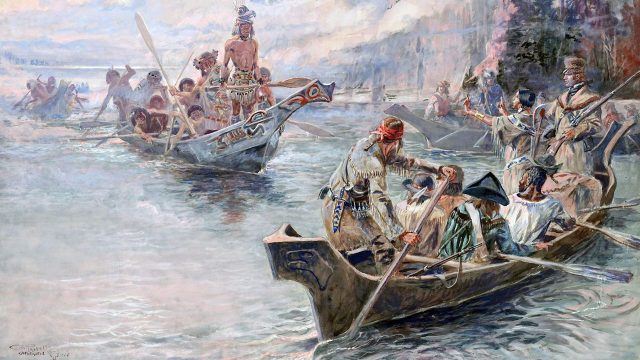
“Do we really need another book about the Lewis and Clark expedition?” asked Andrea Wulf in The New York Times. The answer, after reading Craig Fehrman’s new page-turner, is “an emphatic yes.” One reason for its novelty is that, in revisiting Meriwether Lewis and William Clark’s westward trek into the newly purchased Louisiana Territory, Fehrman has shifted focus away from the famous pair, widening the scope to include other members of the so-called Corps of Discovery as well as several Native Americans the 33 men met en route. The result is “a richly woven tapestry of voices” that “reframes this well-known story, revealing it as more complex, and profoundly human.” Because certain members portrayed didn’t leave expansive journals, Fehrman sometimes has to rely on conjecture or push his imaginative reconstruction too far. But that’s a minor complaint. Fehrman’s multifaceted account is “a fantastic achievement.”
More than 220 years on, “the Lewis and Clark expedition still intrigues,” said Karin Altenberg in The Wall Street Journal. Tasked by President Thomas Jefferson, who had been long obsessed with exploring the West, Lewis and Clark’s team journeyed from St. Louis to the Pacific Ocean and back, with most of the 8,000-mile journey on the Missouri and Columbia rivers. Some members of the party had joined out of patriotic spirit, some for money, and others, including the kidnapped Shoshone teenager Sacagawea, had no choice. “Lewis and Clark had to make sure this diverse, multilingual crew jelled, all the way to the Pacific and back,” and it’s a testament all parties’ desire for peace that the expedition’s many interactions with Indigenous tribes resulted in only one violent death. “Immensely engaging,” The Vast Enterprise gives a well-known story “fresh breadth.”
“This is vivid, character-based history,” said Chris Vognar in The Boston Globe. The chapters rotate between the viewpoints of principal players, among them soldier John Ordway, Lakota and Arikara leaders, Jefferson, and, yes, Lewis and Clark. Fehrman also fleshes out two participants often treated as footnotes. York, an enslaved servant to Clark, was awarded a degree of autonomy during the journey, while Sacagawea, the enslaved wife of interpretor Toussaint Charboneau, is shown to be a valuable collaborator and becomes “a three-dimensional character with her own hopes, dreams, and regrets.” Shuffling between these figures “pays enormous dividends, as Fehrman weaves a tale that uses human stories to go beyond hard facts and calcified myths.” The result is “a ripping good read.”
‘Small Town Girls: A Writer’s Memoir’ by Jayne Anne Phillips
Jayne Anne Phillips’ evocative new book “rejects the linear chronology of a typical memoir,” said Donna Rifkind in The Wall Street Journal. Instead, its structure “mimics the fracturing of modern American life as she has witnessed it.” Born and raised in West Virginia in an Allegheny Mountain town, the Pulitzer Prize–winning novelist, who is now 73, left Appalachia in early adulthood and has since lived on both coasts and in the Mountain West. But her hometown of Buckhannon “has never loosened its grip,” and as the author of 2023’s Night Watch reflects on her upbringing and nomadic adulthood in the book’s 22 personal essays, she seems to be both blurring the line between dreams and memories and tracing “a slow-motion rupture” in American society.
“Phillips brings to this memoir the kind of resonant details and sharp insights that have enriched her fiction,” said Heller McAlpin in The Christian Science Monitor. Her family helped settle West Virginia; one side of the family fought for the Union, the other for the Confederacy. She brings us inside the local beauty parlor where her schoolteacher mother kept weekly appointments. She writes empathetically about her parents’ separation after she and her brothers left home and movingly about her mother’s final days. Almost by necessity, given her deep local roots, “Phillips’ gaze often extends beyond family,” and in one essay, she details how West Virginia, once cut off from the coast, was gradually sullied by timber barons, then coal companies and, most recently, the fracking industry.
“It is hard to read Small Town Girls without recalling your own childhood,” said Gabrielle Stecher Woodward in the Southern Review of Books. But Phillips hasn’t created a “one-stop antidote to home-sickness.” Instead, “what she does provide is a sense of comfort for those grappling with their own grief,” whether about lost loved ones or bygone times. Her “quietly devastating” passages about witnessing her mother’s final decline are “grounded in Phillips’ refusal to look away from the truths so easily postponed.” Because her sensibility is the only through line we need, Small Town Girls proves to be “a master class in the art of the personal essay.”
A different perspective on Lewis and Clark and a memoir rooted in West Virginia