
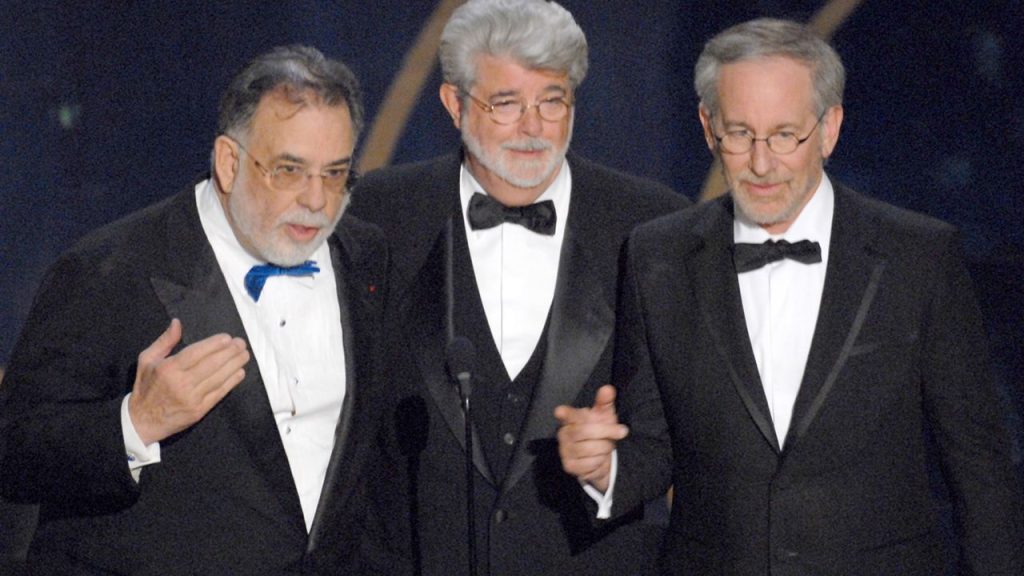
‘The Last Kings of Hollywood: Coppola, Lucas, Spielberg, and the Battle for the Soul of American Cinema’ by Paul Fischer
“Paul Fischer’s compulsively readable account of how Francis Ford Coppola, George Lucas, and Steven Spielberg changed the world of moviemaking isn’t just a group biography,” said Chris Vognar in The Boston Globe. “It’s also a collage of art, commerce, and ego, set against what became a new age of Hollywood blockbusters—an age that this trio did much to create.” As the 1960s turned to the ’70s, the trio were little more than “brazenly confident” kids eager to make their own movies, with the older Coppola having a slight head start. By 1971, the three were friends and allies. By 1977, they had found paths within a changing industry to making three market-altering hits: The Godfather, Jaws, and Star Wars. Fischer’s story of how each got there raises a question that matters in any such field: “What does it mean to sell out?”
“Fischer shrewdly analyzes his trio’s individual temperaments,” said Wendy Smith in The Washington Post. In 1969, the manic dreamer Coppola partnered with the loner Lucas to create American Zoetrope, a production company that was supposed to break free of cinematic norms. Lucas shared Coppola’s dream of escaping Hollywood’s restraints, but he was prioritizing money when he pushed Coppola to say yes to directing The Godfather. Meanwhile, his love of comic books and old movie serials made him a more natural partner with Spielberg, with whom he eventually co-created the Indiana Jones franchise. Lucas’ priorities changed after he made Star Wars. Fischer depicts him as becoming the kind of profit-focused producer he once despised. Coppola, in turn, is depicted as erratic and self-indulgent. Yet “there are no simple people in The Last Kings of Hollywood,” Fischer’s “smart, juicy” account of a transitional moment in American filmmaking.
“At times, one wishes for more characters,” said Alexander Larman in The Spectator (U.K.). Some of the larger-than-life figures of the era, including Martin Scorsese and Brian De Palma, are “relegated to entertaining walk-on appearances.” But by focusing on Coppola, Lucas, and Spielberg as a trio, Fischer “derives a fresh idea from a period that has already been exhaustively studied,” said Michael O’Donnell in The Atlantic. Instead of showing us that lone visionaries can sometimes triumph, Fischer’s account “demonstrates the evergreen value of collaboration.” Though at times the three “fought bitterly,” they made up easily, provided one another with financial support and constructive criticism, and inspired one another to make better films. The title of Fischer’s book suggests that American moviemaking will never have another era as rich as these three knew. But today’s ambitious young filmmakers should read the book differently. “Perhaps the artistic fraternity of the ’70s is not a relic but a model.”
‘The Boundless Deep: Young Tennyson, Science, and the Crisis of Belief’ by Richard Holmes
Richard Holmes “specializes in seeing familiar figures from a new slant,” said Suzi Feay in the Financial Times. In his new book, the British biographer blows the dust off Alfred, Lord Tennyson, helping us see Queen Victoria’s favorite poet as “a dashing, compelling, mysteriously conflicted figure.” Tennyson, after all, didn’t reach national-treasure status, or have the money to marry, until past 40. Before then, he struggled not just to make a living but also to cope with the scientific discoveries of the era that upended prevailing beliefs in humanity’s centrality in the universe.
Until his 1850 artistic breakthrough, Tennyson “seemed doomed to loneliness, doubt, and willful eccentricity,” said Catherine Nicholson in The New York Times. Born in 1809 as the third child of 11, Britain’s future poet laureate was raised by a brutal and unstable clergyman father. Tennyson escaped by attending Cambridge, where he found his first true friend in the dashing Arthur Hallam, who died suddenly at 22 on a trip abroad. Immediately, Tennyson began writing elegies to his friend, which grew across nearly 20 years into In Memoriam, the 133-poem collection that won the poet his fame. By focusing on the man who wrote that work, The Boundless Deep “invites us to appreciate the remarkable fruits of his protracted estrangement.”
Unfortunately, the book’s Tennyson “remains an elusive figure,” said Kathryn Schulz in The New Yorker. And Holmes is “almost mute on an obvious question: Was Tennyson in love with Arthur Hallam?” While it’s “lovely” to read Holmes’ commentaries on Tennyson’s verse, he seems too fixated on the poet’s deep engagement with the era’s science and with the implications of such discoveries as Earth’s relative insignificance, the planet’s vast age, and the rise and extinction of its dinosaurs. Still, Holmes writes about the resulting crisis of faith “with such sympathy that even his most secular-minded modern readers feel the shock of finding oneself alone and unloved in a godforsaken universe,” said Lucy Hughes-Hallett in The Guardian. And when Holmes loves a poem, “he writes about it with a wonderful capacity for noticing every pulse of meter, every flicker of nuance.”
Exploring the lives and legacies of three Hollywood icons and learning what made Alfred, Lord Tennyson tick