‘Chosen Land: How Christianity Made America and Americans Remade Christianity’ by Matthew Avery Sutton
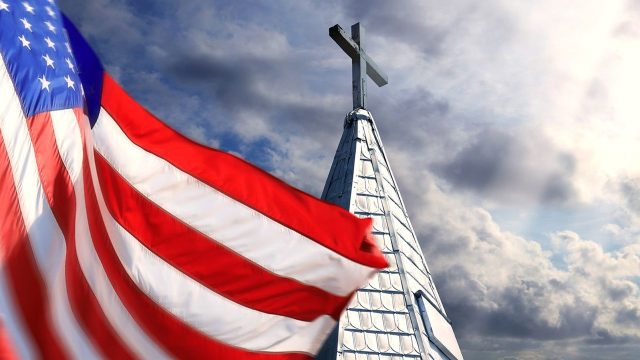
As our country nears its 250th anniversary, “the time is right” for a sweeping new history of Christianity’s role in our national story, said Heath W. Carter in The Atlantic. Matthew Avery Sutton, a historian at Washington State University, begins his account with the arrival in the Americas of European explorers and missionaries more than 500 years ago, and his book “argues convincingly that the quest for Christian America is a perennial national obsession.” Though the U.S. often presents itself as a secular nation, Sutton points out that nearly two-thirds of U.S. citizens today identify as Christians. He also declares, “a bit too boldly,” that the history of American Christianity is the history of America and vice versa. Still, “there is no doubting Christianity’s centrality to U.S. history, for better and for worse.” Sutton, to his credit, is alert to both effects.
First, he identifies four main streams of American Christianity, said Brenda Wineapple in The New York Times. In his taxonomy, “conservatives” are practicing Christians who want little from the state but to be left alone to worship. He uses the label “revivalists” to describe evangelical Christians, who by definition seek to spread their faith. Sutton’s “liberals” value religious pluralism while his “liberationists,” consisting largely of Black churchgoers, promote a form of Christianity that demands justice for the oppressed. But while he “celebrates the vitality of American Christianity,” the “nub” of his argument is that this vitality is a product of a largely nominal separation of church from state that empowered, in his words, an “unofficial, Protestant-infused establishment.” That argument feels paranoid, and “diminishes the very real contribution of the First Amendment to the nation.”
Though Sutton “tries to be fair to each of his subjects,” said Daniel K. Williams in Christianity Today, his sympathies are clearly with America’s marginalized, and the “revivalists” in his account “appear to be agents of oppression.” Because his focus is on the intersection of Christianity and political power, he also says little about the particulars of American Christian teachings and how they’ve impacted people on an individual basis. Still, Chosen Land is the first book since Sydney Ahlstrom’s 1,100-page A Religious History of the American People, published in 1972, to attempt such a comprehensive survey. Sutton’s “superbly written” work manages to cover “an enormously wide range of material” in half as many pages. Better yet, it’s so full of colorful story-telling that it’s “the type of popular work you can read on a plane or a bus.”
‘Kids, Wait Till You Hear This!’ by Liza Minnelli
“There are a lot of extravagant emotions in Kids, Wait Till You Hear This!” said Joanne Kaufman in The Wall Street Journal. That’s to be expected from Liza Minnelli, daughter of the gifted but deeply troubled Judy Garland. Minnelli became a star in her own right before she reached her 20s and embarked on a string of addictions, affairs, and marriages. But in her new memoir, she’s most compelling when writing about her early adolescence, when she was policing her mother’s addictions while feeding her pills to keep her functioning. Once Minnelli frees herself at 16, “the book devolves into a standard, frequently repetitive blend of triumph and trial,” and while Minnelli is admirably candid about her own addictions, it’s “a bit Liza with a zzzzz.”
To me, Minnelli’s memoir is “surprisingly cohesive and spry,” said Fiona Sturges in The Guardian. Importantly, “it captures Minnelli’s voice, which combines showbiz luvviness with winning vitality.” Recounting her quick rise to screen, stage, and recording stardom, she “gleefully” labels herself “the original nepo baby,” conceding the edge she had as the daughter of Garland and the great screen director Vincente Minnelli. Liza “revels” in her career highs, including her four Tonys and her Oscar for 1972’s Cabaret. And though she also eventually details passing out drunk on a New York City sidewalk, “the most eyebrow-raising material concerns her tumultuous love life.” She calls her fourth husband “a pasty-faced jerk” and refuses to apologize for her youthful cheating, when the lovers she juggled included Peter Sellers, Martin Scorsese, Desi Arnaz Jr., and her first two husbands.
“I’m not sure the story I absorbed is the story Liza wanted to tell,” said Sam Wasson in Air Mail. “Or maybe I got it perfectly”: that since suffering maternal neglect, she has been constantly running from herself. “Is it all those lost decades of drink and drugs that account for the Wikipedia-like blandness of her memories?” That could be, though it’s also possible that when she describes her mother dying at 47 from an overdose and attributes the death to Garland’s having “let her guard down,” she’s provided us a different clue. “Suffice to say, Liza is not about to repeat her mother’s mistake.”
The role of Christianity in America and Liza Minnelli tells (somewhat) all