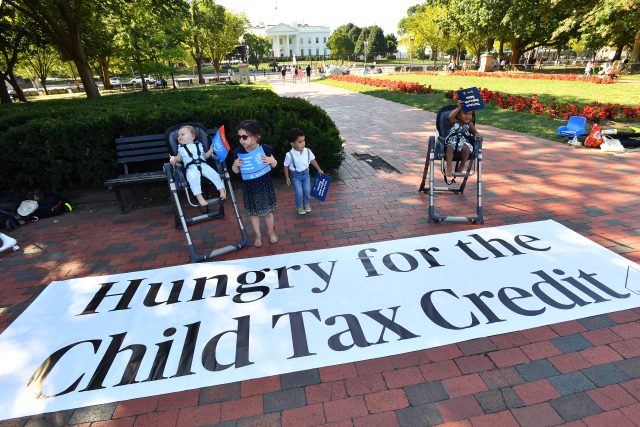
Congressional negotiators on Tuesday unveiled their long-awaited tax package that would ease burdens on small businesses while expanding the popular child tax credit program that has been widely lauded for helping dramatically cut child poverty rates in the United States.
The proposal, hammered out by chief negotiators Sen. Ron Wyden (D-Ore.) of the Senate Finance Committee and Rep. Jason Smith (R-Mo.) of the House Ways and Means Committee, is a “commonsense, bipartisan, bicameral tax framework” the pair announced in a press release touting the agreement. In addition to expanding the child tax credit, the proposal would “lift the tax credit’s $1,600 refundable cap and adjust it for inflation,” NBC News reported, citing analysis from the Center on Budget and Policy Priorities which estimated that, once fully in effect, the expansion would “lift some 500,000 or more children above the poverty line” while benefiting some 5 million children in total.
The proposal, totaling approximately $78 billion, would be funded by “reining in” the pandemic-era “employee retention tax credit” that’s become a “hotbed of abuse,” according to The New York Times, which called the deal a “rare bipartisan agreement spanning both chambers.” In his press release, Wyden acknowledged as much, saying that “given today’s miserable political climate,” the agreement is an especially “big deal.”
Wyden also vowed to “pull out all the stops” to ensure the package passes in time for the upcoming tax filing season.” Whether that will happen, however, “remains to be seen,” The Hill cautioned. In particular, the Republican-led House is dealing with “issues related to government funding and the border, as well as an extraordinarily tight timeline” to pass the tax proposal ahead of the Jan. 29 start to tax filing, Politico reported.
The deal, which essentially trades easing business tax credits for expanding the childhood tax program, means “the Ds are getting some things that they want to work on,” while “Republicans are getting things they want to work on,” Florida Republican Rep. Greg Steube told The Wall Street Journal. The proposed package would expire in 2025, alongside “other major pieces of the 2017 tax law, which also lapse then.”
Congressional negotiators have unveiled their nearly $80 billion tax plan — now they have to pass it.