From Antony and Cleopatra to Burton and Taylor, history is filled with volatile relationships.
One might expect some circumspection from politicians about their personal ups and downs playing out in the public arena. But in an era of geopolitical instability and terminal online-ness, the rest of us can barely keep up.
Break-ups
Elon Musk and Donald Trump
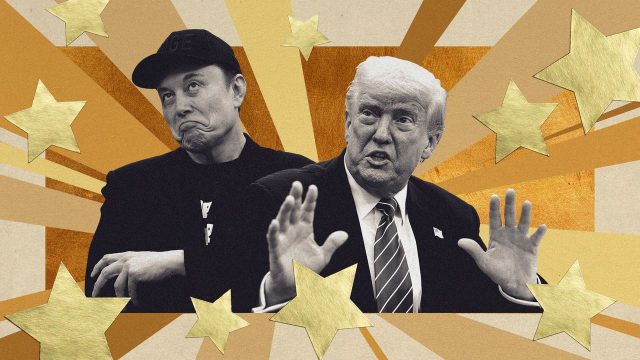
It was “perhaps the most widely predicted break-up in American political history”, said Fortune. The “bromance” between Elon Musk, the world’s richest man, and Donald Trump, one of the most powerful, ended in very public acrimony.
The Tesla and X boss was initially known as the US president’s “first buddy” for his seemingly unparalleled access. Musk helped bankroll Trump’s return to the White House, and claimed after his election victory that he loved Trump “as much as a straight man can love another man”. But after taking a chainsaw to the federal government with his “cost-cutting” initiative, DOGE, Musk left the administration in May. Just days later, he urged Republicans to reject Trump’s “massive, courageous, pork-filled” tax bill, which he called a “disgusting abomination”.
After that, the “speed of the fallout was breathtaking”, said The New York Times, and “every bit as lowdown, vindictive, personal, petty, operatic, childish, consequential, messy and public as many had always expected it would be”.
Jeremy Corbyn and Zarah Sultana
After leaving the Labour Party in high dudgeon in July, Zarah Sultana attempted to set up a new left-wing grassroots party with now-independent MP Jeremy Corbyn. But the duo couldn’t even decide on the name, much less anything else.
Corbyn claimed Sultana had set up a paid membership system that collected money and data without proper approval and authorisation. Sultana claimed she had been frozen out by a “sexist boys’ club” of Corbyn and four pro-Gaza independent MPs. The pair had a bitter falling out that saw Sultana claiming she had consulted libel lawyers. She later rescinded the threat, and told Sky News that they were like Liam and Noel Gallagher, the famously feuding Oasis brothers who patched things up for their reunion tour.
However, she neglected to invite Corbyn to a rally due to take place on the eve of the (what is now known as) Your Party conference. Don’t look back in anger, indeed.
Keir Starmer and Angela Rayner
Angela Rayner was once seen as the future of the Labour Party – and possibly its future leader. But this summer she became embroiled in controversy after admitting that she had mistakenly underpaid stamp duty on a flat in Hove. Keir Starmer initially stood by his deputy, but the noise grew louder and she was nicknamed “three pads” Rayner.
Rayner referred herself to the independent ethics adviser, and after being found to have breached the ministerial code, she handed in her resignation, plunging Labour into a chaotic deputy leadership race and cabinet reshuffle. Starmer’s response to her resignation letter was ostensibly warm: “You have been a trusted colleague and a true friend for many years.”
But now the rumour mill is once again stirring that Rayner might be gunning for his job. She declined to rule out running for the party leadership if Starmer finds himself defenestrated, telling the Daily Mirror in her first big post-resignation interview that she had “not gone away”. (Neither has her bill: she has reportedly not yet paid her £40,000 stamp duty as HMRC has not sent the bill out.)
Make-ups
UK and EU
One of the most acrimonious break-ups in recent history must surely be Brexit. But this year, there’s been something of a warming in relations between the EU and its erstwhile member, the UK. (The UK, after all, still benefits from EU funds.)
In May, the government and the bloc held their first joint summit since the UK left the EU, and the word on everyone’s lips was “reset”. The former foes agreed on a new deal; Starmer hailed it a “new era”. Not everyone was on board with this make-up: Tory leader Kemi Badenoch called the deal a “total sell-out”.
This month, Labour announced that a new agreement with Brussels to allows UK students to participate in the EU-wide university scheme Erasmus from 2027.
Emmanuel Macron and Sébastien Lecornu
Speaking of rapprochement, French President Emmanuel Macron asked Sébastien Lecornu to return as prime minister just four days after he stood down.
The Élysée Palace said the president had tasked Lecornu with “forming a government” – no easy task in France, given its grande debt problem – and Macron’s entourage “indicated he had been given ‘carte blanche’ to act”, said the BBC.
Lecornu is now aiming his ire elsewhere, blaming “partisan cynicism and presidential ambitions” for his struggle to get next year’s budget plans approved, said Politico. “Everyone wants to push their own agenda and fly their ideological flag,” he said, in remarks that “bore a distinct similarity to those after his surprise resignation”.
Narendra Modi and Xi Jinping
When Xi Jinping met Narendra Modi in September, the Chinese leader used “his favourite catchphrase for China-India relations”, said the BBC: “The dragon and the elephant should come together.”
The relationship between the two most populous countries has been strained for decades, but the Asian giants have taken huge steps to normalise relations. This year, that thawing was “turbocharged by decisions taken thousands of miles away in Washington DC”, when the Trump administration imposed 50% tariffs on Indian imports: a “stunning onslaught from a trusted ally”.
After the September meeting – Modi’s first trip to China in seven years – direct flights between the “dragon and the elephant” resumed, and the visa process was simplified. Their thousands of miles of shared borders are still tense, bristling with troops from both countries. But what relationship doesn’t have boundary issues?
From Trump and Musk to the UK and the EU, Christmas wouldn’t be Christmas without a round-up of the year’s relationship drama