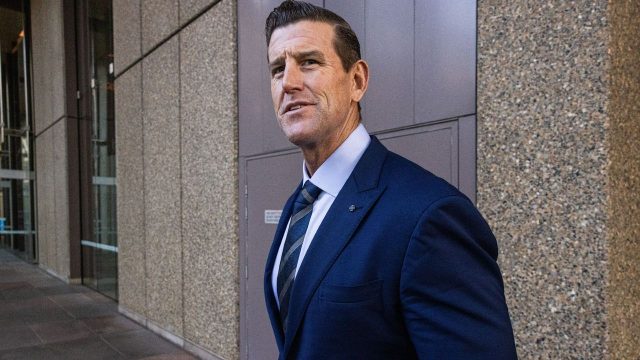
He was once celebrated as Australia’s “uber-soldier”, said Michael Bachelard in The Sydney Morning Herald. Ben Roberts-Smith, a towering 6ft 7in corporal in the Special Air Service Regiment (SAS), had a “bulging chest full of medals” by the time he returned from his sixth tour of Afghanistan in 2012, including the Victoria Cross, for his bravery against the Taliban.
Australia’s most-decorated living soldier was soon very much in the public eye: there was a display devoted to him in the Australian War Memorial’s Afghanistan gallery; he was named “father of the year” in 2013; he even attended the funeral of Queen Elizabeth II in 2022.
However, for years, war reporters had heard “whispers” about his conduct. And from 2018, Roberts-Smith was dogged with allegations of war crimes. Five years later, he lost a defamation case against three newspapers that had alleged that he was involved in unlawful killings in Afghanistan.
Now, so many years on, he has been arrested, said Ben Smee in The Guardian – an episode that “has cut deeply to the core of the Australian psyche”. Roberts-Smith now sits on remand in Sydney’s Silverwater prison, having been charged with five counts of the war crime of murder, dating from 2009 to 2012. If convicted, the 47-year-old faces life imprisonment.
‘Trial by media’
“The wheels of justice are famously slow to turn,” said The Age (Melbourne), “but even by their standards, 17 years is a long time to wait.”
It was in a place known as Whiskey 108, in Uruzgan province, on Easter Sunday in 2009 that Roberts-Smith – who maintains his innocence – is alleged to have shot a detained Afghan man at point-blank range. The victim’s prosthetic leg was reportedly removed as a trophy of war and used as a beer-drinking receptacle by Australian troops. Then, in September 2012, Roberts-Smith is said to have kicked a handcuffed man off a cliff in the village of Darwan, before ordering one of his subordinates to execute him, in a “blooding” ritual.
These accusations have been tested in court before, to a civil standard of proof, when a judge determined that on the balance of probabilities, he had committed murder. His former comrades testified against him; incriminating photos, found hidden in his garden, were shown in court. Unfortunately, there may be many more such cases to come. A judicial report in 2020 found credible evidence that Australian servicemen had played a role in the deaths of 39 Afghan non-combatants in 23 incidents.
For too long, Roberts-Smith and other veterans have been subjected to “trial by media”, without “the opportunity for a fair response”, said Martin Hamilton-Smith in The Daily Telegraph (Sydney). So it’s good that he will finally have his day in court, when the claims against him will be properly tested.
Beyond reasonable doubt
Roberts-Smith is of course innocent until proven guilty, said Andrew Bolt in the Herald Sun (Melbourne). Criminal courts need to find defendants guilty beyond all reasonable doubt. Yet it is shocking that so many public figures – the former PM Tony Abbott, the right-wing senator Pauline Hanson, the country’s richest person, Gina Rinehart – have leapt to his defence, as if it’s the “patriotic thing” to do. They claim that “a war hero is being persecuted by woke civilians judging soldiers in battle from the comfort of their sofas”. This is completely wrong. Alleged crimes of this magnitude cannot go uninvestigated.
What makes the Roberts-Smith case “extraordinary” is that prosecutors do not have any of the evidence they would normally need for this kind of case, said The Australian (Sydney): forensics from the crime scene, contemporaneous witness statements. It will be a test for the legal system, in the full glare of the media. But Australians should maintain confidence in due process, and refrain from jumping to conclusions by either damning Roberts-Smith or excusing him. The claims must be heard in full. The rule of law is a “core” Australian value, and even our heroes are not beyond its reach.
After 17 years, court to hear case that ‘has cut deeply to the core of the Australian psyche’