
By Turneffe Atoll Trust:
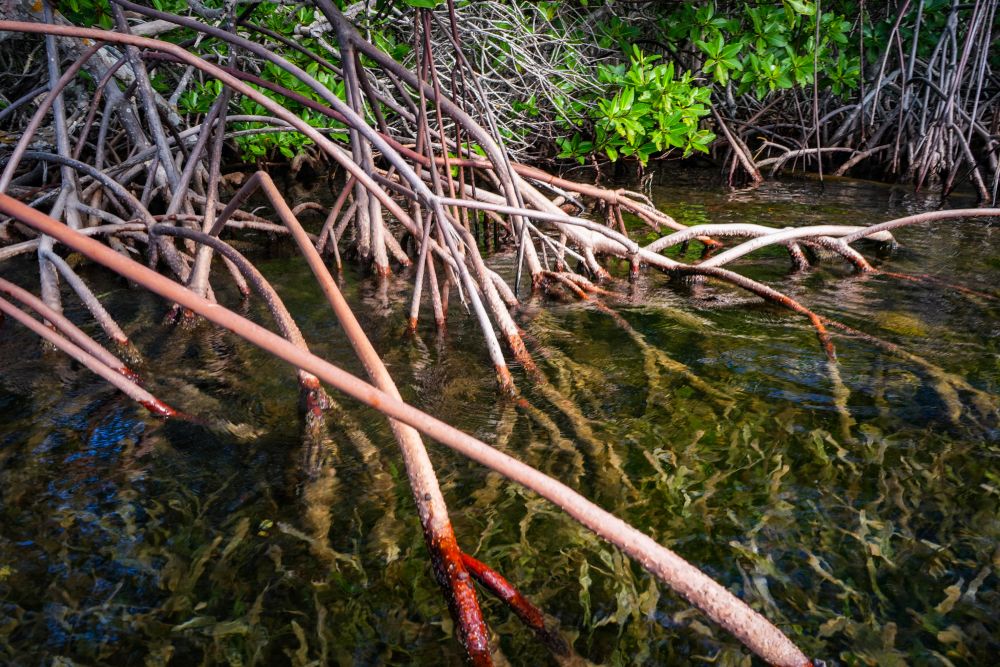
Walk along any stretch of Belize’s coast, and you’ll see them: roots like stilts, leaves shining in the sun, small fish darting in and out. Mangroves are the backbone of our marine environment—and Belize has lots of them.
We know they protect our shores and sustain our fisheries, but scientists are now revealing something even more powerful: mangroves are among the planet’s most effective natural systems for trapping carbon pollution and storing it safely for centuries. This stored carbon is called blue carbon, and it turns out to be critical in the fight against climate change. This creates economic value for mangroves and seagrasses and is another reason these habitats are so important to Belize.
What Is Blue Carbon?


Blue carbon refers to the carbon absorbed and stored by coastal ecosystems—mainly mangroves, seagrasses, and salt marshes. Unlike forests, which store carbon mostly in wood and leaves, mangroves lock most of their carbon deep underground in their soils.
Once buried, that carbon can remain stored for hundreds or even thousands of years—as long as the mangroves and seagrasses are not damaged or destroyed.
Scientists estimate that mangroves can store three to five times as much carbon as land-based forests, showing that their value extends far beyond storm protection and fisheries nurseries.
For a small, climate-vulnerable country like Belize, that’s huge. Our ecosystems are working overtime to help slow global warming, and this also represents a significant economic opportunity for the country.
What Belize’s Latest Blue Carbon Data Shows
In 2023, Belize completed its first national assessment of mangrove carbon stocks—a major step toward understanding how much climate-saving carbon our mangroves hold.
The results confirmed what many conservationists suspected: Belize’s mangroves are enormous carbon sinks, storing carbon not just in their trees but especially in their soils.
The study also found that:
- Belizean mangroves face pressure from destructive development such as dredging, particularly around popular coastal areas like Ambergris Caye, Caye Caulker, Placencia, and Turneffe.
- From 2014 to 2019, Belize lost 94 hectares of mangroves—roughly two-thirds the size of San Pedro Town.
- The majority of stored carbon is in the soil, meaning that when mangroves are cleared or seagrasses are dredged, carbon is released back into the atmosphere, worsening climate change.
Mangroves at Turneffe: A Carbon Powerhouse


Turneffe Atoll, one of Belize’s ecological jewels, is particularly rich in blue carbon. According to a study on Turneffe’s ecosystem value, the atoll contains 6,475 hectares of mangroves, representing 9% of all mangroves in the country.
These mangroves store large amounts of carbon, while seagrass beds—covering more than 36,000 hectares—may eventually add even more to Belize’s blue carbon accounting as research progresses. Studies suggest that Turneffe’s mangroves and seagrass beds may be worth millions of dollars to Belize.
What is clear is that protecting Turneffe’s mangroves and seagrass does more than support fishers, tour guides, and coastal communities. It helps the planet—and in the near future, it may provide major financial benefits for Belize.
Why This Matters for Belize’s Future
Belize is already feeling the impacts of climate change, including stronger storms, unpredictable rainy seasons, and coastal erosion. Mangroves and seagrass beds are our frontline protection.
Blue carbon research also shows that these ecosystems are quietly performing climate work of global importance—work that the world is beginning to recognize and for which Belize may soon be able to benefit financially. This is being addressed through the Climate Change and Carbon Markets Initiative Bill.
As Belize continues shaping its National Carbon Strategy and updating its commitments under the Paris Climate Agreement, blue carbon data will help the country to:
- Protect mangroves and seagrass beds
- Identify priority areas for restoration
- Strengthen conservation laws
- Support landowners who choose to protect mangrove forests
- Create financial incentives for maintaining healthy ecosystems
Belize has revived its national mangrove monitoring team, and protections under the Forest (Protection of Mangroves) Regulations must be strengthened and enforced. This work ensures that our blue carbon stores remain intact—not only for climate goals, but also for fisheries, tourism, coastal livelihoods, and Belize’s financial future.
Belize’s Mangroves: Nature’s Quiet Climate Heroes
Belize faces some of climate change’s harshest impacts. Protecting our mangroves and seagrass beds is one of the most effective local actions we can take—not only for ourselves, but for the global climate.
Mangroves are not just scenery.
They are defenders of our coast, nurseries for our fisheries, and a potential major financial resource for the country.
The more we understand their value, the better we can protect them.
The post Belize’s Hidden Climate Treasure: Why Mangrove & Seagrass “Blue Carbon” Matters More Than Ever appeared first on Belize News and Opinion on www.breakingbelizenews.com.
By Turneffe Atoll Trust: Walk along any stretch of Belize’s coast, and you’ll see them: roots like stilts, leaves shining in the sun, small fish darting in and out. Mangroves are the backbone of our marine environment—and Belize has lots of them. We know they protect our shores and sustain our fisheries, but scientists are
The post Belize’s Hidden Climate Treasure: Why Mangrove & Seagrass “Blue Carbon” Matters More Than Ever appeared first on Belize News and Opinion on www.breakingbelizenews.com.