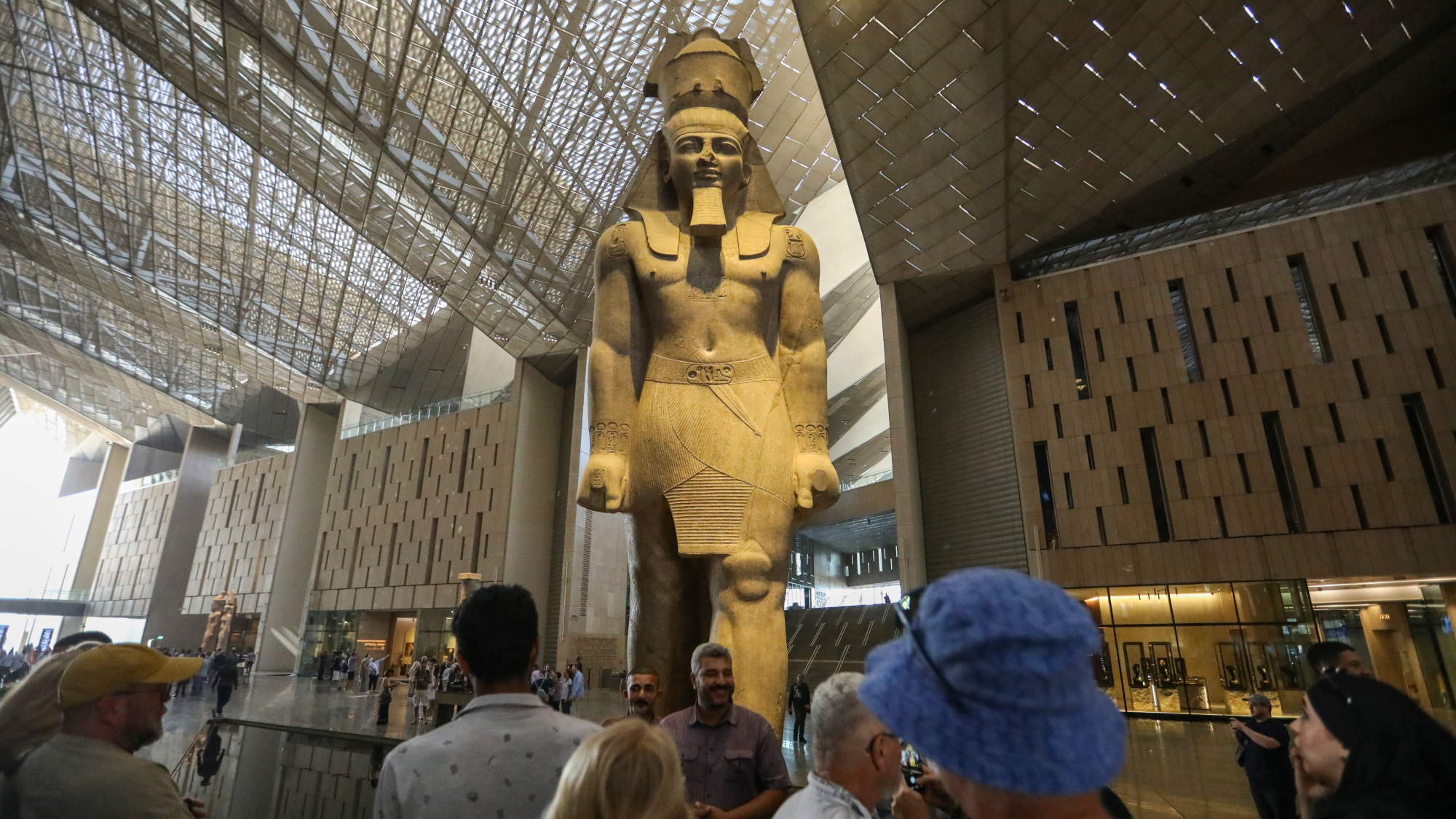
After 20 years under construction, the Grand Egyptian Museum officially opened to the public last month. Located nine miles from central Cairo, and just a mile from the pyramids at Giza, the complex covers some 5.4 million square feet – making it the largest archaeological museum in the world – and cost an estimated $1.2 billion (£888 million).
Read on for more on the milestone museum, as well as the other big stories in the arts world in 2025.
Gift to the world
At its grand opening (which had been repeatedly delayed owing to revolutions, economic crises and the pandemic), President Sisi described the museum as “a gift from Egypt to the world”. Its 12 galleries hold some 100,000 artefacts covering seven millennia of Egyptian history, from pre-dynastic times to the Roman era.
The showstoppers include a monumental, 30ft-tall statue of Ramesses II (pictured above), dating to around 1200BC, and the entire contents of King Tutankhamun’s tomb, about 5,500 pieces, some of which have never been seen in public before. Of equal interest to many, however, are the exhibits shedding light on the daily lives of ancient Egyptians – from statues of bakers at work to hi-tech displays that bring ancient images of hunters and farmers to life. As an added bonus, the building’s huge windows offer astonishing views of the pyramids.
The museum is expected to attract five million visitors a year, giving Egypt’s tourism industry a much-needed boost; and its opening has already led to renewed calls for the repatriation of Egyptian artefacts held in public collections abroad – including the Rosetta Stone, at the British Museum.
Looted art
An 18th-century portrait stolen by the Nazis 80 years ago was found in Argentina this autumn – thanks to the dogged efforts of a retired Dutch systems specialist. It all started in 2010, when Paul Post read in his father’s wartime diaries about the confiscation of the Netherlands’ diamonds. Intrigued, he started to investigate, and homed in on Friedrich Kadgien – a Nazi official who was also suspected of having looted art.
Working with Dutch reporters, Post discovered that Kadgien had fled to Argentina after the war, and that his daughter still lived there. She did not engage with them, but this year, she put her house on the market – and in the estate agent’s photos, reporters spotted a missing portrait by Giuseppe Ghislandi hanging above her sofa. It is now in the hands of the authorities, pending its likely return to the heirs of the Jewish dealer from whom it was stolen.
Protest art
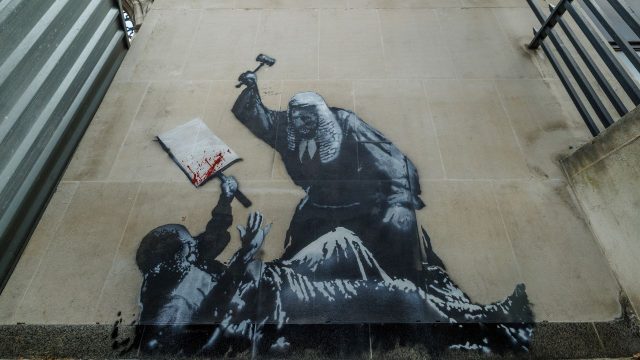
Banksy confirmed that he had struck again in London in September, after an image (pictured top) of a judge beating a protester with a gavel appeared on an exterior wall at the Royal Courts of Justice.
The stencil was presumed to be referring to the banning of the Palestine Action group, and the arrest of hundreds of its supporters. Security guards swiftly covered up the Banksy, and it was later removed. Officials said they’d had no choice as the building is listed. Legal experts pointed out that British judges don’t make the law, they just interpret it, and that they don’t use gavels.
Sold, at record-breaking prices
Global art sales fell a further 12% in 2024, to $57.5 billion (£42.5 billion), as geopolitical tensions continued to affect the top end of the market. And in the first half of this year, sale results from the leading auction houses were down again, and more major private galleries closed. But in the autumn, there were signs of a rebound.
In September, Pauline Karpidas’ surrealist collection sold for $100 million (£74 million) at Sotheby’s in London, nearly double its estimate; and in November, Sotheby’s New York sold 24 paintings from the collection of the late Leonard Lauder for $527 million (£393 million). The highlight of the sale was Gustav Klimt’s life-size “Portrait of Elisabeth Lederer” (pictured below), a young woman who was the daughter of one of Klimt’s most important patrons. The Lederers were Jewish, and to avoid Nazi persecution following the Anschluss, Elisabeth claimed that Klimt, who’d died in 1918, was her biological father.
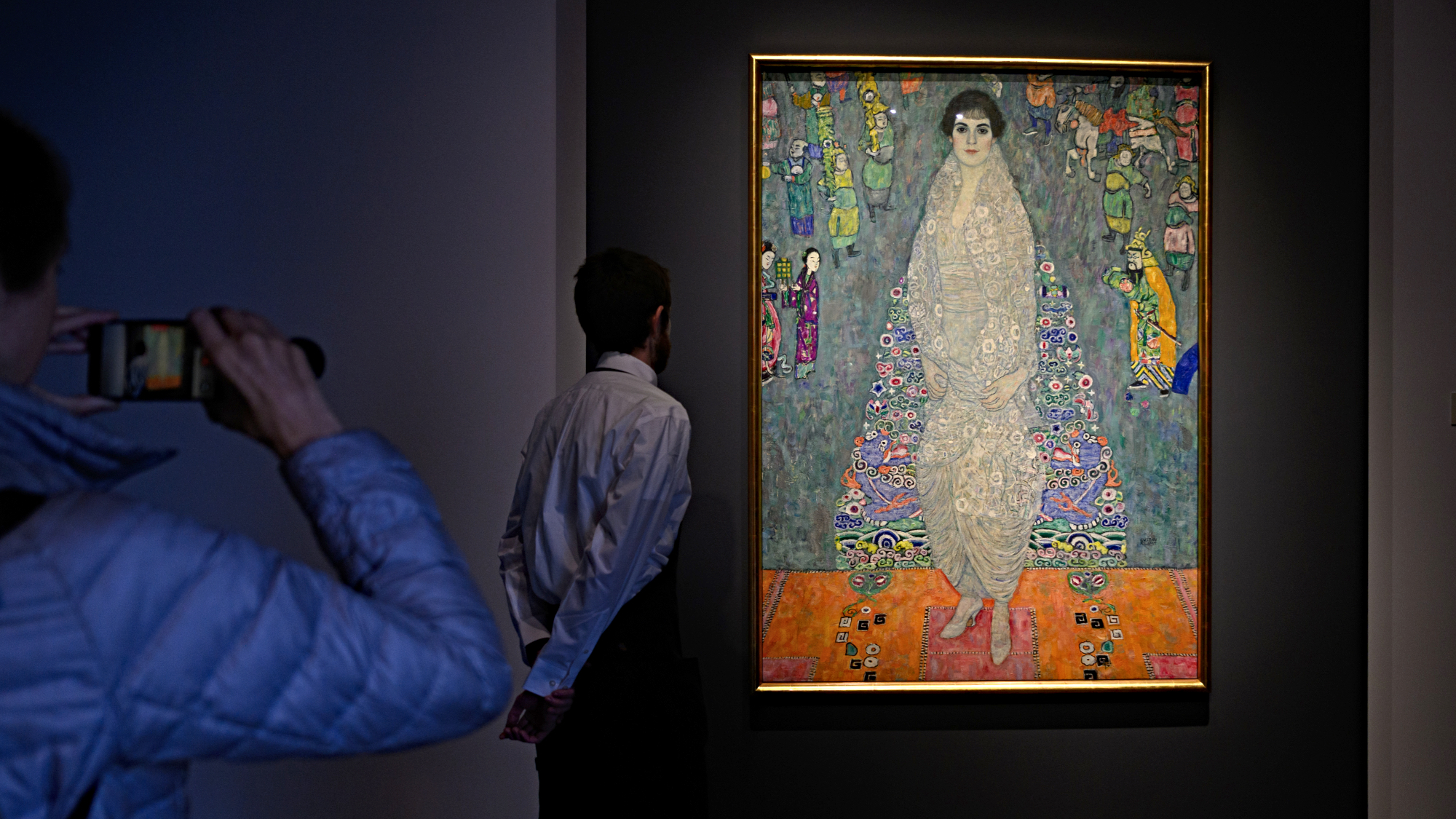
This tactic saved her life, and also saved the painting: it meant that it was kept in Vienna, to await reclassification as Aryan art (as opposed to degenerate art), when the Nazis sent the rest of her parents’ priceless collection out of the city. Believed to have included at least 10 Klimt paintings, the Lederer collection was held at the Schloss Immendorf – and was destroyed when SS troops set fire to the castle at the war’s end. The surviving portrait sold for $236 million (£176 million), the highest price ever paid at auction for a modern work, and the second-highest for any work.
Leonard Lauder, the son of Estée Lauder and the former CEO of the cosmetics giant, was a great art collector and philanthropist. In the years before his death in June, aged 92, he gave $1 billion (£742 million) worth of cubist art to the Metropolitan Museum of Art in New York, and millions to the Whitney Museum of American Art. His collection helped Sotheby’s to hit $706 million (£569 million) in sales that night, the biggest haul in its 281-year history. Days later, the auction house notched up another record, when it sold Frida Kahlo’s surrealist self-portrait “The Bed (The Dream)” for $55 million (£41 million), smashing the 2014 record for a female artist at auction ($44 million, around £32 million, set by a Georgia O’Keeffe).
The hammer price, however, was not a surprise: surrealist works by female artists are currently highly sought after, and “Kahlomania” has lately reached new heights, with numerous major exhibitions around the world dedicated to the Mexican artist. Sotheby’s had given the 1940 painting an upper estimate of $60 million (£44 million).
Year of Turner
If 2025 belonged to anyone in the art world, it was J.M.W. Turner. The artist was born in April 1775, and his 250th anniversary was marked by events all over the UK. Most have closed, but in Liverpool the Walker Gallery’s “Turner: Always Contemporary”, exploring Turner’s work and its impact on later artists, runs until February, while Tate Britain’s “Turner & Constable: Rivals & Originals”, which features “The Burning of the Houses of Lords and Commons”, on loan from a gallery in the US, runs until April. And the Turner Contemporary in Margate has his oil sketch “Waves Breaking on a Lee Shore at Margate” on loan from Tate Britain, also until April.
Forgery factory
Italian police raided a clandestine workshop in the northern outskirts of Rome in February, where paintings falsely attributed to the likes of Picasso, Rembrandt and Jean Cocteau were being churned out, allegedly for sale online.
Officers from a specialist art unit found some 70 paintings in the workshop, as well as hundreds of tubes of paint, brushes, forged stamps from historic private galleries, and a typewriter that appeared to have been used to create fake letters of authenticity.
The property reportedly belonged to an art restorer, who was suspected of being behind the enterprise. Police said the suspect had sold “hundreds” of paintings of dubious authenticity on auction sites such as Catawiki and eBay.
From a short-lived Banksy mural to an Egyptian statue dating back three millennia