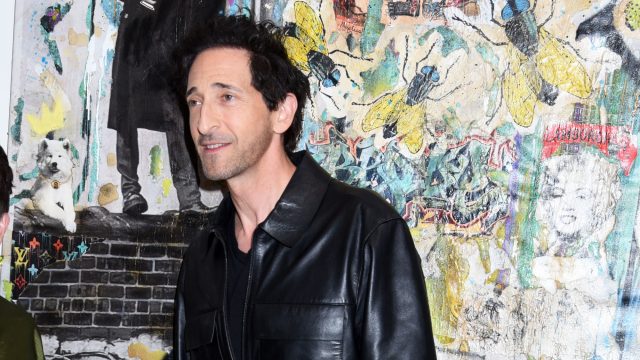
Forgive me for adding to the undue attention that Adrien Brody’s current gallery show is receiving, said Alex Greenberger in ArtNews. Unfortunately, “I can’t stop thinking about how bad this art is.” The two-time Oscar winner is exhibiting nearly 30 paintings that are visually ugly and thematically “about as subtle as a sledgehammer.” A Queens, N.Y., native, Brody has adopted a “faux naïve aesthetic” that evokes the hectic city of his 1980s youth. His collage-like canvases juxtapose images of cartoon characters and weapons, with graffiti-like streaks of paint partially obscuring newspaper clippings and other detritus of our visual culture. Nothing that he attempts “adds any nuance to his commentary on the American zest for carnage.” And in several works, he makes “cringeworthy” allusions to ’80s art star Jean-Michel Basquiat, nominating himself as a spiritual heir.
Last month, a Brody painting sold for $425,000 at a benefit auction in France and instantly “became a source of mockery online,” said Rachel Sherman in The New York Times. The derivative, Andy Warhol–inspired image centers a blue-eye-shadowed Marilyn Monroe against a muddled background featuring the letters of the Hollywood sign. Critic Annie Armstrong had recently revived the phrase “red-chip art” to describe work that celebrates styles that were once considered tacky and that fetch blue-chip prices from a new breed of collectors. The Eden Gallery show prompted her to label Brody an avatar of the trend. “The only difference between Brody’s efforts and any garden-variety red-chip artist is how often he peppers in his own visage,” said Annie Armstrong in Artnet. “It’s kind of an interesting move. Red-chip art relies on celebrity iconography, so it’s intriguing to see a cutout of Brody himself plastered to a canvas with an outsize Basquiat crown painted over his head. He understands the canon.”
In a twisted way, “Made in America might be one of the most significant shows of the past 10 years,” said gallerist KJ Freeman in her Substack newsletter. “Not because it’s groundbreaking,” but because it makes clear that the market for fine art is not a mechanism for identifying and celebrating talent. The system was “never built to recognize anything outside the glow of celebrity, money, and myth.” Usually, it’s a celebrity buyer that lifts an artist’s market value. Brody brings the celebrity buzz himself, and shouldn’t be faulted for that. As the son of celebrated photographer Sylvia Plachy, he has probably dreamed of making memorable art for decades, and now he has won the market’s blessing. “In a broken game, Adrien Brody is a great artist. Maybe that’s what pisses everyone off the most.”
Eden Gallery, New York City, through June 28