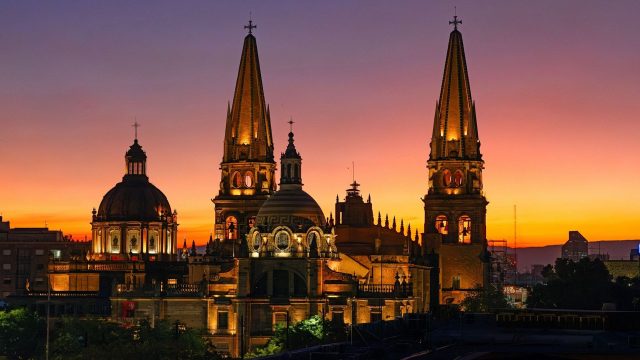
Jalisco is the arid, sun-blasted western state of Mexico, where mariachi music, tequila and charrería (the national equestrian sport) originated. Some of the country’s best- known writers, artists and actors were born here, too – and nowhere better embodies the state’s character than its capital, said Michael Snyder in Condé Nast Traveller.
Home to more than five million people, Guadalajara is a “gleefully chaotic” and “famously hedonistic” city that lacks the “stage-set perfection” of Puebla or Oaxaca, owing partly to the depredations of 1950s city planners. But Mexico’s second city still has an “offhand elegance”, many magnificent buildings, and rich traditions of gastronomy and craftsmanship.
The city’s greatest sight is perhaps the Hospicio Cabañas, an early-19th-century orphanage with a chapel where José Clemente Orozco painted 57 frescoes in the late 1930s. Tracing Mexico’s history from “colonial savagery” to industrialisation, they are “heart-rending” in their power, and climax in an image of a “Promethean prophet, the celebrated Man of Fire”, striding across the central dome.
Among the other remarkable buildings in the city’s old centre is the Mercado San Juan de Dios, a brutalist public market built in 1957, with “leafy patios” and “voluptuous canopies of cast concrete”. It is also worth touring the neighbourhood of Colonia Americana, which has fine modern architecture, including Luis Barragán’s Casa Clavigero, which epitomises the “idiosyncratic” regionalist style that flourished here in the 1920s.
Here, too, there are also lots of shops, galleries and cafés showing off Guadalajara’s “genius for craft”. Among the most exciting are the contemporary art space Plataforma and Occidente, a “sleek” showroom offering “a panorama of the city’s contemporary design scene”. To meet the artisans themselves, however, the best place is Tonalá, 30 minutes’ drive away, where workshops are “tucked discreetly” into the homes of families who have produced ceramics and other goods for generations.
Mexico’s second city is ‘gleefully chaotic’ but has an abundance of charm