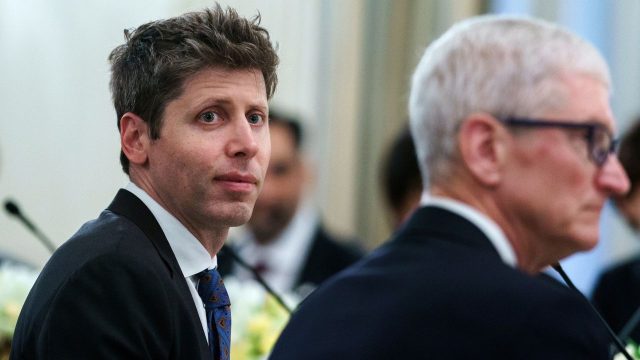
Two of the biggest tech giants are locked in a head-to-head legal battle, with Apple claiming OpenAI stole trade secrets as the AI start-up plans its first hardware devices.
Apple launched the “blockbuster lawsuit” last week, accusing OpenAI and several of its staff – formerly Apple employees – of “stealing secret hardware plans”, said the Financial Times. One of the staff named in the lawsuit is OpenAI’s head of hardware, who was “a top Apple device designer”.
The lawsuit, which doesn’t name OpenAI chief executive Sam Altman, amounts to “a spectacular breakdown in the relationship” between two of Silicon Valley’s “biggest names”.
What is the background between the two?
Apple and OpenAI launched a partnership in 2024, working to integrate OpenAI technology into Apple’s voice assistant, Siri. Apple also built ChatGPT into operating systems for iPhones, iPads and Macs.
But tensions began to surface last year when OpenAI bought a hardware start-up co-founded by Jony Ive, the former chief designer at Apple – and the brains behind the iPhone. OpenAI’s $6.4 billion purchase of io Products signalled that it was “foraying into hardware”, said The Guardian.
OpenAI is working with the “design guru” to develop a line of AI devices, including a hand-held gadget similar to a smart speaker, but equipped with a camera. These are “intended to compete with the iPhone and other Apple products”, said Bloomberg. Ive is “helping lead an effort to supplant” the very device he did so much to create. Much of his design team at Apple followed him and now work either at OpenAI or on its hardware products. This “exodus” has “fuelled resentment” at Apple.
The scale of departures is “astounding”, said Business Insider. More than 400 former Apple employees now work at OpenAI, with some being “unusually senior”. Apple is “furious” that it’s losing talent to “a scrappy start-up” that’s “refusing to stay in its lane”. Last month it unveiled its revamped Siri, which used Google’s Gemini AI model rather than OpenAI’s ChatGPT.
What does the lawsuit claim?
“OpenAI’s nascent hardware business now rests on the shakiest of foundations, rotten to its core by its illegal reliance on misappropriated trade secrets,” Apple wrote. The suit claims OpenAI “poached Apple employees”, said The Guardian, “coaxing them to hand over confidential material, product designs and other tightly held information”.
It names Tang Yew Tan, OpenAI’s chief hardware officer – and a former vice-president at Apple. In 2024, Tan left Apple to work on Ive’s start-up. After OpenAI purchased io Products, it appointed Tan as its own chief hardware officer. The lawsuit claims Tan took information about Apple suppliers with him.
Apple also alleges that when its employees went for job interviews at OpenAI, Tan “asked them to show up with something unusual”, said The Verge: hardware components they were working on at Apple and unreleased product samples for “show and tell sessions”.
Apple claims another former employee took an Apple laptop when he left for OpenAI, and used an authentication bug to breach the company’s internal network and download “dozens of Apple’s confidential hardware-related files”.
After filing the lawsuit, Apple sent “a barrage” of legal warnings to about 40 of its former employees at OpenAI, looking for evidence, said the FT. These “aggressive tactics” show “just how broad and combative the legal fight could become”.
What does OpenAI say?
OpenAI says it is not aware of “any evidence that the complaint has merit”. “We have no interest in other companies’ trade secrets,” said a spokesperson. But if the case goes to trial, it could “reveal the secret hardware OpenAI has long teased”, said CNET, perhaps before it is ready to launch.
Apple is seeking damages and a court order that would block OpenAI from possessing or using its trade secrets. Essentially, OpenAI is “a huge threat” to Apple, said Business Insider. It wants to either “directly challenge the iPhone, or completely replace this device as the go-to gadget of the AI era”.
OpenAI is “ridiculously well funded”, so Apple can’t easily acquire it to bring talent back into the fold. It’s also “too ambitious to swat away or subsume easily”. This explains “the intensity (or desperation?)” of Apple’s lawsuit.
The dispute also “underscores just how intertwined Apple and OpenAI have become”, said Bloomberg. “It’s an extraordinarily awkward situation, made all the more remarkable by the web of personal relationships that still connects the two companies.”
Tech giant alleges that AI start-up poached staff and stole trade secrets in its attempt to develop hardware devices and replace iPhone