
Hannah Clugston (The Art Newspaper) reviews “Ana Mendieta,” which opened at the Tate Modern, London, today, July 15, 2026, and will remain on view until January 17, 2027. She writes, “London exhibition explores how ancient sites informed the work of the late Cuban American artist, who was best known for her performance and land art.” Here are excerpts; read full article at The Art Newspaper. [Also see our previous posts Exhibition: Ana Mendieta and I thought of her as a volcano.]
Ana Mendieta’s best-known series, Silueta Series (1973-80), is a collection of photographs and films that capture silhouettes of the artist’s body in nature: etched in the ground, buried among flowers or even aflame. Sometimes the Cuban American artist (1948-85) is present; other times there is a faint imprint of her body. They are momentary sculptures, temporarily marking Mendieta’s presence on earth.
In 1984, towards the end of her life, Mendieta began visiting Neolithic sites around Europe, including Mnajdra and Tarxien in Malta; Hadrian’s Villa, Cerveteri’s necropolis and Pompeii in Italy; and Newgrange in Ireland. All are places where traces of long-lost civilisations can still be felt and found carved in the ground. [. . .]
The decision to curate in this way will allow visitors to see her work as Mendieta did—as part of a long history of expression that has deep roots in the earth and the communities preceding us. Valentine Umansky, the exhibition’s curator, says it is interesting that Mendieta spoke about her work being in the tradition of Neolithic art “because to people who know her work, she’s the most contemporary artist —making performances and films that are experimental and ephemeral. Actually, what she’s saying is: ‘In the long arc of time, I am closer to rupestrian mark making.’ And I thought this was such an interesting take on her and her practice.”
[. . .] Ensuring visitors “feel” Mendieta’s ephemeral works, the exhibition will open with Ochún (1981), her last moving-image work that features waves rushing around an opened human silhouette. “You step into the exhibition and suddenly you’re hit by the sound of waves,” Umansky says. “It slows you down, it slows your heart down, and it allows you to effectively attune to your own body.”
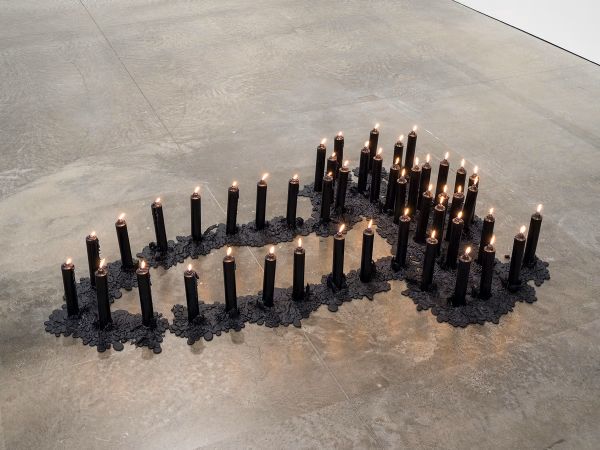
The vitality of her momentary sculptures will be captured in the recreation of several pieces, including Ñañigo Burial (1976), a Silueta made from black ritual candles that will be lit regularly throughout the duration of the show; a recreation of the first earth-body work that Mendieta produced for an indoor gallery setting; and the restaging of a tree sculpture (first made in 1982) outside Tate Modern.
For full article, see https://www.theartnewspaper.com/2026/07/13/ana-mendietas-neolithic-art-recreated-for-major-tate-modern-survey
[Photo above by Alex Yudzon: The Tate Modern show will re-create key works from Ana Mendieta’s Silueta Series, including Ñañigo Burial (1976); © Estate of Ana Mendieta Collection, LLC. Licensed by ARS, New York/DACS, 2026/Courtesy Marian Goodman Gallery and Alison Jacques, London.]
Hannah Clugston (The Art Newspaper) reviews “Ana Mendieta,” which opened at the Tate Modern, London, today, July 15, 2026, and will remain on view until January 17, 2027. She writes, “London exhibition explores how ancient sites informed the work of the late Cuban American artist, who was best known for her performance and land art.”