
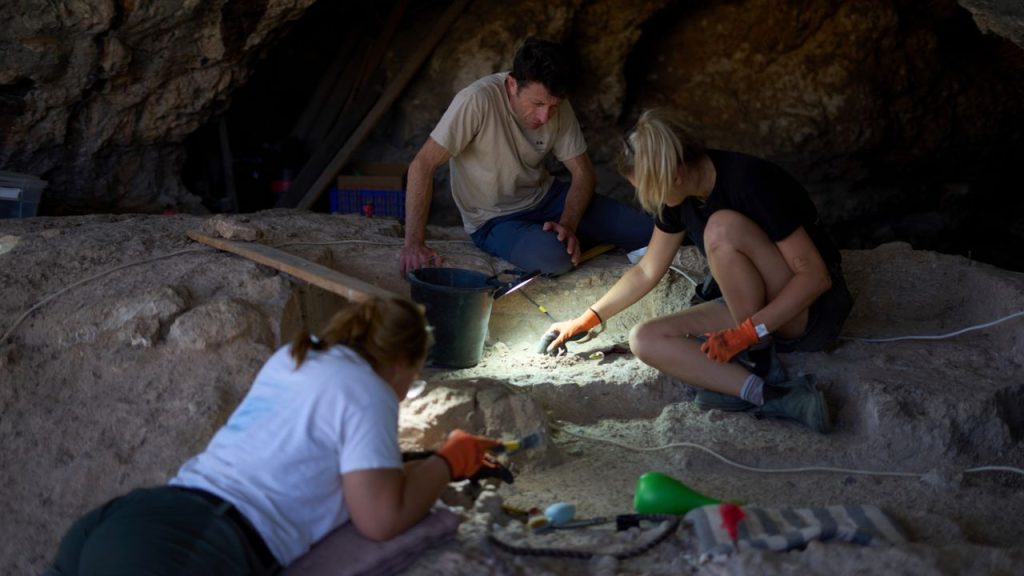
Archaeologists have been excavating Israel’s Tinshemet Cave for nearly a decade, but a new discovery in the cave is making waves for what it reveals about early humans and their behavior. Most interesting to archaeologists is the uncovering of a primitive burial ground, which experts hope will shed new light on how early humans honored their dead, and how those trends persist today.
What did archaeologists find in the cave?
The discovery was published in the journal Nature Human Behavior in March but only gained traction in the news several months later. At the cave, located in the hills of central Israel, archaeologists found what is believed to be “one of the oldest burial sites in the world,” where the “well-preserved remains of early humans dating back some 100,000 years were carefully arranged in pits,” said The Associated Press.
Archaeologists have found human remains at the cave before, some even older than 100,000 years. But this latest discovery is notable because of “objects found beside the remains that may have been used during ceremonies to honor the dead,” said the AP, which could illuminate “how our ancient ancestors thought about spirituality and the afterlife.”
Objects found at the burial grounds include “basalt pebbles, animal remains, or fragments of ochre, a reddish pigment made from iron-rich rocks,” said The Jerusalem Post. Many of these objects had “no known practical use for daily life, suggesting they were part of rituals meant to honor the dead.” The remains themselves were also well-preserved, and one was in “such good condition that archaeologists could observe how the fingers were interwoven.”
Why is this important?
The discovery is “reshaping our understanding of human interactions during the Middle Paleolithic period,” said the American Friends of the Hebrew University in a press release. It can “suggest the presence of shared rituals and strong communal bonds,” which could share direct links to the funerary practices of today.
Leaders of the excavation have underscored the importance of the find. It is an “amazing revolutionary innovation for our species,” said Yossi Zaidner, a professor of archaeology at Hebrew University in Jerusalem and one of the excavation directors, to the AP. While early humans were known to bury their dead, this burial ground is evidence of the “first time we are starting to use this behavior.”
The burial findings are also “bolstering earlier discoveries from two similar burial sites dating to the same period in northern Israel,” said Christian Tryon, a professor at the University of Connecticut, to the AP. These caves were excavated 100 years ago and 50 years ago, respectively, so there are “many uncertainties with those sites, but this is confirming it’s a pattern we know, and they’re really nailing down the dates.”
But mysteries still remain, and we may not get an answer soon. It will “take many more years to fully excavate the site,” said Newsweek. This is because archaeologists must use “hand chisels and pen-sized pneumatic drills resembling dental tools” to preserve the cave. But as more of the cave is excavated, researchers “hope to deepen their understanding of how and when early humans began treating death with ritual, symbolism, and meaning.”
The cave is believed to be one of the world’s oldest burial sites