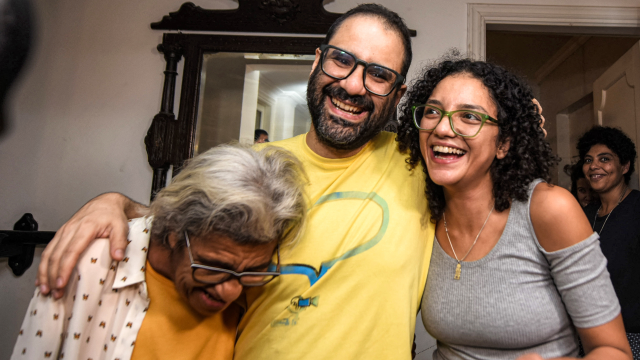
Keir Starmer is facing calls to strip Alaa Abd el-Fattah of his UK citizenship, days after the British-Egyptian dissident touched down in the UK following his release from an Egyptian jail.
In the latest of his string of prison sentences, el-Fattah had been convicted in 2021 of “spreading fake news” for sharing a Facebook post about torture in the country. On Boxing Day, Starmer said he was “delighted” by the return of the 44-year-old, a leading voice in Egypt’s 2011 Arab Spring uprising. “Alaa’s case has been a top priority for my government since we came to office,” the prime minister said on X.
But the celebrations ground to a halt as old tweets resurfaced in which the activist appeared to endorse the killing of Zionists and the police. In a statement today, el-Fattah apologised “unequivocally” for the “shocking and hurtful” posts, most of which were written between 2010 and 2012 – but said some had been “completely twisted”.
What did the commentators say?
His posts were “disgusting and abhorrent”, said Kemi Badenoch in an op-ed for the Daily Mail. He should have been given a “free and fair trial” in Egypt, but “there ends my sympathy”. It’s one thing to work to secure someone’s release from prison when they have been treated unjustly, but “quite another to elevate them, publicly and uncritically, into a moral hero”. Home Secretary Shabana Mahmood must now consider options including whether el-Fattah’s passport should be “revoked and he can be removed from Britain”. Given the “real-world harm” that has resulted from “antisemitic rhetoric” in recent months, “calls for violence against Jews cannot be brushed aside”.
“There is no excuse for what he wrote,” said Chris Philp, who was immigration minister under Priti Patel when el-Fattah was granted citizenship in 2021. People expressing these types of extremist views “have no place in the United Kingdom”, Philp told BBC Radio 4’s “Today”.
Downing Street sources claim Starmer was “unaware” of el-Fattah’s comments, said The Telegraph in an editorial. “Really? These were hardly secret.” Surely a dossier would be compiled by the Foreign Office or MI6 “about an individual the state was investing so much time and effort into being released. Did he not read his briefs?” There is also the question of why the last Conservative government granted him citizenship in the first place.
The “blithe expressions of delight” by three secretaries of state about el-Fattah’s recent release reveal how “stupid” they are, said David Shipley on The Critic. “These people have spent years not bothering or not caring to check el-Fattah’s social media, an exercise which took people on Twitter less than a day.”
“There’s no way this is just a Labour thing,” said Dan Bloom on Politico’s London Playbook. “Tory and Labour ministers pushed for” his release “for years”. Yet “it’s hard to imagine a trickier situation” for Starmer following his enthusiastic reaction. Labour ministers are among the voices now calling for el-Fattah to be stripped of his citizenship. The fiasco is a “kick in the face” following the recent antisemitic attacks at Bondi Beach, said an unnamed senior Labour MP. And while aides are insisting Starmer didn’t know about the tweets, said Bloom, “the question is… who did?”
What next?
Revoking el-Fattah’s citizenship would likely be a “pretty big headache” for Mahmood, said Bloom. The home secretary can take away people’s passports on terrorism and national security grounds, “but only rarely”. Doing so “could end up in the courts”, which “might look dimly on a government welcoming el-Fattah only to boot him out a few weeks later”.
Resurfaced social media posts appear to show the democracy activist calling for the killing of Zionists and police