
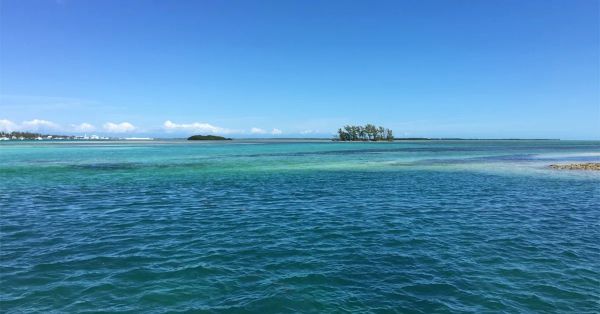
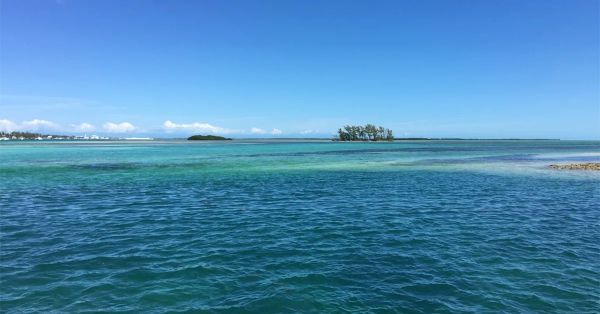
In “American Airlines Is Flying Nonstop to a Caribbean Island with Powdery Beaches, Neon Water, and a Shark Lab,” Karen Udler (Caribbean Journal) writes about Bimini and its beauty, asserting that “There are 50 shades of blue here.” Here are excerpts; read more about fishing, The Shark Lab, The Dolphin House Museum, where to stay, and more at Caribbean Journal.
Bimini comes into view low and flat, a thin strip of land in the Gulf Stream set against water that changes color as you approach. Deep blue gives way to turquoise, then to pale, shallow flats where the bottom is visible from the surface. Boats slow as they near the harbor. The island’s shape becomes clear quickly: narrow roads, short distances. The sea is always present, either in sight or just beyond a line of buildings.
This closeness defines how Bimini works. You move between water and land and then you repeat. People arrive by boat, by ferry, or by air, then orient themselves around the harbor, the beaches, and the flats. It is tiny archipelago that rewards attention rather than itinerary-building.
Beginning Feb. 14, American Airlines will be kicking off the only nonstop flights from the United States to Bimini on a major carrier, creating a direct air link from South Florida to one of the Bahamas’ most water-driven destinations.
Getting There Just Got Easier
American’s new service will operate three times a week from Miami, with flights on Mondays, Wednesdays, and Saturdays aboard Embraer 175 aircraft. The route is part of the airline’s expanded winter schedule out of South Florida and brings Bimini within a short, manageable flight for travelers who want to spend more time on the island than in transit.
The airport sits close to Alice Town and the harbor, keeping arrivals informal and efficient. Within minutes of landing, visitors are moving along the island’s main roads or toward the water. The schedule supports short stays and repeat trips, making Bimini practical for long weekends rather than requiring extended planning or time off.
Explaining the Geography of Bimini
Although it’s often referred to as a single island, Bimini is actually a small archipelago. North Bimini and South Bimini form the main inhabited center, connected by a short causeway, while surrounding cays and islands stretch outward in different directions. East Bimini (which you can reach in a flats boat) lies undeveloped across shallow water, with long stretches of exposed shoreline and open flats, while places like Cat Cay and Gun Cay sit nearby with private docks, reefs, and anchorages. This geography shapes how visitors experience the destination: short boat rides open access to different beaches, snorkel sites, and fishing grounds, and time in Bimini often moves laterally across water rather than staying fixed in one place.
Underwater Bimini
For many visitors, the first real introduction to Bimini happens offshore. The island is known for its diving and snorkeling, with shallow reefs and consistently clear water that allow long stretches of time in the sea without complicated logistics. Coral formations sit close to the surface, fish move easily between reef and open water, and visibility often extends far beyond what first-time visitors expect.
Sites near the Bimini Road and surrounding reef systems allow snorkelers and divers to enter the water quickly and stay there. Boat rides are short, and excursions focus on time in the water rather than extended transits. Conditions accommodate a wide range of experience levels, from first-time snorkelers to seasoned divers looking for relaxed but rewarding reef time. [. . .]
For full article, see https://www.caribjournal.com/2026/02/04/american-airlines-bimini-caribbean-island-bimini-flying/
In “American Airlines Is Flying Nonstop to a Caribbean Island with Powdery Beaches, Neon Water, and a Shark Lab,” Karen Udler (Caribbean Journal) writes about Bimini and its beauty, asserting that “There are 50 shades of blue here.” Here are excerpts; read more about fishing, The Shark Lab, The Dolphin House Museum, where to stay,