For many of Belize’s rural communities, a trip to the doctor’s office is much more complicated than a simple walk-in or appointment. It often involves navigating public transportation schedules and long distances, and can sometimes require an entire day’s dedication. For decades, this has been the case for families living in Duck Run 1 and neighboring villages in western Belize. The recent establishment of a new polyclinic, however, is about to remove one of the community’s greatest barriers to healthcare.

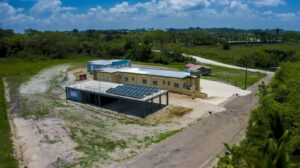
 Photo by Ignite Ltd. Aerial views of newly built Polyclinic in Duck Run 1, Cayo District


Constructed through funding from the European Union and the Government of Belize in partnership with the International Organization for Migration (IOM), the Duck Run 1 Polyclinic is fully equipped with consultation rooms, medical furniture, and all essential supplies needed to bring healthcare services closer to the people who need them. The facility will serve not only residents of Duck Run 1, but also neighbouring communities, including Duck Run 2, Duck Run 3, Santa Familia, and Los Tambos. In total, approximately 6,000 people are set to benefit. And while the polyclinic represents an important investment in healthcare for rural Belize, for the residents who have spent years traveling long distances to access medical care, its significance extends far beyond the building itself.
Ciriaco Castro has called the village of Duck Run 2 home for more than thirty years. During that time, visiting a doctor has, more often than not, meant traveling to San Ignacio or Belmopan. It’s a journey that he says has become increasingly difficult with age and without reliable transportation—and it’s an experience that reflects that of many others.
Families have often had to travel significant distances for routine medical appointments, sometimes facing long waits and even having to return home without being seen.

Photo by Ignite Ltd. Mr. Ciriaco Castro, Resident of Duck Run 2 Village, Cayo District
When asked what he thinks of the new clinic, Castro noted, “ I believe everyone is going to be happy about it, because we are all benefiting.”
That sense of shared benefit is echoed throughout the surrounding villages.
One of the first residents of Duck Run 3, Elvin Larios remembers when there were no roads connecting the growing communities. While infrastructure gradually improved over the years, access to healthcare remained a persistent challenge.
“More or less, we started it in 1985, and I came to this country in 1976,” he said. “We were working in Spanish Lookout, and then we came to this village and began building in the village. Three of us arrived at first, and from there we began to expand the place.”

Photo by Ignite Ltd. Mr. Elvin Larios, Resident of Duck Run 3 Village, Cayo District
Like Ciriaco Castro, Elvin, and other residents of Duck Run 2 have often had to seek out transportation for travel to San Ignacio, located about 14 miles away:
“And sometimes, when we arrived, the place was already full. Sometimes we went for nothing and had to return, then go back another day.”
With the new clinic, the residents will be able to rest easy knowing healthcare is just minutes away.
“This clinic that is being established, we will see quite a difference—maybe not everything we need, but we already have a beginning…it brings benefits to us, the community, and the communities in this area.”
Bridging the Gap
Before the polyclinic, community health workers like Ordel Alford, Sandi Castro, and Arcelita Perez worked hard to ensure that residents were not left without care. Through meaningful work like monitoring patients with chronic illnesses, checking glucose and blood pressure levels, carrying out home visits, and helping residents navigate the public health system, they have been helping to bridge the gaps between rural western Belize and essential healthcare services.
For many, they were among the first people to call whenever illness struck.
Ms. Ordel Alford recalls transporting patients herself when no other options were available:
“If they call me… I could bring them in my vehicle… If they don’t have a vehicle, I could assist them. That’s my job.”

Photo by Ignite Ltd: Ms. Ordel Alford, Community Healthcare Worker, Duck Run 1 Village, Cayo District
For Alford, the opening of the new polyclinic means residents will no longer have to rely so heavily on long journeys or the generosity of neighbours simply to receive medical attention. And, it also serves to strengthen the work that Alford and others like her have been doing. To Sandi Castro, that means being better able to serve her community—the main reason why she decided to become a community health worker. It’s a change that she is welcoming with open arms.

Photo by Ignite Ltd: Ms. Sandi Castro, Community Healthcare Worker, Duck Run 2 Village, Cayo Distric
“This polyclinic will be a big opportunity for my community and for me as well,” she said.
Much like Sandi, Arcelita Perez has dedicated herself to serving residents across rural western Belize. Perez, who has been a community health worker for ten years, believes that the polyclinic is “a blessing” and that its impact will certainly extend far beyond Duck Run 1.

Photo by Ignite Ltd: Ms. Arcelita Perez, Community Healthcare Worker, Duck Run 1 Village, Cayo Distric
“Everyone around the neighboring villages will be blessed because they can come here, and they can have their primary health care.”
Together, the three women represent years of dedication to ensuring their neighbours receive the care they need. Today, rather than replacing that work, the Duck Run 1 Polyclinic strengthens that dedication by giving them a permanent healthcare facility where they can continue serving.
Healthcare Closer to Home
Dr. Juan Carlos Sabido, Chief of Staff at the San Ignacio Hospital, understands just how important it is to reduce barriers to healthcare in rural communities. He also understands just how taxing it can be for families from those communities to access services. According to him, the new clinic is expected to ease not just the physical journey but the financial burden as well:
“For families in Duck Run 1, travelling to the community hospital usually took about 40 minutes, and reliable public transportation was limited. They had to plan their hospital visits around the bus schedule, hoping to be seen in time to catch the return bus. If they missed it, they often had to find a ride or pay approximately $60 for private transportation. By bringing healthcare closer to the community, this new polyclinic will save families both valuable time and as much as $60 in transportation costs each time they need medical care.”
 Photo by Ignite Ltd: Dr. Juan Carlos Sabido – Chief of Staff at San Ignacio Community Hospital, Cayo District
The clinic has been designed as a comprehensive primary healthcare facility, providing services for patients of every age from Monday to Friday between the hours of 8 AM and 5 PM.
“We’ll be able to take kids all the way below one year of age, all the way up to the elderly and everything in between,” Dr. Sabido explained.
And, in addition to providing routine consultations, the clinic is also set to be a provider of National Health Insurance (NHI), offering residents a very broad range of services.
“We do welcome all of the neighboring communities to come and register so that they can start taking advantage of the NHI services as well. This clinic is an NHI provider, and with that, once we get that rolling, we’ll have internists, pediatricians, an OBGYN, and a nutritionist. “
“It’s a lot easier,” added Dr. Sabido. “You no longer have to plan your whole week or whole day because you need to go and see the physician or you need to take your kids because they’re feeling ill.”
For young parents like Juanita Sanchez, that comes as a much-welcomed relief. Living just minutes from the new facility with her daughter, she remembers when even routine medical visits meant travelling far from home.

Photo by Ignite Ltd. Ms. Juanita Sanchez, Resident of Duck Run 1 Village, Cayo Distric
“It’s better now, because my baby, if she gets sick, well, I could bring her here.”
All people should be able to live in dignity. Access to energy, healthcare, quality education, and water—among others—are essential rights. The European Union through its Global Gateway strategy continues to contribute infrastructure, capacity building, and other measures for reinforcing the capacities of Belizean public actors in the delivery of essential public services to the country’s population. This goes beyond just healthcare and includes access to electricity and justice as well.
The EU has been a steadfast partner of Belize in the health sector, supporting the strengthening of public health services. In recent years, the EU supported crucial renovations of some of the country’s most important infrastructure, including at the Central Medical Laboratory in Belize City, the Punta Gorda Community Hospital, and the Corozal Community Hospital.


Photo by Ignite Ltd. Interior shots of the Polyclinic: Waiting area (top left), Consultation room (top right), Pharmacy (bottom)
Thanks to the infrastructure improvements introduced, these facilities are now disaster-resilient, energy efficient, and “green”. Among many other initiatives enhancing the health sector in Belize, the EU has also supported the provision of specialized training for central and district level health sector managers and other personnel, strengthened health services organization and management in Belize, funded the development of key policies for the health sector, and supported the upgrading and expansion of the Belize Health Information System.
The new Duck Run 1 Polyclinic comes as part of a wider European Union-supported initiative to improve climate resilience and strengthen communities across western Belize. Alongside the new polyclinic, the project, implemented through the IOM, also delivered a hurricane shelter in Duck Run 1, completed right before the start of the hurricane season as well as hurricane shelters in the other communities targeted under the project.
Additionally, the EU funded the upgrading of water systems to ensure better water supply in the villages of Santa Familia and Los Tambos. Drainage infrastructure was also improved thanks to the establishment of 4 miles of drains and 12 culverts. The initiative also allowed for capacity development through the formation and training of community-level emergency response teams and firefighting brigades across six communities.
While these EU-supported initiatives reflect the strength of international partnership, their greatest impact will be measured by the lives touched. For the thousands of residents that they are set to serve, they mean better access to essential services, improved everyday quality of life, community resilience, and stronger support for community workers. For communities like Duck Run 1, that impact is already being felt, as access to healthcare will no longer be defined by the distance residents must travel.
The post A New PolyClinic for Duck Run appeared first on Belize News and Opinion on www.breakingbelizenews.com.
For many of Belize’s rural communities, a trip to the doctor’s office is much more complicated than a simple walk-in or appointment. It often involves navigating public transportation schedules and long distances, and can sometimes require an entire day’s dedication. For decades, this has been the case for families living in Duck Run 1 and
The post A New PolyClinic for Duck Run appeared first on Belize News and Opinion on www.breakingbelizenews.com.