
In the framework of the 60th Venice Biennale, C& AL editors Marny Garcia Mommertz and Cristian Baena “reflect on a recent press trip to Martinique alongside the artist and curators of the French Pavilion.”
Martiniquan artist Julien Creuzet intricately blends poetry, folklore, sounds, and sculptures into immersive installations that tell stories of Black resistance across the Diaspora, the Caribbean in particular. With whispers that olfactic components will be part of his show – the French Pavilion – at the 60th Venice Biennale, as well as an extensive collaborative sound archive, anticipation has been mounting.
In this conversation, Cristian Baena and Marny Garcia Mommertz reflect on a recent press trip to Martinique alongside Creuzet and the pavilion’s curators Cindy Sissokho and Céline Kopp. The two share some of their thoughts on their encounters with the artist, his work, and the press trip. Initially they had set out to learn what had been planned for the Venice project, only to realize that for Julien Creuzet and his team, the French Pavilion for 2024 was only beginning with this trip in Martinique.
Marny Garcia Mommertz: I want to start by addressing something that happened in the days after our trip and that has been on my mind since. On 12 March, while Julien was still in Martinique, preparing for Venice with his curatorial and studio team, France announced the preparation of constitutional changes in Mayotte, one of its twelve overseas departments. These changes will see the removal of droit du sol (citizenship by birthright on French soil) to try to reduce migration to the archipelago, which is located between Madagascar and the Mozambican coast. Critics have pointed to France’s history of trying out new laws in overseas departments, and have warned of the dangerous nationalist path that lies behind the door that this constitutional change potentially opens. That discussion, taking place in a different yet related context, reflects something that was present throughout our trip: a constant wrestling between Caribbean and French identities. And what it essentially tells us is that not everyone born in French territory is French. Because some parts of France appear to not be really French.
Cristian Baena: I see the question of foreignness, which the 60th Venice Biennale’s curator Adriano Pedrosa proposes with the title Foreigners Everywhere, as a topic that has potential to open up a painful dialogue that many artists around the world seek to represent in their work. This is something that we spoke about with Julien, who is confronted with his experience as a stranger when he is called a citizen “from overseas.”
MGM: This is key. He brought up the notion of overseas citizens, also referred to as “ultramarine citizens,” during the official press conference for the French Pavilion, held at Edouard Glissant’s house in Le Diamant, Martinique. He chuckled and explained that the expression “ultramarine citizen” makes him think of a Marvel character. The audience laughed. But there is tragedy and pain in his comparison: the comic-book characters are “strange” and “different” because they usually possess physical superpowers that make them nonhumans. The lands that these characters are from, France’s “ultramarine departments,” are then strange and foreign too.
CB: So many questions came up during our visit. One important one was “why was Julien selected to represent France”?
MGM: Yes, this was a very obvious question that no one dared to ask openly until the last day of our trip. We visited Campus Caribbean Des Arts, the art school where Julien had been a student for one year before deciding to leave his home in Martinique and move to France. Julien invited family, friends, students, diplomats, journalists, and teachers to ask questions. One of them was: “Why were you chosen by the jury to represent France, now that your work is increasingly rooted in Antilleanness?” The artist’s response: “I think you need to ask them [Institut Français] this question. And then also, maybe they didn’t have a choice” – alluding to the current political climate in France. It’s a tricky yet intriguing question to ask when trying to understand the broader context that this pavilion is taking place in.
CB: I want to talk about something that was as telling about our trip as the surrounding politics: the feelings. Our first gathering with the group of practitioners, elders, family and journalists invited by Julien and his team took place at Cap 110 at Anse Caffard. It’s a sculptural installation commemorating the abolition of enslavement. Sitting in a half-moon circle and wrapped in industrial and wave sounds, Julien announced that the days ahead would be a journey into his mind and work. I think it set the tone for what he was trying to achieve on the trip and for his approach in general: he wants us to feel his work [. . .]

CB: I interpret and feel Julien’s work as a reconstruction of different worlds. It’s as if the remains of an aged shipwreck begin to emerge and take on new meaning in the present. Glissant wrote, “I write in the presence of all the languages of the world.” I hear an echo of this in Julien’s work. As a Black Colombian who did not have access to art education, I wanted to understand how a person without an art education can relate and feel represented by Julien’s work and whether he is conscious of that question. In one of the conversations in Martinique, he explained that beauty is key and that everyone can understand it. But he also spoke about the generosity you just mentioned:
… within the question of beauty, there is also the question of generosity. Because everybody can understand when something is generous and when something is trying to be generous. And I’m sure that people who don’t have an artistic education, when they see an installation, can have feelings of generosity. Maybe with something simple, maybe with color, maybe with music, maybe with some details of the work. And that for me is very important.
MGM: I think it’s curious how little was shared verbally during the press conference at Glissant’s house in Le Diamant. That place, where thoughts around the need for opacity were born, poetically underlined Julien’s choice to share only scarce information about Venice. [. . .]
Cindy Sissokho said that everything one needs to know about the exhibition in Venice is in the title. But it was also said that Venice began in Martinique. And that “it is about decoding and listening with intention,” urging us to embrace the vast depth of interpretation Julien’s work has to offer. The multiple collaborators Julien picked to support him artistically during the trip made it easier to delve into his imagination and stay focused on the now.
CB: These collaborators, poet Estelle Coppolani (Réunion), poet Simone Lagrand (Martinique), artist Victor Anicet (Martinique), artists Minia Biabiany (Guadeloupe), Valérie John (Martinique), and Christian Bertin (Martinique), and performance artists Annabel Guérédrat and Henri Tauliauti (Martinique), all represent different generations. The way Julien incorporated them into this trip can be seen as an artistic, critical, and political experiment. [. . .]
For full article, see https://contemporaryand.com/magazines/a-journey-into-the-mind-and-work-of-julien-creuzet
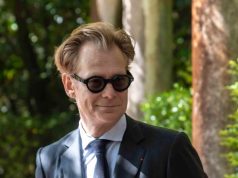
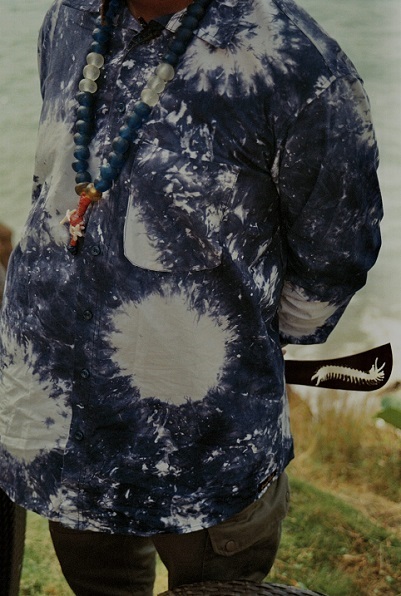
[Photo above by Cristian Baena: Julien Creuzet.]
In the framework of the 60th Venice Biennale, C& AL editors Marny Garcia Mommertz and Cristian Baena “reflect on a recent press trip to Martinique alongside the artist and curators of the French Pavilion.” Martiniquan artist Julien Creuzet intricately blends poetry, folklore, sounds, and sculptures into immersive installations that tell stories of Black resistance across