
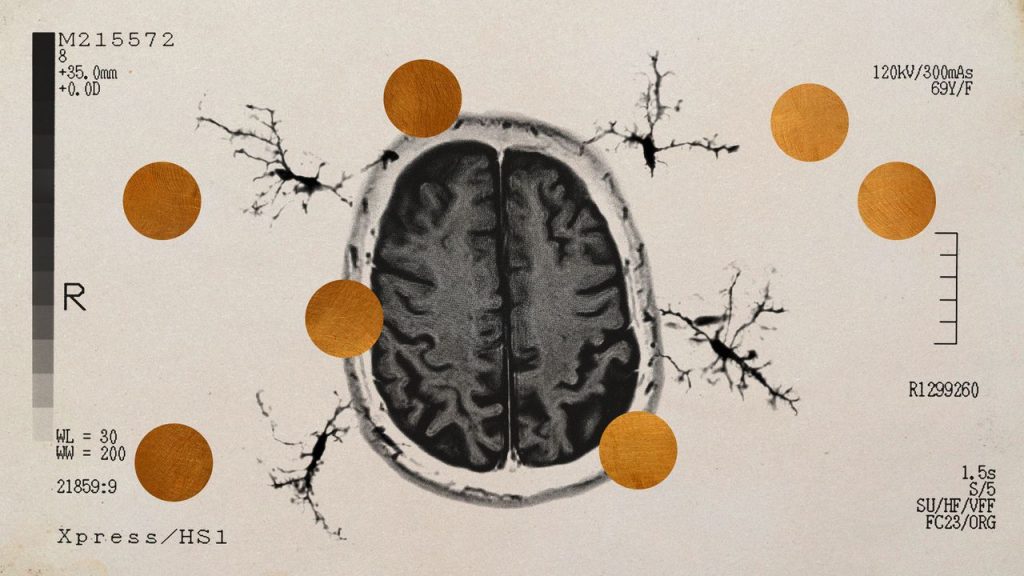
Alzheimer’s disease, a progressive brain disorder that gradually degrades a person’s cognitive and memory functions, may have a new treatment on the horizon. A copper-based drug has been found to improve long-term memory in mice. While not yet tested on humans, researchers are hopeful that the compound could extend the capabilities of those with the disease.
Clearing out
Scientists found a drug that can clear out toxic proteins in the brain, according to a study published in the journal ACS Chemical Neuroscience. Alzheimer’s is “driven by the buildup of toxic proteins called amyloid-beta,” said a release about the study. These proteins are usually flushed out into the bloodstream through the blood-brain barrier. However, in those with Alzheimer’s disease, the “pumps doing the heavy lifting, called P-glycoprotein (P-gp), weaken significantly, clogging the drain and trapping the toxic proteins in the brain.”
A buildup of these proteins in the brain leads to memory loss and cognitive decline. But there may be a solution in a copper-based compound Cu(ATSM), which has “anti-inflammatory and neuroprotective properties,” Joseph Nicolazzo, the senior author of the study, said in the release. The drug could be used to reduce the buildup of amyloid-beta proteins in the brain by “increasing the number and activity” of the P-gp pumps, said Newsweek.
This study is the first to show that “Cu(ATSM) can increase the abundance of P-gp clearance pumps in an Alzheimer’s model, by 24.1%, effectively linking the repair of the blood-brain barrier to a reduction in toxic proteins and improved cognitive function,” Jae Pyun, the lead author of the study, said in the release. “Over 56 days, the treatment reduced toxic amyloid-beta by 42% and improved spatial learning by nearly 44%.”
Not just yet
Alzheimer’s disease is the number one cause of dementia, accounting for about 60-80% of cases, according to the Alzheimer’s Association. The condition also worsens over time. In its early stages, “memory loss is mild, but with late-stage Alzheimer’s, individuals lose the ability to carry on a conversation and respond to their environment,” said the Alzheimer’s Association. “On average, a person with Alzheimer’s lives four to eight years after diagnosis but can live as long as 20 years, depending on other factors.”
Cu(ATSM) improved the long-term spatial memory of mice, showing promise for future human clinical trials. The compound has also “already progressed to clinical testing for conditions like Parkinson’s and ALS,” Nicolazzo said in the release. However, “despite its promising results in animals, a pilot comparative analysis found that Cu(ATSM) provided no significant benefit to humans with ALS,” said Science Alert.
It is estimated that over 7 million Americans ages 65 or older are living with Alzheimer’s. By 2050, that number is projected to rise to close to 13 million, according to the Alzheimer’s Association. Alzheimer’s does not currently have a cure, but a drug that could prolong cognition and lifespan would be a game changer.
The disease itself is still full of unknowns. “Alzheimer’s involves the biological environment of the aging brain, including membrane biology, inflammation, vascular function, lipid metabolism and cellular resilience,” neuroscientist Dayan Goodenowe said to Newsweek. “So any SINGLE mechanism still has to be validated before we know whether it produces meaningful clinical benefit.”
It clears out toxic proteins in the brain that cause memory loss