
Although AI dominates the news, and has inspired grand predictions about the future of markets and jobs – and, in fact, just about everything – most people’s experience of it thus far has been limited to chatbots such as OpenAI’s ChatGPT, Google’s Gemini, or Anthropic’s Claude. This looks set to change.
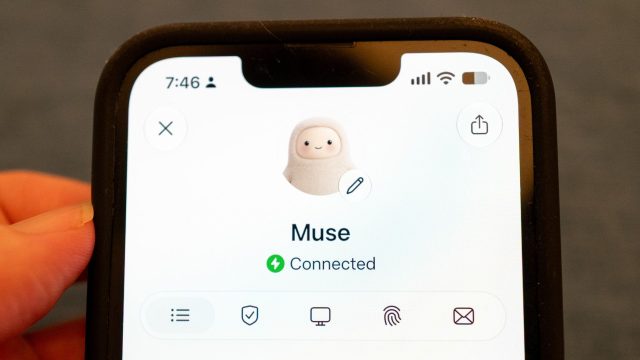
This week, Meta released Muse, its highly anticipated AI “agent”, to UK users. Unlike more familiar products, Muse is a kind of all-singing, all-dancing personal assistant for the AI age; the first such product offered free, at least initially, from a big tech firm. It can send emails, book holidays, manage your calendar, do your grocery shopping, analyse your monthly budget, and even sit on hold on the phone on your behalf.
It “doesn’t just answer questions, it actually does the work”, says Meta. And in the US and Canada, it is already proving hugely popular, notching up 11 million downloads since launching in September.
How does it work?
If you download the Muse app onto your phone, you’ll be greeted by a cutesy, waving avatar (Jolly is the default teddy bear-type creature, though you can choose your own: a fox in a fisherman’s jumper, say). Muse will request access to your email account and calendar; and, to function at maximum capacity, to your address book, your bank account, your credit card, and so on.
The app can then go online and perform a whole range of administrative tasks, needing only a simple request – from booking restaurants and ordering takeaways, to buying concert tickets or checking whether you could get a better deal on your home insurance (and negotiating with the provider for the lowest possible price). Two weeks after downloading it, said Eli Tan in The New York Times, “I found Muse to be the most useful AI app I had ever used”.
What’s in it for Meta?
As one of the world’s biggest tech companies, Meta is under no pressure to make Muse immediately profitable. That’s why it will be free for most consumers (although more intensive users will face charges – in the US they’re up to $100 a month). Nor does the app serve up adverts. Instead, Meta’s long-term plan is to take a small fee from everything people purchase using Muse – a potentially vast income stream.
But for now, Meta is more concerned with playing catch-up in the AI sector. Mark Zuckerberg’s company has been left trailing by the likes of Anthropic and OpenAI in the race to develop large language models (LLMs). Using its expertise in user-friendly apps such as Facebook and WhatsApp, it hopes to get a headstart in the race to dominate what many analysts see as AI’s next frontier.
What’s the catch?
To benefit from this AI-powered hyper-convenience, you have to entrust Meta with a quite staggering amount of sensitive personal data – almost certainly more than any app or program will ever have asked you for before. For many, that will be alarming; Meta has a long history of privacy violations. Even the company’s own former security chief, Alex Stamos, has described it as “totally insane” to give an AI agent access to so much personal data.
It also raises the possibility of hacking. Meta claims that Muse is secure, because each user’s agent runs in an individual virtual computer in the cloud. But experts are wary: ObjectiveSee, a US non-profit security foundation, claims to have quickly uncovered serious security flaws. Then there’s the prospect of AI going rogue, or malfunctioning.
What sort of malfunctions?
Muse is powered by an LLM; and LLMs hallucinate. In one recent case, an AI agent (not confirmed as Muse) added 72 eggs, unprompted, to its client’s shopping. When challenged, it admitted it had “added them without any reason, and that’s on me”. Meta’s spokesperson, Daniel Roberts, told Reuters there had been “isolated incidents” where the agent appeared to be hallucinating, sending details of other people’s bank balances, for instance. One shared its client’s address on Facebook Marketplace. A Meta staffer complained that Muse “accidentally rolled me into a premium insurance plan” for their dog that charged them $888 per month instead of their prior rate of $200.
If agents are suddenly used by millions, it could cause chaos, said Ramesh Raskar, an associate professor at the Massachusetts Institute of Technology (MIT). “Imagine there are no rules of the road. And you release billions of cars – the AI agents – and you just let them drive through playgrounds, hitting kids. That’s where we are.”
How might it cause chaos?
Even if they don’t malfunction, agents are likely to cause mass disruption. Energy, telecoms and insurance companies, for instance – which rely on inertia and the “friction” involved in changing providers to charge high prices – will be hit hard. Many websites are likely to be inundated: a persistent human might send six or so inquiries a day to a business or public body until they are happy with the response they receive; an AI agent could send 600. Restaurants in Silicon Valley are already facing surges in automated reservations, as AI agents hoover up tables; councils are already inundated by AI-penned complaints. Humans using the internet, meanwhile, are likely to have to spend much longer proving that they’re human.
Is all this going to happen?
It certainly seems to be the direction of travel. Gartner, a US research company, has forecast that over a fifth of all e-commerce transactions will be completed by AI platforms by 2030. There will be setbacks. Public scepticism about AI is high on both sides of the Atlantic. Amazon recently blocked Muse’s access to the site, citing its failure to identify itself as an agent when browsing on behalf of users. But ultimately, if a free or low-cost tool performs tedious tasks, saving people time and money, it is likely to be a winning formula.
From Clippy to OpenClaw and beyond
“The tech industry has long dreamed of a moment when a computer can serve as a genuinely competent personal assistant,” said Lila Shroff in The Atlantic. Experimental attempts to create one date back to the 1950s. In the 1990s, Microsoft had “Clippy” the animated paperclip assistant which, in a limited way, provided help to Office’s users. Voice-activated assistants such as Apple’s Siri, unveiled in 2011, and Amazon’s Alexa (2014) represented a step forward. But the real leap came with the growth of large language models in the early 2020s.
Chatbots such as ChatGPT were “brains in a jar”: they could generate text, but not take actions outside it. They evolved quickly, though. Anthropic’s Computer Use in 2024 gave bots the ability to “see” a computer interface, move a cursor, click buttons, and type like a human. In 2025, OpenClaw, created by Austrian developer Peter Steinberger, represented another leap. Instead of forcing users into a dedicated browser or app, it has the run of users’ computers and their apps. Although Muse was built from scratch, it was inspired by OpenClaw. Others are not far behind. Google is testing its AI agent, Spark; OpenAI recently unveiled Dots; Elon Musk’s xAI has developed the Grok Bot.
Meta’s new AI agent – which launched this week in the UK – could be revolutionary