Potentially? Tom Phillips (The Guardian UK) reports on the Salvadoran army’s actions in Haiti. He writes, “Soldiers may end up in ferocious battles across sprawling slums, say experts who question Nayib Bukele’s motive.”
It has been nearly five years since El Salvador’s authoritarian leader, Nayib Bukele, launched his controversial “war” on gangs – transforming his country’s fortunes and becoming a hard-right beacon for Latin America’s fight against violent crime.
Now the Salvadoran populist seems intent on exporting his hardline tactics to the region’s most violence-stricken nation, Haiti. He has sent more than 2,000 troops and special forces to the Caribbean country since four citizens of El Salvador were abducted there on 18 October. “We will help you reclaim your country from the hands of the traitors who betrayed the legacy of Dessalines,” Bukele tweeted in Haitian Creole this week, in reference to one of the leaders of the Haitian Revolution, Jean-Jacques Dessalines.
Bukele’s use of mass incarceration and secret negotiations to tame El Salvador’s gangs has made him a hero among rightwing politicians and violence-weary citizens across the Americas, including in Haiti, where heavily armed groups have commandeered much of the capital, Port-au-Prince, since President Jovenel Moïse was murdered in 2021.
Experts say many Haitians welcome the idea of a Bukele-style crackdown, even if El Salvador and Haiti are dramatically different places.
Vanda Felbab-Brown, a Haiti security expert from the Brookings Institution in Washington, said: “Right now, the conditions in Haiti are so awfulthat there’s a huge craving for a strongman who [can] deliver Haiti from the gangs.People are desperate and they want whoever will stop the desperation.”
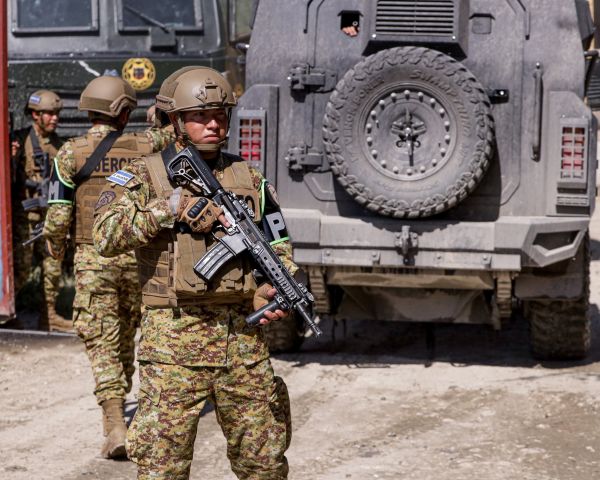
followings have gone online to hail his Haiti intervention. “He’s single-handedly going to clean up the entire Caribbean. I wish more political leaders had balls like this,” claimed one cheerleader, alongside images of rifle-toting Salvadoran soldiers on the streets of Port-au-Prince.Others posted footage of crowds of Haitians celebrating the troops’ arrival, although there have been reports of protests against the deployment.
There are also widespread concerns over Bukele’s foreign foray – the first the region has seen in many years, outside a UN mission – with mystery shrouding its true objectives. There are fears it could fuel the already devastating levels of bloodshed and aggravate a humanitarian crisis in which more than 1.5 million citizens have been forced to flee their homes.
When the four Salvadorans – who Bukele said were aviation technicians – vanished after going shopping in a gang-run area north-east of Port-au-Prince’s airport, El Salvador’s president initially painted his military operation as a rescue mission. [. . .]
But over the following days, Bukele’s tweets began to suggest more ambitious goals. “We came to Haiti to fight against the wicked,” the social media-savvy leader wrote.
In another post, he denied he was stumbling into a Caribbean version of the Battle of Waterloo, when Napoleon Bonaparte’s dreams of imperial glory were finally crushed. “God will grant us victory. The Creator of the Universe is with us,” Bukele insisted.
Felbab-Brown said those posts indicated his objectives were broad and involved “degrading the gangs”, rather than simply rescuing his four citizens – or more likely, given the brutality of Haiti’s gangs, their bodies.
It is unclear how long Bukele’s troops plan to stay, although they are setting up a base near the US embassy, suggesting a quick exit is unlikely.
[. . .] Felbab-Brown agreed. “It’s possible he’s trying to strengthen his hero image in Latin America and show that he can do what he did in El Salvador beyond El Salvador,” she said, noting how the Central American country faced “real economic headwinds” that posed a challenge as Bukele sought to extend his seven-year rule.
Experts do not rule out the possibility of Bukele dealing a blow to the gangs – in the short term at least – but say the risks are immense.
Already, a volatile constellation of armed groups is operating on the ground in Haiti trying to subdue gang fighters – so far with limited success.
It includes vigilante mobs armed with guns and machetes, the Haitian police and army, foreign mercenaries employed by Vectus Global, a firm owned by Erik Prince – who founded the controversial private military contractor Blackwater – and a UN-backed mission called the Gang Suppression Force (GSF), led by a Mongolian army general.
Bukele’s soldiers, who are not operating under the command of the GSF, have now entered that messy fray. “It is an orchestra without a conductor,” warned Romain Le Cour, who runs the Haiti Observatory at the Global Initiative Against Transnational Organized Crime and is a regular visitor to Port-au-Prince.
One major risk is escalation. “With drones, attack helicopters and heavy weapons, the confrontation has changed dramatically in a matter of days,” Le Cour said. “Civilians are paying the price. This is urban guerrilla-type combat, where residents are trapped between criminal groups and intensive operations. Thousands have already been displaced.” [. . .]
For full article, see https://www.theguardian.com/world/2026/nov/07/el-savador-war-on-gangs-haiti
[Photo above by Patrice Noel/Reuters: Salvadoran soldiers return to base after a patrol in Port-au-Prince, Haiti.]
Potentially? Tom Phillips (The Guardian UK) reports on the Salvadoran army’s actions in Haiti. He writes, “Soldiers may end up in ferocious battles across sprawling slums, say experts who question Nayib Bukele’s motive.” It has been nearly five years since El Salvador’s authoritarian leader, Nayib Bukele, launched his controversial “war” on gangs – transforming his