
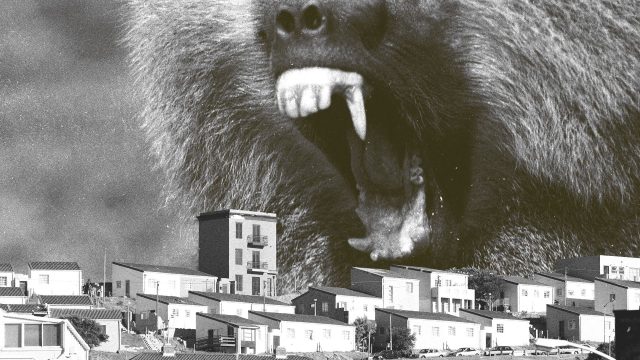
Authorities in South Africa’s capital city have set out plans to round up and remove around 60 chacma baboons, which are increasingly coming “into conflict” with the city’s human residents, said Reuters. The animals can be “intimidating” – males grow up to one metre tall and weigh around 50kg – and this urban primate population has adapted to city life, raiding bins, cars and houses for food.
But plans to move the baboons to a newly built sanctuary have “triggered a bitter dispute” over whether they should be “confined, culled or allowed to coexist with residents”. Protests are ongoing, and the issue could play a major role in Cape Town’s upcoming municipal elections.
‘Divisive’ and ‘expensive’
Problems with baboons in the city stretch back decades but they have “reached boiling point” over the past two years, said The Guardian. In the early 2000s, the city authorities stopped the culling of baboon troops in response to public pressure, but that has since swollen the population by a third – to around 500. Geography is “partially to blame”, too, as the baboons are “boxed in” between the steep landscape of the Table Mountain National Park and “the sprawling urban development that stretches to the Atlantic Ocean”.
Current baboon-management measures in the city have not only been “divisive” but “expensive”. Full-time rangers monitor the groups as part of a programme that costs around R20 million (£900,000) every 18 months. Those who support the baboons being removed say the only serious alternative is culling. Officials believe the primates will be “better off if they are confined” and supported by a high standard of care in alternative locations, said CNN.
There is also a wider plan that includes “strategic fencing, better waste management and stronger by-law enforcement”, said SA People News. Authorities have already started distributing 6,000 lockable “baboon-proof bins” to some of the most affected communities. It remains to be seen how well this solves the competition between people’s need for “safe neighbourhoods” and wildlife’s needs for habitat.
Failure of leadership
“For years, baboons have been chased, paintballed, harassed and subjected to increasingly intensive forms of disruptive management,” said the Daily Maverick. What is fundamentally a failure of environmental leadership has “repeatedly been attributed to the animals themselves”. There have been few attempts to teach householders why food waste should not be mixed with other rubbish in outside bins, for example, “even though this would reduce wildlife attractants”. The baboon-proof bins are a good step, but Simon’s Town, an area where 60 baboons have been identified for removal, has been excluded from the rollout.
Cape Town is a city that “derives so much of its identity, beauty and prosperity” from the nature around it, and many believe that the decision to remove the baboons will be a stain on its environmental record. The city has municipal elections in November, and voters will be all too aware that any solutions to the baboon problem are a “measure of the kind of city Cape Town is choosing to become”.
“The best solution to resolving conflicts is to prevent them,” said US anthropology professor Shirley C. Strum on The Conversation. Preventing undesirable baboon behaviour, like raiding food, is easier than trying to tackle it once it’s become engrained. Translocation methods – like the one the city authorities plan – have been successful in the past but, nowadays, there are “very few places left where baboons can’t get into trouble”. Culling them is highly difficult due to their “wily” nature and, “even if you succeed (which I doubt)”, then “another troop will soon take its place”. It’s difficult but we must face up to the fact that “conflict between baboons and humans won’t change unless human behaviour and attitudes change”.
City plans to remove wild animals have sparked protests, and could even affect upcoming local elections