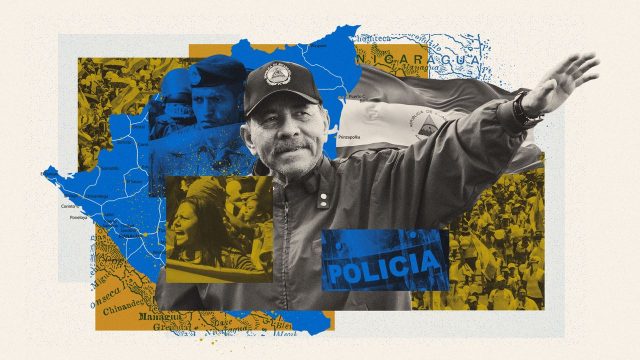
Nicaragua will stop holding elections in a bid to prevent foreign-backed interference, the country’s long-standing president Daniel Ortega has announced.
In a speech to commemorate the Sandinista revolution, which overthrew the US-backed Anastasio Somoza dictatorship in 1979, the 80-year-old strongman leader declared “the days when parties backed by the Yankees and the Somocistas would return to power are over – never again”.
Who is Daniel Ortega?
A key figure in the revolution, Ortega has held office continuously since 2007, having also served as president in the 1980s.
During his nearly two decades in power, his government has transformed Nicaragua into an “authoritarian state”, according to the UN Human Rights Council.
He has cemented control over virtually all branches of government, including the army and judiciary, and crushed political opposition, with hundreds killed and even more imprisoned following mass anti-government protests in 2018. Last year, further constitutional reforms extended presidential terms to six years, made his wife, Rosario Murillo, co-president, and effectively established a one-party system.
Why has he cancelled elections?
The last elections in 2021 were “widely disputed” after Ortega “detained opponents and business leaders and criminalised dissent”, said Reuters. Hundreds of opposition figures were imprisoned in the run-up to the vote, including a number of presidential hopefuls, before being stripped of their citizenship and expelled to the US and Guatemala.
Nicaraguans had been due to go to the polls again next year before Ortega’s recent announcement that “there won’t be any more elections here for them to try to seize the government and seize power”.
But analysts and opposition figures say the move has highlighted the Ortegas’ fear of a growing opposition movement taking root.
“Ortega and Murillo are evidently afraid at the idea that the slightest political opening could create the conditions for dissent to manifest and threaten their grip on power,” said Tiziano Breda, a senior analyst at Armed Conflict Location & Event Data, a non-profit organisation that tracks political violence. “Instead of staging a rigged election, they have opted to eliminate electoral competition altogether.”
What will the international reaction be?
In the wake of the US military raid in January to capture Venezuela’s then-President Nicolás Maduro, the Nicaraguan government announced it would release more political prisoners, “apparently an effort to stave off pressure on itself”, said AP News. “But there has been no follow-up and little transparency on the issue.”
Despite proscribing the Ortega government as a dictatorship, and imposing sanctions on more than 2,350 Nicaraguan officials and their relatives, the Trump administration has remained remarkably quiet on Ortega and the potential for regime change.
There are a “range of explanations” for this, said Politico’s Nahal Toosi, “including that the regime is making smart moves on battling drug trafficking, that it’s benefiting from a lack of natural resources for Trump to covet and that it doesn’t have a slew of migrants in the US”.
“The lesson from Nicaragua is: don’t matter too much, don’t embarrass Washington and don’t become a domestic political issue,” said Juan Gonzalez, a former Latin America aide to Joe Biden. “For an administration that doesn’t care about democracy or human rights, that’s an effective survival strategy for authoritarians.”
Daniel Ortega’s regime ‘evidently afraid’ that democracy could ‘create the conditions for dissent to manifest and threaten their grip on power’