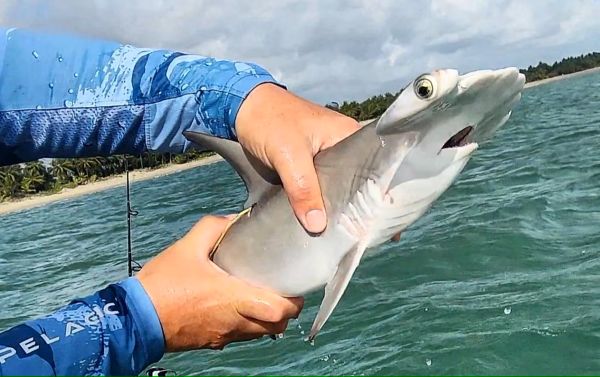

Below, we share excerpts from an article by Melissa Cristina Márquez (Forbes) who explains that new research in Puerto Rico reveals that local scalloped hammerheads are a genetically distinct population, underscoring urgent conservation needs for this endangered species. She writes that “the study highlights a critical regulatory gap where vulnerable species are legally landed in territorial waters despite federal bans.”
In a related article in El Nuevo Día — “Proponen un nuevo refugio marino en la costa de Cataño para tiburón único de Puerto Rico” [A new marine refuge is proposed off the coast of Cataño for Puerto Rico’s unique shark species]— Melanie Ortiz Álvarez (American Association for the Advancement of Science) says that scientists and fishermen are exhorting the government to establish a shark refuge (and a halt to shark fishing) in the Boca Vieja area of Cataño, a reef near the fishing village, which serves as a breeding spot for the scalloped hammerhead sharks (Sphyrna lewini).
Here are excerpts from Forbes.
The first thing most people tend to notice about a shark is its dorsal fin. Can’t blame them: it’s the poster-child for slicing through the water and inspiring everything from awe to anxiety depending who you are. Thanks, Jaws. But sharks have more than just a dorsal fin and in Puerto Rico, it is another fin entirely that is helping scientists better understand one of the Caribbean’s most complex conservation challenges.
The fin in question? The anal fin. It’s a small fin located on the underside of many shark species. It is not particularly impressive to look at, unlike the dorsal or caudal (tail) fin, and it has little commercial value. Yet according to new research, this overlooked body part may hold the key to monitoring shark fisheries more effectively across the Caribbean. “I can’t really take credit for the idea [of using the anal fin,]” says lead author Dr. Devanshi Kasana who performed this work while an independent consultant to Mote Marine Laboratory & Aquarium and is currently affiliated with Oceana. “The method was actually developed and tested first in Belize, where researchers found that shark anal fins can be surprisingly informative [by allowing us] to identify species and estimate the size of the shark that was landed. We sometimes describe them as a kind of ‘biological logbook’ because each fin contains information about what was caught.”
Puerto Rico is home to a small-scale shark fishery driven largely by local demand for affordable shark meat. Compared to industrial fisheries, these operations are relatively modest with fishers often working close to shore and selling their catch through local fish markets. But like many small-scale fisheries around the world, managing them can be difficult. One major challenge is knowing exactly which shark species are being caught. [. . .]
To address this problem, researchers tested a creative alternative: instead of relying entirely on scientists to monitor landings, they asked fishers to save the anal fins from every shark they caught. The fins were dried, collected and later analyzed by researchers. The approach essentially turns fishers into contributors to the “biological logbook.”
Over an 18-month period, fishers at two major fish markets in Puerto Rico submitted nearly 400 shark anal fins as part of a collaborative monitoring program. Researchers then combined fin shape analysis with DNA barcoding to identify which species were being landed and used established relationships between fin measurements and body size to estimate the length of each shark. Altogether, nine shark species were recorded in the fishery; the most frequently encountered was the Caribbean sharpnose shark (Rhizoprionodon porosus), a species prohibited in U.S. federal waters, followed closely by the scalloped hammerhead (Sphyrna lewini), which is also federally prohibited and listed as ‘Threatened’ under the U.S. Endangered Species Act. Nearly all scalloped hammerheads were juveniles, and none had reached maturity.
While it seems like a “small” detail, it actually is a big deal. The scalloped hammerhead is one of the ocean’s most recognizable sharks, defined by its wide, hammer-shaped head and unmistakable profile. But behind that iconic shape is a life history strategy that makes the species especially vulnerable to fishing pressure; these sharks grow slowly, mature late and produce relatively few young over their lifetime. Catching individuals before they have a chance to reproduce can have significant consequences for population recovery. “Unfortunately federally prohibited species making up such a large proportion of the catch isn’t surprising and [is in line with] our previous work,” said co-author Raimundo Espinoza Chirinos, Executive Director of Conservación ConCiencia, a non-profit organization in Puerto Rico dedicated to environmental research and conservation. [. . .]
What’s even more striking is the fact that the Puerto Rican scalloped hammerheads were not only differentiated from the Northwest Atlantic population but also showed genetic separation from populations sampled in Belize and Brazil! In other words, Puerto Rico may represent a unique and previously underappreciated component of scalloped hammerhead genetic diversity, one that the team hopes warrants targeted conservation attention. “As one of the first shark research organization in Puerto Rico, seeing the genetic findings that suggest our scalloped hammerheads are distinct and to date part of a unique Scalloped Hammerhead population is incredibly meaningful,” said Espinoza Chirinos. “It confirms the urgency of our local conservation efforts and highlights why establishing protections like the proposed Boca Vieja Scalloped Hammerhead Wildelife refuge is so vital for this specific population.” [. . .]
For full article by Melissa Cristina Márquez, see https://www.forbes.com/sites/melissacristinamarquez/2026/07/01/scientists-uncover-a-potentially-unique-hammerhead-population-in-puerto-rico/
For full article by Melanie Ortiz Álvarez (in Spanish, with subscription), see https://www.elnuevodia.com/ciencia-ambiente/flora-fauna/notas/proponen-un-nuevo-refugio-marino-en-la-costa-de-catano-para-tiburon-unico-de-puerto-rico/5M
[Photo above is from El Nuevo Día.]
Below, we share excerpts from an article by Melissa Cristina Márquez (Forbes) who explains that new research in Puerto Rico reveals that local scalloped hammerheads are a genetically distinct population, underscoring urgent conservation needs for this endangered species. She writes that “the study highlights a critical regulatory gap where vulnerable species are legally landed in