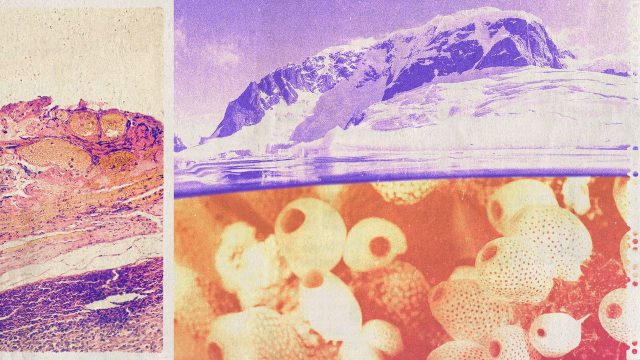
New medicine can be found even in the iciest of locations. During an expedition to Antarctica, scientists discovered a species of sea squirt that may promise a new cancer treatment. The marine organism contains bacteria capable of producing a toxin that could eventually become a widely available drug. However, research still needs to be done on the species and bacteria before it can be tested on humans.
The dive
The cancer-fighting sea squirt, also called an ascidian, was first discovered 20 years ago and identified as a potential cancer therapy. The bacterium in the organism, Candidatus Synoicihabitans palmerolidicus, can “produce the metabolite palmerolide A, which kills melanoma cells without causing too much harm to healthy human cells,” said Discover.
Scientists have now conducted a second expedition to Antarctica to “better understand the compound and explore whether it could someday contribute to new therapies for patients battling melanoma,” said a news release by the University of South Florida. “Our expedition focused on determining where the ascidian’s melanoma-killing bacterium occurs and how widespread it is,” Sam Afoullouss, a postdoctoral researcher who participated in the dive, said in the release. “We also wanted to understand how it lives inside the organism and how that connects to the compounds linked to melanoma research.”
Sea squirts are “sac-like marine invertebrates that tend to live on sloped sea beds,” said the BBC. The ascidians found in Antarctica have “evolved over millions of years to cope with the harsh conditions there, producing chemical defenses that can deter predators and disease.” The discovered species was found at “depths between 60 and 80 feet, often along sloped or vertical seafloor surfaces where water currents are strong,” said the release. These “currents help deliver nutrients that sustain the organisms.” Such conditions allow for the organisms to be highly specialized.
The test
The researchers tested the sea squirt’s bacteria on melanoma cells in mice. “The good news is it didn’t kill the mice,” Bill Baker, a chemistry professor at the University of South Florida who led the first expedition and advised the second one, said to The Guardian. “It did kill their cancer, so we know it has the physiological properties to act like a drug.” The scientists are also analyzing the “quantity and distribution of palmerolide A, the bacterium, and the molecular target of palmerolide A,” Baker said to Discover. “These analyses will help us determine, for example, whether the ascidian and bacterium are working in concert, whether the bacterium is detrimental to the ascidian, or one of several other potential relationships between the two.”
Most FDA-approved drugs originated in nature, and Antarctica could be a rich source of new possibilities. While the sea squirt shows promise, the “pathway to producing a safe and effective anti-melanoma drug, with approval for use in humans, is long,” said The Guardian. It would “require a succession of strictly regulated and ever-expanding trials even after a drug was formulated.” Still, the knowledge gained from this expedition “could significantly advance the timeline.”
The organism may help produce a cancer-killing toxin