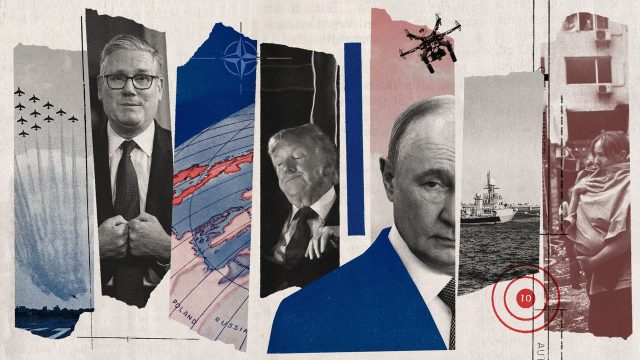
All eyes will be on Donald Trump as Nato leaders gather in Ankara this week following his administration’s warning that allies must step up defence spending “immediately” or face consequences.
Last year’s summit was hailed as a “breakthrough” after members committed to spending 5% of GDP on defence – 3.5% on core requirements and 1.5% on broader security needs – by 2035, said Elsa Ohlen on CNBC.
This year’s gathering is “expected to move the debate from pledges to implementation” on “questions about procurement, industrial capacity, support for Ukraine and the political architecture of what the Trump administration has called ‘Nato 3.0’”.
“This is really the Nato summit where Nato goes from burden sharing to burden shifting,” Ulrike Franke, senior policy fellow at the European Council on Foreign Relations, told the channel.
What did the commentators say?
Nato is “both stronger than it was 18 months ago, when Trump returned as US president, and a lot weaker”, said the Financial Times. It is in “better shape” largely thanks to pressure from Trump to get non-US members to spend more “investing in readiness and rearmament”, and as Europeans take on “more command roles even as the US military remains professional and fully engaged”.
At the same time, the alliance is “much weaker because confidence that the Trump administration would stand by its allies if they are attacked has cratered”. The US, under the unpredictable president, also seems “to lack the discipline to come up with a burden-shifting plan”.
That is why this week’s summit in Turkey has been described as “one of the most consequential” in years, said Radio Free Europe’s Washington correspondent Alex Raufoglu. As the US seeks a “more balanced transatlantic partnership”, it is looking for clear signs that “this relationship is becoming more equal – not only financially, but strategically”.
The “expected focus is on industrial outputs”, but the allied “will to fight back to back is no less important than material defence readiness”, said Visegrad Insight editor Wojciech Przybylski. “Russia knows it better than most” and so this week’s summit will “test the political resolve – whether Western leaders can still project unified purpose and unambiguous strategic intent”.
What next?
Some, such as Poland, the Nordic and Baltic countries, “are doing more than others”, Matt Whitaker, the US ambassador to Nato, said ahead of the summit. “But many others are lagging behind” their pledge to up defence spending by 2035.
The Telegraph reported that Trump is “thought to be planning to reward or punish countries based on their defence spending”. Those with higher spending are likely to be moved “up the queue for the purchase of US weapons and mean they are invited for more face-to-face meetings with the president”.
This “threatens to put the US president on a collision course with Britain”, after Keir Starmer failed to secure a fully funded defence investment plan ahead of the start of the summit on Tuesday.
The UK is now ranked 12th among Nato members in terms of spending per GDP, having been third a decade ago. The outgoing PM is expected to “face down a rebuke” from Trump “in one of his final acts in office this week”, said The Times.
Donald Trump ‘thought to be planning to reward or punish countries based on their defence spending’