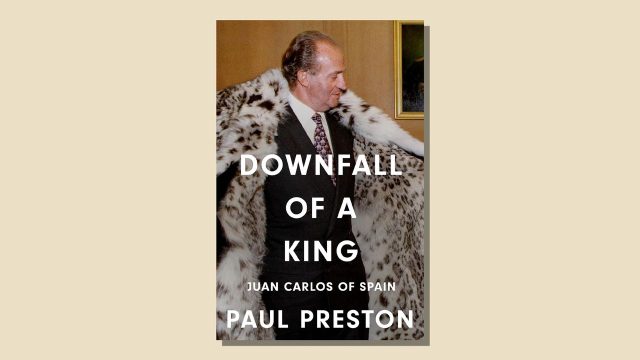
The life of Juan Carlos I, Spain’s 88-year-old former king, has been one of “richly deserved triumph followed by richly deserved disgrace”, said Jim Lawley in The Spectator. And it’s a life that is superbly charted by Paul Preston in this “magisterial” biography.
Born in Rome in 1938, Juan Carlos was the son of Don Juan de Borbon, the exiled heir to the Spanish throne. Aged 10, he was sent back to Spain by his father, to be indoctrinated in the “political tenets” of Spain’s fascist leader, General Franco – who’d intimated that this could pave the way for a “restoration of an authoritarian monarchy”. Taking a close interest in the prince’s education, Franco would regularly lecture his charge “on the mistakes made by previous Spanish monarchs”.
It was a “very lonely” childhood, but Juan Carlos emerged as Franco’s chosen successor, and was proclaimed king after Franco’s death in 1975. Contrary to the dictator’s wishes, he then set about initiating democratic reform. In 1981, his “supreme test came” when he faced down a military coup. “Grateful Spaniards poured out onto the streets”, to hail the king who’d saved their democracy.
If the first half of this book “tells the tale of a lonely boy who turns into a noble king”, then the second “tells of his transformation from noble king into corrupt sleazebag”, said Craig Brown in The Sunday Times.
Having always been “something of a playboy”, Juan Carlos married Princess Sofia of Greece in 1962. But that didn’t staunch his appetite for what Preston calls “industrial-scale adulteries”. Although estimates vary, according to the highest figure mentioned he has slept with 4,786 different women – a voraciousness matched by his talent for procuring mammoth “gifts” from Middle Eastern rulers ($10 million from the Shah of Iran; $100 million from the Saudis), and a taste for “bear hunts and elephant hunts”. In 2014, “beset by political scandal and ill health”, he was “obliged to abdicate in favour of his son, Felipe”. Since 2023, he has lived in Abu Dhabi.
“Preston’s narrative is perhaps needlessly haunted by the question ‘Why?’,” said Jeremy Treglown in Literary Review. Seeking psychological reasons for Juan Carlos’ self-indulgence, he writes of the “strain of having to please two antagonistic masters” – his father and General Franco – and describes a horrifying accident in his late teens, when he fatally shot his “intellectually more able” younger brother while playing a game with an ornamental pistol. Yet the references to his “damaged psyche” don’t seem altogether convincing. “You don’t need to have read ‘Don Quixote’ or ‘King Lear’ to know that some men just go nuts.”
Paul Preston examines the wild rise and fall of Juan Carlos I