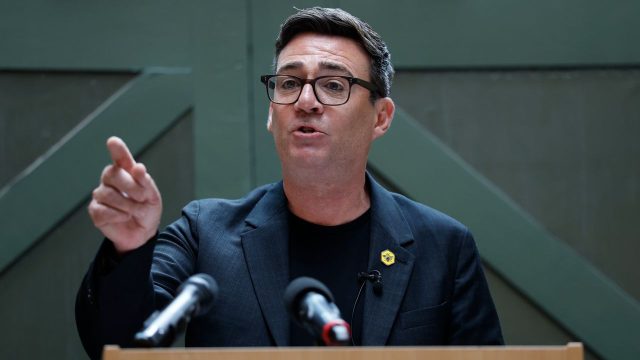
In his first speech as prime minister in waiting, Andy Burnham promised he would achieve “good growth in every postcode” and spearhead the “biggest rebalancing of power” in political history.
Keir Starmer announced his own “devolution revolution” in 2024, but Burnham aims to move even more influence away from Westminster towards other regions of the UK to drive more balanced economic growth.
His speech at the People’s History Museum in Manchester was “important in shedding light on a Burnham Britain”, said The Times. As he was championing a “devolution first” attitude, the support of his audience was “not in doubt”. But the “viability of his proposals was”.
How is the UK already devolved?
Manchester has benefited from some of the “most extensive” powers devolved to English cities, said the BBC. It has significant control over local transport, housing and strategic planning decisions.
Northern Ireland and the Welsh Senedd have similar autonomy over health, education and housing policies among others, with the latter also managing local government. In Scotland, Holyrood controls health, education, local government, environment, justice and policing. It can set most income tax rates and has some control over welfare policy, too.
What has Burnham proposed?
Burnham said he would create a “No 10. North”, a new prime minister’s office based in Manchester and acting as the “nerve centre of a rewired Britain”. It would support regional powers in delivering a nationwide agenda of reindustrialisation, regeneration and reform of essential services.
Local authorities would be offered greater control over key utilities such as water, energy and transport. Burnham’s advisers have also “floated ideas” about allowing local authorities to introduce local income tax and, and set and retain business rates to mirror policies in Denmark, Sweden and Canada, said Matthew Brooker on Bloomberg.
The dispersal of power has already begun. The MP for Makerfield has appointed Caroline Simpson as his deputy chief of staff to lead No. 10 North should he become prime minister, said The Guardian. Previously described as Burnham’s “right-hand woman”, the career civil servant has overseen Greater Manchester’s £3 billion-a-year budget since 2024.
What is the aim?
The UK is one of the most centralised economies among developed countries, said Brooker. In 2023, the share of UK tax revenue generated at a subnational level – essentially by regions below the central government – was less than 5%, according to the Organisation for Economic Co-operation and Development. This is compared with 14% for France, 24% for Spain and nearly a third for Germany. “Regions tend to do better when they raise more of their own revenue.”
If Burnham’s devolution policies prove successful, the “big prize” would be a rise in nationwide GDP, said Bloomberg. If the rest of the UK came even halfway to matching London’s productivity levels, the economy would be “at least 4% larger”, according to PwC analysis from 2019.
There has been no indication how Burnham will split his time between London and Manchester, but the decision felt “more significant than the relocation of staff”, said the BBC’s chief political correspondent Henry Zeffman. With a tailored agenda, it could signify a “wider shake-up of the machinery of government is in the offing”.
“Rethinking and reshaping No. 10 is long overdue,” said the Institute for Government. But Burnham’s plans for No. 10 North will only succeed if “he knows – and spells out in public – what a split operation is for”.
Likely PM looks to surpass Starmer’s ‘devolution revolution’, redistributing more power away from Westminster to regions like Manchester