“Hew Locke: Passages” is now open at the Museum of Fine Arts Houston (MFAH). This traveling exhibition is on view from June 21 through September 13, 2026.
Description: Hew Locke reinvents the signs and symbols that define public spaces—from statues to coats of arms, royal insignia, official portraits, monuments, and imperial architecture. He uses photography, drawing, sculpture, and assemblages to explore the histories of colonialism across five continents—filtered through present-day realities of global trade, migration, and diaspora.
The most comprehensive survey of Locke’s work to date, Hew Locke: Passages showcases the spectrum of his practice through three decades of his sculptures, collages, and assemblages.
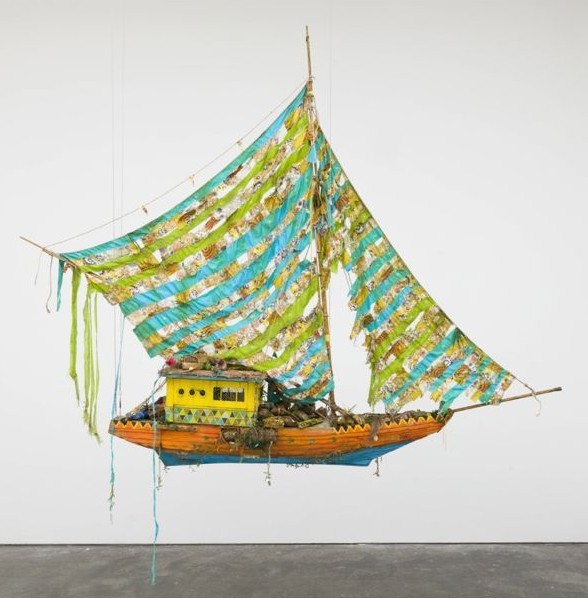
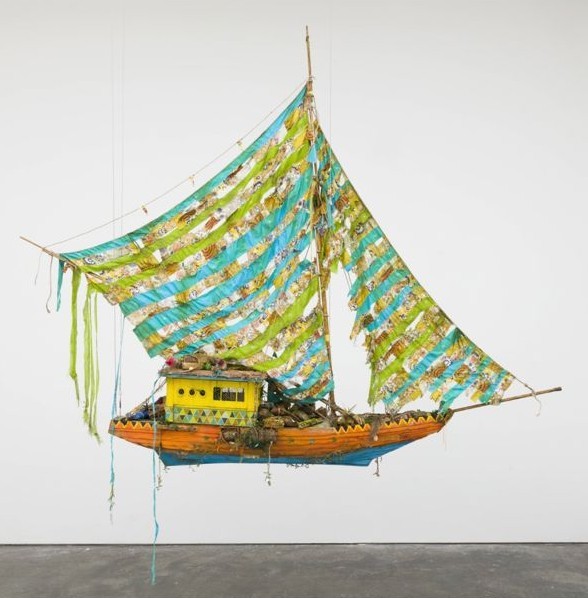
Highlights include examples of Locke’s altered royal coats of arms and historic stock-share certificates; his suspended sailing vessels, which summon both the trans-Atlantic histories of enslavement and current refugee crises; his reimagining of commemorative equestrian monuments; and his richly detailed Infanta charcoal drawings, which reinterpret the imperial portraits of Diego Velázquez.
Acclaimed as one of the most distinctive and thought-provoking multimedia artists working today, Locke was born in Scotland in 1959, moved with his family to Guyana in 1966, and returned to Britain in 1980. He says that if he weren’t an artist, he would be a historian. “A lot of my work has to do with the burden of history and how history affects us today.”
For more information, see https://www.mfah.org/art/exhibitions/hew-locke-passages
Also see https://www.instagram.com/hewdjlocke/ and https://hewlocke.net/Q
[Shown above: a key work in the exhibition: Hew Locke’s “The Survivor.”]
“Hew Locke: Passages” is now open at the Museum of Fine Arts Houston (MFAH). This traveling exhibition is on view from June 21 through September 13, 2026. Description: Hew Locke reinvents the signs and symbols that define public spaces—from statues to coats of arms, royal insignia, official portraits, monuments, and imperial architecture. He uses photography, drawing,