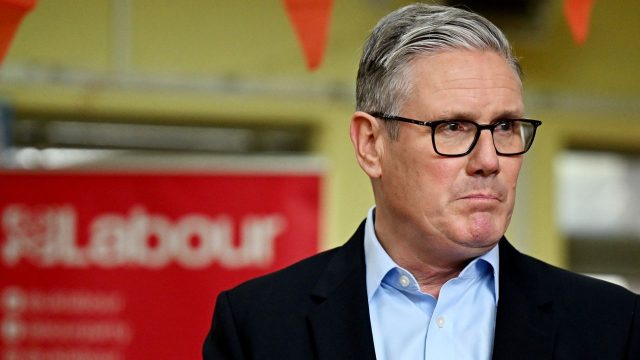
Two Ukrainian men have been found guilty of plotting arson attacks last year on property relating to Keir Starmer.
The trial of Roman Lavrynovych, 22, Stanislav Carpiuc, 27, and a third man was “strange”, said the BBC, “mainly because the true author of the drama was never revealed”.
But as more details of the case come to light it has revealed a shadowy network of online provocation and misinformation allegedly orchestrated from Russia that constitutes what the PM called “an attack on democracy” itself.
El Money
During the six-week trial at the Old Bailey, jurors heard that the fires at Starmer’s former family home and other related targets were ordered by a Russian-speaking handler on the encrypted messaging app Telegram. Going by the pseudonym “El Money”, he directed Lavrynovych to carry out the attacks in exchange for promises of payment in cryptocurrency.
A Financial Times investigation “based on Telegram archives, cryptocurrency wallets, court evidence and interviews with Western officials” established that El Money was “located in Russia and was closely aligned with NoName057(16), a pro-Kremlin hacktivist group that the US has called a Russian ‘state-sanctioned project’”.
But the Russian embassy told the BBC: “We reject any attempt to associate Russia or its foreign ministry with unlawful activities.” It said that Russia poses “no threat to the United Kingdom or its people and harbours no aggressive intentions towards Britain”.
Now the BBC has identified evidence suggesting that El Money, or EL as he was known on Telegram, “is a young Russian diplomat, schooled in information warfare by spies and propagandists, who is close to the highest levels of power in Moscow”. The broadcaster named him as 23-year-old Evgeny Lyukshin, the son of a senior official.
It concluded that the arson attack was “just one part of an extensive campaign of sabotage, provocation and lies leading all the way to the Russian state”.
Part of this misinformation campaign included a “conspiracy theory falsely claiming that the arsonists were male prostitutes seeking revenge” on the PM, said The i Paper. Research by The i Paper and the Center for Countering Digital Hate charted the false “rent boy” rumour, which first emerged online less than 15 minutes after Lavrynovych was arrested and before it was made public by the police. The rumour spread from a “handful of small X accounts, through a network of far right activists and conspiracy theorists, into Russian media outlets and widespread online circulation”.
The accounts where the claim originated did not appear to be directly part of Russian disinformation networks. But Melanie Smith, from the Institute for Strategic Dialogue, said Russian propagandists continually “monitor the online ecosystem” – particularly the far right in Europe – “trying to figure out which narratives are circulating and which ones of those work to their advantage”.
Russia’s war against the West
While not proven in court, the alleged involvement of Russia “points to a series of incidents in recent years, which, though piecemeal and hard to prove, lay bare how Russia’s intelligence services have moved towards a new kind of attack on the West”, said The Guardian.
“Dozens of people” have been detained across Europe – in Britain, Lithuania, France and Estonia – “accused of being foot soldiers in a new front of Russia’s war against the West”. This “war” includes Moscow-backed campaigns of “sabotage, arson and disinformation against the continent”.
Russian nationalist cyber groups like NoName, linked by the FT to last year’s London arson attacks, “have sought to recruit proxies online to further the Kremlin’s geopolitical interests, as well as foment disorder across Europe by amplifying far-right and anti-migrant messages”.
Britain, in particular, has become a “soft target” for Russian and other state propaganda because of a failure to educate people on how to deal with information warfare. This leaves it “extraordinarily vulnerable”, security expert Fiona Hill told a recent parliamentary committee.
“As it becomes harder to convince Russians that their own country is on the up, Vladimir Putin is instead presenting the West as not just hostile but in crisis”, said historian Mark Galeotti in The i Paper. The Kremlin “eagerly mines the news for stories it can spin, shade and downright misrepresent to advance these lines”, and Starmer’s misfiring government is “offering ample opportunities”.
As one staffer at the state-controlled Channel One news operation in Moscow said of the UK government: “There’s a combination of belligerence and incompetence there, a self-righteousness and lack of self-awareness that is just too good to pass up.”
Russian cyber proxies ‘foment disorder across Europe’ to further Kremlin’s interests