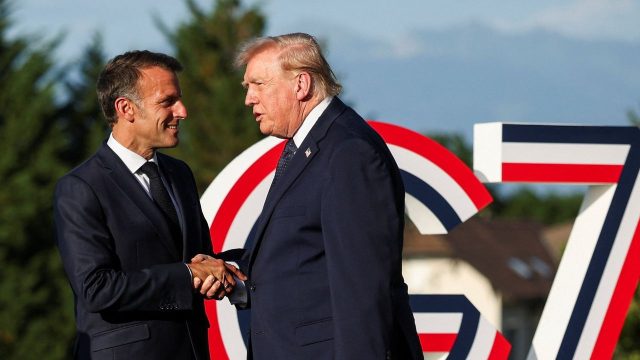
Host Emmanuel Macron is expected to pull out all the stops for this week’s G7 summit to prove that this gathering of the world’s richest democracies still matters in an age of strongman politics.
In one of his last big diplomatic set pieces before his presidential term winds next year, Macron “will seek to paper over divisions” between Donald Trump and the other six leaders, said Euronews. Top of the agenda will be trying to “forge common positions on how to end the war in Ukraine”, on the resumption of traffic through the Strait of Hormuz, and on “the development of safer technologies”.
What did the commentators say?
The summit is being held in the alpine spa town of Évian-les-Bains. The last time the G7 met here was in June 2003, when the US had invaded Iraq despite “the strident objections of France and Germany”, said Mark Landler, France editor of The New York Times. Then-US president George W. Bush “got chilly handshakes” but he worked hard with the other leaders “to maintain the veneer of like-minded countries uniting to confront the perils of an unruly world”. Two decades later, it’s the same town but another American war in the Middle East, and any “veneer” of unity has been “stripped away”.
The G7 is “a forum created to solve geopolitical crises but it was excluded from the US-Israeli planning for war” with Iran, said Flavia Krause-Jackson, Bloomberg’s Europe editor. And it was ignored by the US in both the diplomacy for and the timing of the peace deal, which Trump announced the day before the summit, with the signing taking place after it ends.
The truth is that while, collectively, the G7 nations – France, Italy, Germany, the US, the UK, Canada and Japan – might account for 45% of global GDP, individually, few would count as one of the world’s “biggest or indeed most powerful economies”, said Jonathan Moules in the Financial Times. And Trump would clearly rather play geopolitics with Vladimir Putin or Xi Jinping than waste time building consensus with leaders he views as weak.
For their part, Canada and Europe “no longer view the US as a partner on key issues such as climate change and security”, said Landler in The New York Times. And some even see America as a “threat”, given Trump’s “deepening disdain for Nato” and his repeated pursuit of Greenland. Across the group, there are “diverging opinions” on “how far to pull away from the US” but that’s certainly the direction of movement.
What next?
Expectations of what this three-day summit can achieve are “already low”, said Clea Caulcutt on Politico. “Despite all the efforts of the French presidency, the G7 format has lost much of its relevance,” an EU official told the website.
“They will talk, but I’m not sure anything will come out of it,” said a former French official. And even if it did, “any gains secured could be fleeting” with such a mercurial US president. In the end, it’s really all about keeping up appearances. As one European diplomat put it bluntly: “It will be a success if there is a family photo.”
Top-nation summit has ‘lost much of its relevance’ in Donald Trump’s world, say diplomats ahead of annual gathering in Évian-les-Bains