The world-renowned Bayeux Tapestry will embark on a “highly secretive journey” to cross the Channel on loan to the British Museum, said ITV News. The artefact, which depicts the Battle of Hastings in 1066, has reportedly been insured for “around £800 million” by the UK Treasury during its 10-month stay, which will begin in September.
The 70m embroidery, believed to have been created in the 1070s by English needleworkers, has left Bayeux only twice in 950 years. In 1803, it was displayed in Paris by Napoleon to inspire troops against the British, and during the Second World War it was moved several times to protect it from damage and the Nazi occupation.
The Tapestry is the “single most recognisable and understood object in our history”, said former Chancellor George Osborne, now chair of the British Museum, told the Financial Times. “The only thing that comes close is Stonehenge, and nobody’s going to be moving that any time soon.”
Dress rehearsals
The announcement of the loan “caused uproar” in France, said The Telegraph. A petition started by La Tribune de l’Art newspaper garnered around 78,000 signatures protesting the move due to the fragile condition of the tapestry. An assessment of the fabric in 2021 found that it contained “24,000 stains, 16,445 creases, almost 10,000 areas of damage and about 30 tears”.
A new “highly detailed” report on the arrangements for the tapestry’s transportation has “eased many concerns”, said Le Monde. “Nothing has been left to chance”, said Delphine Christophe, director general of heritage and architecture in the Ministry of Culture.
British roads – which generate “far more intense and constant vibrations” than their French counterparts – are the main source of concern. As such, teams have tested seven routes, and experts have “mapped every pothole and bump along the route from Bayeux to the British Museum”. Vibrations have now been “reduced by 96%”, said the outlet. This is about the “same level of movement a sculpture experiences on its pedestal in a museum”.
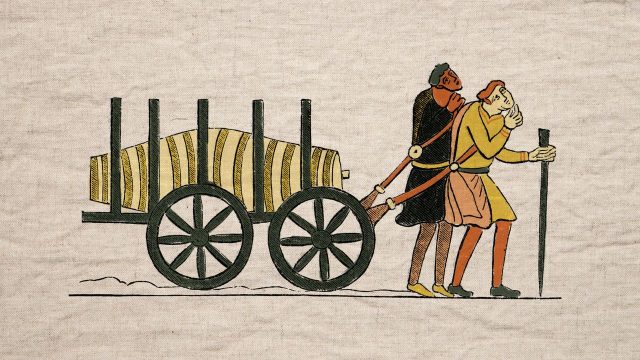
For the journey, the tapestry will be stored in a 1.6 ton “specially built climate-controlled crate” which is “literally suspended in mid-air” to minimise adverse motion. Two “full dress rehearsals” using a replica of identical length and weight have already taken place to practise proper handling of the 900-year-old work. The tapestry itself is currently being stored in a “secret location”.
‘Arduous’ journey
The Bayeux Tapestry is more than an artefact, said Financial Times political editor George Parker. Its arrival on British soil will be “hailed as a symbolic reconciliation of Britain and France after the chaos and bitterness of Brexit”. Ironically, despite depicting violent and bloody conflict between the Normans and Anglo-Saxons, the effort to bring the tapestry back to the UK has become a “symbol of Anglo-French co-operation”.
Britain’s journey to displaying the Bayeux Tapestry has been “arduous”, said The Independent. Requests to exhibit it in London have been “rejected several times”, most notably for the coronation of Queen Elizabeth II in 1953, and for the 900th anniversary of the Battle of Hastings in 1966. President Emmanuel Macron, however, first “signalled his eagerness for the move” in 2018, although progress was stalled by the Covid pandemic.
Now, the British Museum is “set to hit the jackpot”, said Le Monde. The cost of installing, displaying and protecting the piece, none of which will be covered by France, is “classified and likely enormous”. But considering that the tapestry has attracted around 400,000 visitors in Bayeux, the museum could easily expect to generate at least “€10 million” (£8.6 million) in ticket sales.
This will be the “museum event of the century”, but it may not be the easiest viewing experience, said Apollo Magazine. Time slots for viewing will be “only 40 minutes”, which has caused the art community to “raise an eyebrow”. “With the tapestry being 70m-long, that means each visitor has about 34 seconds to move along the work in 7cm intervals.”
British potholes just one obstacle in epic journey that has become ‘symbol of Anglo-French co-operation’