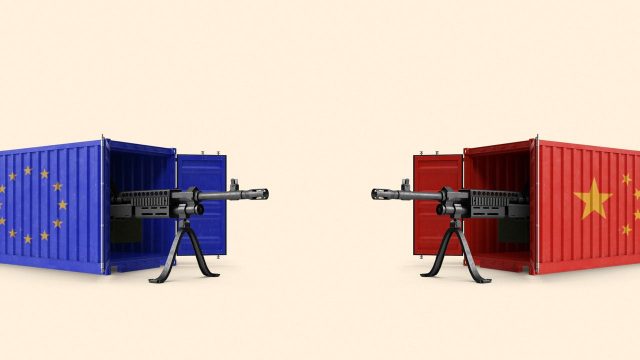
China’s manufacturing might is overwhelming Europe, and Europe is gearing up to push back. A trade war could be in the offing as Brussels seeks to protect the continent’s workers and factories from a flood of inexpensive imports from state-backed Chinese manufacturers.
European Commission President Ursula von der Leyen is aiming for a “major crackdown on subsidized Chinese imports,” said Politico. Europe cannot “be the victim of a predatory strategy that is destroying our industry,” EU industrial strategy chief Stéphane Séjourné said to the outlet.
China is warning it will retaliate against any EU action. Europe is “going further and further down a radical path,” said state-run social media account Yuyuantantian, per The Wall Street Journal. The tit for tat could further unsettle a global economy already rattled by President Donald Trump’s trade policies and fallout from the Iran war.
What did the commentators say?
The Chinese economy is “taking everyone down,” Michael Schuman said at The Atlantic. The country has become a “government-subsidized, export-driven manufacturing juggernaut” that is “alienating trading partners.” That includes Europe, where Chinese imports are “costing Germany 10,000 manufacturing jobs a month.” The success of China’s export strategy may make its businesses seem “unstoppable,” but its continuation relies on the “assumption that other countries will continue to absorb China’s exports.” Beijing may instead be pushing its rivals to embrace a “protectionism that depresses prosperity for everyone.”
“What, precisely, is the problem with Chinese surpluses?” Martin Sandbu said at the Financial Times. Chinese car imports have indeed increased in recent years, but that merely “displaced imports from elsewhere.” The overall number of vehicles shipped into the EU has “remained steady” during that time. Europe could benefit from manufacturing competition “as a spur to faster productivity improvements at home.” That would be good both for European businesses and “for consumers.”
The EU may be “finally waking up to China,” Peggy Corlin and Luca Bertuzzi said at Euronews. The reassessment “has been long in the making” after “decades of deepening economic dependence.” But Europe is not entirely united on the issue. Germany, for example, is still focused on “securing market access for German companies in China,” while Spain is welcoming a “growing share” of Chinese investments. “Political will” is the “key determining factor” in what happens next.
What next?
Europe’s search for solutions is “increasingly urgent,” said The New York Times. EU officials are worried about the “imminent collapse of industry,” Jeromin Zettelmeyer, the director of the Bruegel think tank, said to the outlet. “The tone is basically panic.”
Curbing imports could ultimately be “profoundly tricky” in a European marketplace where consumers have become “hooked on what China is selling,” said the Times. The issue may soon come to a head. “Global economic imbalances” will be on the agenda for the G7 Summit of European and North American leaders later this month.
EU seeks ‘major crackdown’ on flood of imports