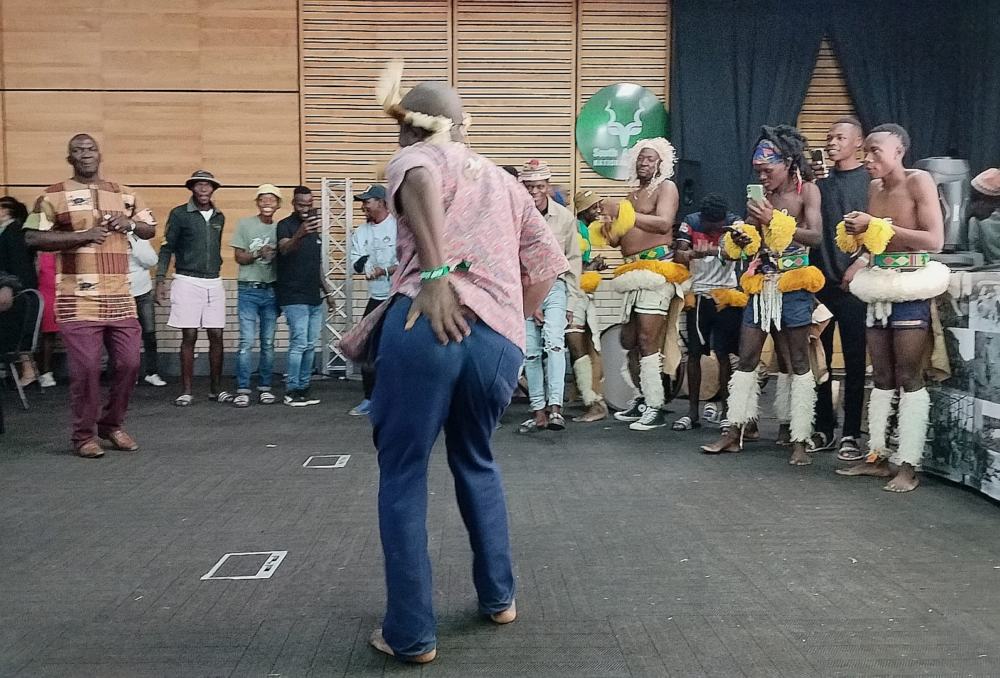
A gripping performance of the muchongolo traditional Tsonga dance, the ululating of women, thunderous applause from a delighted, predominantly rural audience, the beating of drums and a message-driven choral music rendition echoed through Kruger National Park’s Nombolo Mdhluli Conference Centre — named after a legendary ranger who worked at the globally acclaimed conservation area for 52 years.
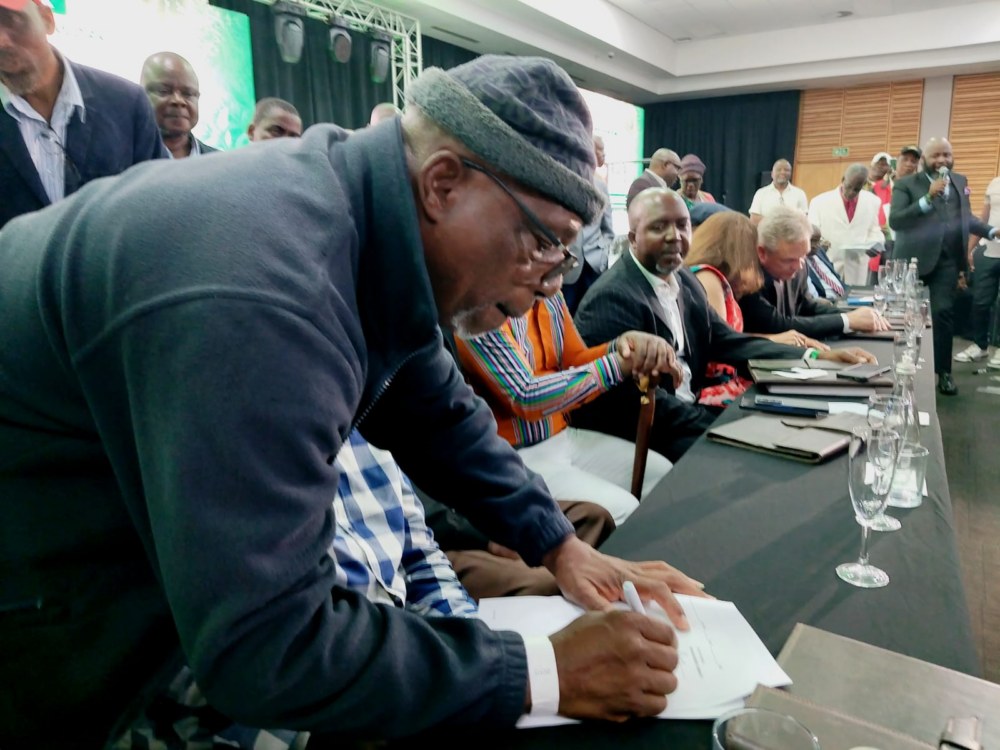
For forestry, fisheries and environment minister Willie Aucamp, the historic occasion provided an opportunity to join in the Tsonga dance moves as South African National Parks (Sanparks) board member Rachel Nxele, chief executive Hapiloe Sello, land claims committee chairperson Chief Luvhuwani Matsila, traditional leaders and local communities celebrated the signing of the watershed beneficiation scheme framework agreement.
According to Sello, the signing on Friday of the sixth version of the post-democracy agreement, driven by principles of inclusive conservation, took 10 years to realise, requiring long working hours, sweat, sleepless nights and moments of frustration before the parties could reach the milestone.
So slow was the pace of achieving meaningful progress in negotiating a final deal among the parties that Sello likened years of delays to “grass in Kruger stopping growing because of the to-and-fro” — illustrating a decade-long state of indecision.
Sello said: “To the people of the soil, owners of the land on which we stand, I am humbled and deeply honoured to stand here today after a decade, witnessing what will one day be written in the annals of history.
“Our grandchildren will tell this story to their own grandchildren.
“A higher power has worked with us over the past 10 years, during which there were many meetings — some productive and some not.
“Negotiations collapsed and were revived, with tensions setting in and requiring all sorts of interventions.
“Ultimately, we found common ground, which took a great deal of effort.
“I must thank everyone involved in the process. The owners of the land brought a significant amount of respect to the negotiations.
“With talks now behind us, the hard work begins.
“It is phase two, requiring even more hard work and attention to detail.
“We have to ensure that governance and compliance are followed, and that the agreement is interpreted and implemented correctly, delivering opportunities and tangible benefits to our partners, the landowners.”
Explaining the workings of the beneficiation scheme agreement, Sanparks head of communications JP Louw said the Beneficiation Scheme formed part of the overall settlement agreements entered into with communities in line with government’s efforts to address land dispossession.
Louw said the minister of land reform and rural development, Mzwanele Nyhontso, as custodian of government’s land restitution programme, supported the initiative and had signed the beneficiation agreement.
Through the scheme, Sanparks was “enabling structured access to commercial and non-commercial opportunities for qualifying previously dispossessed communities through investment, employment and entrepreneurial opportunities”.
“These include participation in concessions, enterprise and supplier development, bursary funding, skills transfer and long-term livelihood creation linked to the park economy.
“This agreement is structured in such a way that it safeguards Kruger National Park as a vital national asset, ensuring that its conservation efforts and operations continue uninterrupted and ensuring land claimants benefit from their ancestral land without taking up residence within the park.
“The scheme is not designed as a once-off intervention but as part of a broader, systematic and ongoing approach to integrate historically dispossessed communities into the mainstream of conservation-led development,” said Louw.
The scheme, he said, provided “a model of conservation that works for people and the environment alike”.
“The success of the scheme will be measured not only by economic outputs but by the strength of the relationships that are built and the opportunities it unlocks together with communities.
“It also complements ongoing initiatives within the Kruger National Park area, including skills development programmes, SMME incubation and investments linked to eco-tourism commercial opportunities.
“Collectively, these efforts are intended to unlock the full socio-economic potential of the park in a way that balances conservation imperatives with human development needs.”
Aucamp described the Kruger centenary as “a milestone that invites the country to reflect on a century of conservation while deliberately shaping a more inclusive and development-oriented future”.
“The beneficiation scheme is based on partnership, opportunity and shared value for both these communities and Kruger National Park.
“This initiative reflects our commitment to managing national parks in a way that ensures inclusive economic opportunities.
“Conservation must be a driver of development, and communities must see themselves in the value that flows from these landscapes,” Aucamp said.
He said national parks were not isolated assets but shared national resources whose sustainability depended on strong, mutually beneficial relationships with surrounding communities.
Sanparks interim board chairperson Beryl Ferguson said Kruger’s lessons “have offered us a commitment to a shared future”.
Ferguson said: “The establishment of Kruger National Park in 1926 came at a cost to many of the communities represented here today — people who were dispossessed of land that they had occupied, used and cared for over generations.
“Today, we acknowledge that history openly and with humility.
“Sanparks recognises that restitution is not only about financial compensation.
“It is about restoring dignity, enabling participation and ensuring that conservation delivers meaningful value to those who were historically excluded.
“The beneficiation scheme is a governance instrument grounded in fairness, transparency and long-term sustainability.
“It is also an acknowledgement that progress has not always moved at the pace our stakeholders deserved.
“We are therefore deliberate in positioning today as a turning point where accountability shifts from commitments to implementation.”
Former Kruger National Park managing executive Gareth Coleman, who is credited with playing a crucial role in the negotiations, said suggestions that he was central to the process were overstated.
“As managing executive of the park for about two and a half years, I was part of the process with Chief Matsila.
“With Chief Matsila and the board, we got the process going around the beneficiation scheme.
“It has not been easy.
“The journey has not been easy leading up to today.”
Coleman said the journey was not smooth.
“Perhaps the major difficulty was a misunderstanding at the outset of the settlement agreements.
“There were different expectations between Sanparks and the land-claiming communities about the meaning of the initial settlement agreements and the extent of expectations regarding their content.
“I think it was a difficult starting point and a question of trying to find each other.
“The signing of the scheme is of huge significance.
“In this area, people or communities who used to own this land have now signed an agreement in which their rights to the land have been acknowledged far more centrally than in the past.
“It is about people getting their dignity back — what South Africans want.
“It is not necessarily the financial reward that comes with it.
“It is an acknowledgement that we were here, are still here and will be here in the future.”
President Cyril Ramaphosa will on Saturday evening deliver a keynote address at Kruger to mark the park’s 100th anniversary.
Historic deal sees communities set to gain from sche signed with SANParks