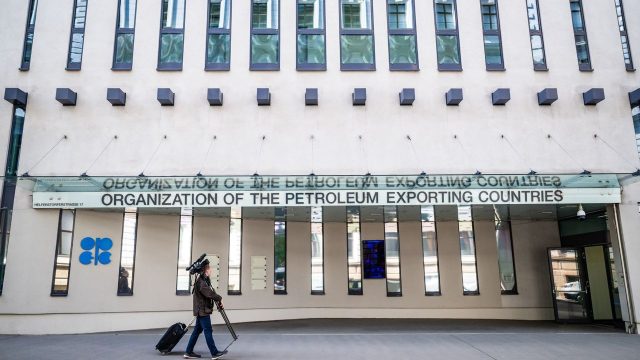
On 28 April, the UAE, which produces about 4% of the world’s oil, thanked the Organisation of the Petroleum Exporting Countries (Opec) for “five decades of cooperation”, then resigned.
Opec is an intergovernmental group that imposes production quotas on members to keep oil prices “fair and stable”, it says; economists see it as a classic example of a cartel, a group that collaborates to reduce competition and raise prices.
Why did the UAE leave Opec?
The UAE is thought to have left because it wants to increase production, against the wishes of Saudi Arabia, Opec’s de facto leader, but it had also recently been attacked by another member, Iran. In theory, the UAE could now export more oil, lowering the commodity’s soaring price. But thanks to the continued closure of the Strait of Hormuz (through which over half of the UAE’s oil and all of its gas usually passes), and the chaotic state of the peace negotiations between the US and Iran, energy markets barely moved. Some analysts, however, called it “the beginning of the end of Opec”.
Why was Opec created?
From the 1930s until the 1970s, a group of seven Anglo-American companies known as the “Seven Sisters” – the ancestors of today’s BP, ExxonMobil, Chevron and Shell – dominated the world oil market. They had secured long-term concessions across the Middle East, as well as in Venezuela and Indonesia, which meant they controlled over 80% of world supplies.
Producer nations were initially given only modest payments in return. After the Second World War, oil-producing countries increasingly chafed under the Seven Sisters’ grip, often demanding a larger share of revenues. In 1951, Iran nationalised its oilfields, which was reversed by a US- and British-orchestrated coup.
Around the same time, Saudi Arabia negotiated a 50:50 revenue-sharing deal with Aramco, the (then) US-owned Saudi oil company; this model soon spread. Even so, the Seven Sisters retained control over prices and production, as well as refining and distribution. Opec was created in response.
How did it come into existence?
In early 1959, in response to growing Soviet oil production, the Seven Sisters cut prices by 10%, infuriating the oil ministers of Venezuela and Saudi Arabia, who started making plans that year in Cairo. In September 1960, shortly after another price cut, Opec was founded in Baghdad by Venezuela, Iran, Iraq, Kuwait and Saudi Arabia, in an effort to reshape the system in the producers’ interests.
The first international organisation led by what was then called the Third World, Opec worked incrementally at first, driving “participation agreements”, which gradually transferred ownership of oil companies to host governments. But it also expanded its membership: Qatar, Libya, Indonesia, Algeria and Abu Dhabi (the largest emirate) joined in the 1960s; Nigeria joined in 1971. By 1973, when an oil crisis shook the world, Opec controlled more than half of global oil production.
What happened in 1973?
In October, King Faisal of Saudi Arabia and his Arab allies – enraged by US support for Israel in the Yom Kippur War against Syria and Egypt, and Israel’s continuing occupation of East Jerusalem and the West Bank – convinced Opec to hike the price of oil from around $3.01 to $5.12 per barrel; the Arab nations also imposed an oil embargo on the US and other nations that backed Israel.
By early 1974, the price had risen above $12 per barrel – a 300% increase. Although the embargo only lasted until March 1974, it triggered a two-year global economic crisis, creating oil shortages and spiralling inflation, and bringing the West’s postwar boom to an end, with all manner of long-term consequences.
The long tail of the 1973 oil crisis
It’s hard to overstate the effects of the 1973 crisis and the “stagflation” that ensued, which exposed the great vulnerability of Western nations, raised unemployment sharply and accelerated deindustrialisation. It has been plausibly linked to everything from a great shift in the world financial order to the invention of punk rock.
In the UK, it speeded up the development of North Sea oil and gas fields (discovered in 1965), and the adoption of natural gas for home heating; France pivoted sharply to nuclear power. Energy conservation only became a priority as a result of the crisis.
In the US, it permanently changed the car industry, opening up the market for lighter, more fuel-efficient – often Japanese – vehicles. This, in the long run, helped make the Toyota Corolla the bestselling car of all time.
There were also unanticipated consequences in Saudi Arabia, where the monarchy used the great oil wealth created to promote a puritanical, fundamentalist version of Islam. (Among the beneficiaries of the ensuing construction boom around holy sites were the bin Laden family.) This was partly to counter the spread of left-wing ideas in the Arab world, though King Faisal, a pious man, was said to be sincerely horrified by “the spiritual dangers of easy affluence”.
Did the strategy work?
The embargo’s main objective was to pressure the US into making Israel leave the Palestinian territories it had occupied in 1967. This didn’t happen, but Opec kept prices high through the 1970s: the decade saw one of the largest transfers of wealth in history, as “petrodollar” infusions from industrialised nations to nationalised oil firms allowed Opec members to fund massive infrastructure projects, build up their militaries, and establish welfare states.
The Iranian Revolution of 1979 also kept prices up. At the same time, rich countries took steps to become less dependent on oil; while soaring prices encouraged new exploration, from Alaska to the North Sea, and the Soviet Union became a major producer.
What effects did this have?
The resulting “oil glut” in the 1980s meant that Opec’s power drained away. Opec decreased oil production quotas to stabilise prices, but members failed to comply, producing above their limits; while non-Opec producers pumped out more to fill the gap. Saudi Arabia, frustrated and losing market share, opened the spigots in 1986, crashing the oil price. In the years after, quotas were largely restored – but Opec’s ability to affect world prices was relatively limited, and poorer members often chafed at the restrictions.
What is the situation today?
US shale fracking technology meant that, in 2018, it overtook Saudi Arabia and Russia as the world’s largest producer. Partly in response to these changes, Opec+ had been formed in 2016. A looser group that includes big producers such as Russia and Mexico, it controls about 40% of the world’s output; but the complex, diversified global system limits its power, while smaller Opec members complain that policy is decided by the “Big Two”, Saudi Arabia and Russia. This was one reason why Qatar left Opec in 2019, damaging the image of a unified Middle Eastern bloc; Angola and Ecuador have also left.
The UAE’s departure is on a different scale: it was the cartel’s third-largest producer. The immediate effects are limited by the Iran crisis. But without its “swing” capacity to increase production fast, Opec’s ability to act as a “global central bank for oil” is diminished.
Last month, the United Arab Emirates announced its withdrawal from Opec, threatening the once-mighty oil-producing group