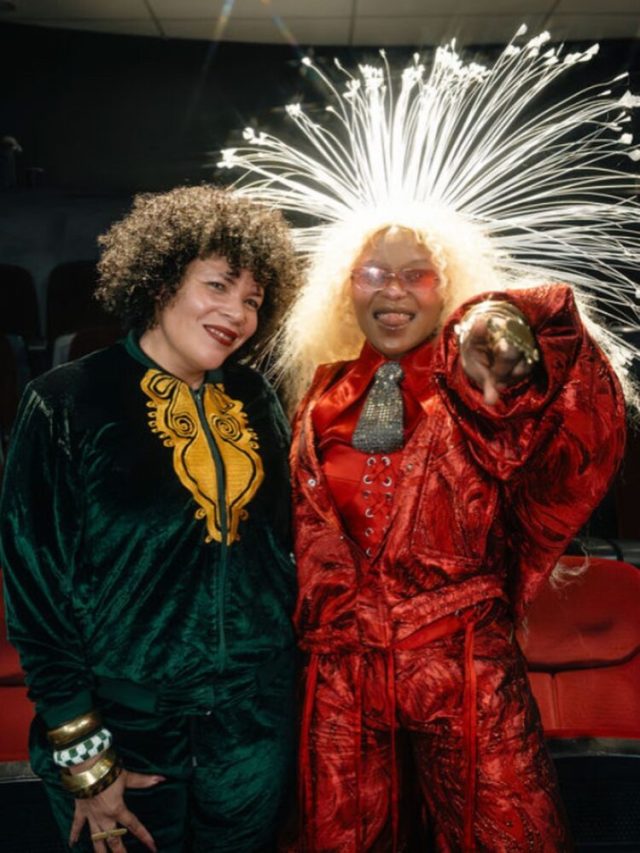
Maria McCloy had a life and impact so big that it feels impossible to quantify. The DJ, publicist, fashion designer, cultural connector, mentor, champion and friend passed away at age 50 on Tuesday, 12 May 2026, at Milpark Hospital in Johannesburg following heart failure.
The news sent a shockwave through South Africa’s arts and culture community, leaving behind a silence where so much energy, warmth and movement had always been.
Her family, in a statement released shortly after her passing, described her as “a vibrant and creative soul who embraced life wholeheartedly”. They spoke of her kindness, her warmth, her generosity and her unwavering love for the people around her.
“She had a special way of bringing people together,” they wrote, “and her presence brought comfort, laughter and love to all who knew her.” She is survived by her mother, her two beloved sisters Thandiwe and Natasha and a vast extended family of friends and collaborators whose grief is as public as the love she gave them.
To understand who Maria McCloy was, you have to understand what she did. And then you have to understand that the doing was never really the point. The point was always the people.
Singer-songwriter Zoë Modiga, one of many artists whose careers McCloy championed, reached for a distinction that cuts to the core of what made her singular.
“I’m not talking about a hopeful, dreamy, ‘best wishes’ love,” Modiga wrote in her tribute, “but a DOING LOVE. Refreshingly no fluff, matter of fact, straight talker, fiery, ‘let’s do this’ and completely in your corner kind of love. She would work you to the bone but unlike most times, you’d look around and be the one on top of the little hill you built.”
Their most recent collaboration was one for the books. Modiga had reached out to McCloy in a mild panic ahead of her album launch at the Market Theatre on 23 April 2026. She needed the seats filled and the support to be there.
“Guess who came through for us?” Modiga wrote. “From a panic to a sold-out show.” It would be their last project together. “There were so many more plans. Ideas. But to have realised what we were able to — that’s a blessing. A gift.”
McCloy’s roots in the Johannes–burg cultural landscape ran deep and long. Journalist and writer Palesa Segomotso Motsumi traces her own career back to McCloy’s influence.
“Before there was Milisuthando Bongela, there was Maria McCloy covering the cultural beat at the Mail & Guardian,” Motsumi wrote, “and she always sent stories to cover my way. Always courteous and down to unearth and develop new voices and talent.”
The relationship between the two stretched across decades and cities. “I will be 40 years old next year and when I bump into Maria — in Bloemfontein, in Johannesburg — she would treat me as a peer. She was a queen. Unmatched and graceful.”
Motsumi’s account of McCloy’s influence dates back to 2014, when McCloy launched her eponymous brand and extends all the way to their most recent conversations about the Montreux Franschhoek Jazz Festival.

championed. Photo: Nkosi Khona Zulu
“She had proposed that I send in my proposal to her,” Motsumi wrote. That was simply how McCloy operated: always opening doors, always making the call, always welcoming people into spaces they hadn’t yet imagined for themselves. “I became a writer and journalist because of Maria McCloy,” Motsumi said plainly.
Singer Nakhane first encountered McCloy on an ordinary Monday morning, in the back seat of their car. Nakhane’s then-new partner Chris Wilson worked with McCloy at MTV and the two drove to work together each day.
Nakhane found themself turning from the front seat to look at this person they’d never quite encountered before — dressed in her unmistakable style, putting the finishing touches on her look, drinking coffee from what they describe as “the smallest, yet beautifully made cup”.
They remember the red of her lipstick, her smile, her hair, her rings, her bracelets, her neckpieces. They had been living in the western suburbs of Johannesburg at the time, still, in their own words, “an Eastern Cape child at heart”.
“Being introduced to her,” they wrote, “I became a real Joburger.”
Six months later, Nakhane and their partner moved into the flat next to McCloy’s and for a while she was simply a friend and neighbour — someone to share Uber rides to Rosebank with a few times a week.
Then they began to see her more clearly. “I realised how much love and passion she had for the people who were fortunate enough to know her deeply,” they wrote.
“But this was not the useless, idle love and passion that a lot of us foster. Hers was specific and when she vowed to do something she did it with all that love and passion dialled to a 10.”
For years, McCloy gave Nakhane clothing from each new collection she designed, freely and without condition — not once asking them to post about it on social media.
They called themself her guinea pig. Books borrowed from her flat were never really borrowed. Later, when Nakhane was signed to a French label that knew little about the South African scene, there was only ever one person they would consider for the publicist role. McCloy got the job.
“The action-first ethic she had in her personal relationships carried over doubly into her work,” they wrote. “I’d never met someone who could laugh at silliness with you one second and then turn and scold you like a disappointed teacher when you had been slacking.”
The two of them learned each other. They argued. And then they woke up at five in the morning together to make it to news interviews on time — McCloy always there in person, not because she had to be but because that was her way of showing that if she expected your best, she would be there delivering hers.
“Johannesburg has lost one of its cornerstones,” Nakhane wrote, “and I don’t know how it will ever recover.”
If there is one figure who perhaps knew the full Maria — the DJ, the mentor, the friend, the creative force — it is Colleen Balchin, also known as Rosie Parade and Coco, who met McCloy in the early days of Maboneng in 2011, when McCloy ran her Market on Main stall every week and Balchin hosted Sunday rooftop parties across the street.
“I was a bright-eyed and chaotic 21-year-old,” Balchin recalled, “and she was a bright-eyed and chaotic 36-year-old. The age I am now, where she has left me.”
Their friendship deepened through the years and the hangouts at Kitchener’s, through the Pussy Party in 2016 where Balchin booked McCloy to DJ before she’d even had a chance to sign off on the flyer and before McCloy had decided she wanted to perform under the name Podesta rather than McCloy. “Of course,” Balchin laughed, “McCloy would McCloy.”
Over the decade that followed, Balchin became something of a DJ mum and manager to McCloy, watching with delight as her career gathered momentum. But it was the quality of McCloy’s friendships that left the deepest impression.
“The genuine love in her world,” Balchin wrote, “as non-negotiable as a pot of earl grey, Wilson’s toffees in her endless supply of incredible bags, a drink on her third song, an electric slide on the dance floor during her DJ sets, a bold lip, and a wicked observation that would leave me cackling while she grinned into her phone. Always arranging the next most amazing thing.”
McCloy’s last DJ set, on 30 April at Ratz, ran for seven and a half hours. The room was up in arms, the music relentless. At 2:30 in the morning, Balchin had to beg her to stop.
“Once she started,” she wrote, “good luck to the person trying to get her to stop.” It was a set played for no client brief, no corporate expectation. Just Maria, doing what she loved, for the love of it. “I’m proud to say,” Balchin wrote, “she nailed that.”
Modiga, in her tribute, remembered dancing all night at McCloy’s 50th birthday, a room that existed, entirely and beautifully, in her honour.
She described her as “the president of culture making” and called her legacy and impact something that “stands tall, always.” She signed off with a tenderness that spoke for all of them: “Dance well, phumula kahle Ndlovukazi (Rest well, Queen).”
There will not be another Maria McCloy. But then, there never was.
Those who loved her remember a woman who gave everything — to her art, to her city, and to every person lucky enough to have her in their corner